Can You Make Money Posting Links Online? Yes, Here’s How
So can you make money by posting links online? The honest answer is yes, and the range of ways to do it is wider than most people realise. Some methods earn a few cents per click. Others grow into hundreds or thousands of dollars per month with the right system behind them.
In fact, link sharing has become one of the most accessible income models available in 2026. You do not need a product, a warehouse or a team to start. All you need is a link, a platform and an audience ready to click. This guide covers 7 real methods that people are actively using to earn from posted links right now.
Why Posting Links Online Can Actually Pay
The internet runs on links.
Every time someone clicks a link and takes an action, money changes hands somewhere in that process. Understanding how that flow works is the foundation of every income method in this guide. So learning how to position yourself in that chain is the first and most valuable step.
Also, the barrier to entry has never been lower than it is right now. You can share links for free on social media, inside online communities or through a simple blog. No technical skills are required to begin. In fact, many of the highest earners in this space started with nothing more than a smartphone and a free account.
Notably, the income potential ranges from a few dollars per month to a full-time salary. The difference lies in which method you choose and how consistently you apply it. So even a small amount of effort, applied daily, can produce a growing income stream over time.
Affiliate marketing is the most powerful way to earn from posted links.
You join an affiliate programme and receive a unique tracking link. When someone clicks your link and makes a purchase, you earn a commission. In fact, this is the method with the highest income ceiling on this entire list.
So how does it work in practice? You share affiliate links through a blog, social media, an email list or a YouTube channel. Each platform works differently, but the core process is the same across all of them. You create helpful content, embed your links and earn every time a reader takes action.
Systeme.io is one of the strongest affiliate programmes available right now. It pays 60% recurring commissions to its affiliates. That means every customer you refer keeps paying you month after month.
So 10 active referrals at $27 each add up to over $160 in recurring monthly income. That income arrives without any additional work on your part.
According to Authority Hacker, the average affiliate marketer earns over $8,000 per month. That is a long-term figure rather than a month-1 result. But it shows clearly what becomes possible with the right programme and enough consistent effort. In fact, many successful affiliate marketers started exactly where you are right now.
This is one of the simplest ways to earn from a posted link.
URL shortener programmes like Shorte.st, AdFly and Linkvertise pay you every time someone clicks a shortened link you have shared. The model is simple: you shorten a link, share it somewhere with traffic and receive a small payment for every click. No content creation is required at all.
In practice, the earnings per click are modest. Rates typically range from $1 to $5 per 1,000 clicks, depending on the country of the visitor and the platform. So this method works best for people who already have large audiences and high volumes of existing traffic to monetise.
Importantly, URL shortener income is best treated as a supplementary stream rather than a primary one. The ceiling is low compared to affiliate marketing. But for someone who regularly shares links to popular content, it adds a passive layer of income with almost no extra effort required.
Also, many short-term programmes include a referral component. If you bring other users to the platform, you earn a small percentage of their click income too. So the earnings can compound slightly if you actively introduce others to the system over time.
Furthermore, the fastest way to earn from this model is to share shortened links to genuinely useful and popular content. Clickbait links often get flagged and removed. So focus on quality destinations, and your click-through rate will hold up better over the long term.
In practice, the URL shortener model works best when you already have a large social media following or a high-traffic blog. Without existing traffic, the earnings are very limited. But for someone who already drives significant daily visits to content, it adds a useful passive layer to their overall income with minimal extra setup time.
3. Referral Links and Sign-Up Bonuses
Referral programmes are one of the most underrated sources of link-based income.
Most major apps, services and platforms pay existing users to refer new customers. Cash-back services like Rakuten and Swagbucks, investment apps like Robinhood and even mainstream tools like Dropbox all have active referral schemes. When someone signs up through your link, you earn a fixed reward with no ongoing work involved.
In practice, the payment per referral varies widely. Some programmes pay $5 per sign-up. Others pay $50 or more when the referred user completes a qualifying action, such as making a first deposit or a purchase. So choosing a small number of high-value programmes beats promoting dozens of low-paying ones.
Importantly, referral income is not usually recurring. Most programmes pay a one-time reward per referral rather than ongoing commissions. So this model works best when paired with affiliate marketing, which provides the recurring income that referral programmes do not.
Also, the highest-paying referral schemes tend to be in financial services. Investing platforms, credit card comparison tools and insurance sites often pay $30 to $100 per qualified referral. So if your audience includes financially minded readers, this is a strong avenue worth exploring.
Notably, you can combine referral income with a blog or social media account very effectively. Writing an honest review of a service you genuinely use is one of the most natural ways to earn from this model. Including your referral link in that review is all it takes to start generating rewards.
Some businesses will pay you to post links on their behalf.
This is a lesser-known but legitimate income source for people with strong writing and research skills. Some website owners and small businesses hire freelancers to share their links inside relevant online communities, forums and social media groups. The goal is to drive targeted traffic to their site or product.
In practice, rates for this kind of work range from $10 to $30 per hour on platforms like Upwork and Fiverr. The role involves finding relevant discussions, writing useful and natural-sounding contributions and including the client’s link in a way that adds value to the conversation. So knowing how to write persuasively is a significant advantage here.
Importantly, most legitimate online communities have strict rules against promotional posting. The best freelance link posters focus on adding genuine value to discussions rather than simply dropping links. Accounts that spam links get removed quickly and reliably, which reflects badly on the client and the freelancer alike.
Furthermore, this is active income rather than passive. You earn when you work. But it is a solid way to earn $200 to $500 per month on the side. In practice, it also builds the writing and marketing skills that open the door to better-paid work over time.
Also, many people use this model as a bridge while they build longer-term passive income streams. It pays from day one without requiring an existing audience or a blog. So it is a practical starting point for anyone who needs to see income quickly.
5. Social Media Link Sharing with Affiliate Programmes
Social media is a powerful distribution channel for affiliate links and referral codes.
Pinterest, Instagram, TikTok and Facebook all allow users to share links in posts, bios and descriptions. The key is building a following around a specific niche and sharing links that are genuinely useful to that audience. So trust and relevance matter far more than raw follower count.
In practice, Pinterest is one of the most effective platforms for affiliate link sharing. Pins have a long shelf life compared to most social media posts. A well-made pin can drive clicks for months after it was first published. So the upfront effort in creating good pins pays dividends for a long time.
Importantly, Instagram does not allow clickable links in standard organic posts. But the link-in-bio approach works well when paired with a landing page or a link-in-bio tool. So 1 bio link can direct visitors to multiple affiliate offers at the same time.
Also, many social media creators earn $500 to $3,000 per month from affiliate link sharing once they have built an engaged niche following. The income builds slowly at first and then accelerates as trust grows. So the early months require patience and consistency before the results become visible.
6. Start a Niche Blog with Affiliate Links
A niche blog is one of the strongest long-term income assets for earning from posted links.
You write helpful articles around a specific topic and embed affiliate links naturally within the content. Over time, those articles rank in search engines and attract steady organic traffic. So the income builds passively as your library of published content grows.
In practice, the strongest niche blogs earn from several affiliate programmes at once. A finance blog might promote budgeting apps and investment tools. A technology blog might promote software subscriptions and accessories. So choosing a niche with genuine buyer demand and worthwhile products to promote is the critical first decision.
Notably, according to Hostinger’s side hustle statistics, affiliate marketing is valued at over $18.5 billion globally. It is also one of the fastest-growing online income streams available today. That figure reflects the scale of real money being earned from posted links every single day. So the market for affiliate content is large and continues to grow.
That said, blogging takes time to produce results. Most new blogs take 6 to 12 months to see meaningful traffic from search engines. But once that traffic arrives, it compounds month after month. In fact, a well-ranked article can drive affiliate commissions for years without further work from you.
It covers everything from picking your niche to publishing your first post and placing your first affiliate link.
7. Email Marketing with Affiliate Links
Email is arguably the highest-converting channel for sharing affiliate links.
When someone joins your email list, they have already shown a genuine interest in your topic. So when you recommend a product through an affiliate link in an email, the conversion rate tends to be far higher than on social media. The audience is warmer and more trusting by nature.
In practice, you build a list, send regular helpful emails and include affiliate links where they fit naturally. A list of 500 engaged subscribers is enough to generate a meaningful monthly income when the products you recommend are well-matched to what your readers need. So, the quality of the audience matters more than quantity.
Importantly, platforms like ConvertKit, GetResponse and Mailchimp all let you automate much of this process. You write a welcome email sequence once, and it delivers itself to every new subscriber automatically. So the income from that sequence becomes genuinely passive once the system is live.
Also, an email list is the only audience you truly own. Social media algorithms change without warning. Search engine rankings shift unpredictably. But your email list belongs to you regardless of what happens on any platform.
In fact, building that list is one of the best early moves any link poster can make for long-term income security.
Furthermore, combining email marketing with a niche blog creates a compounding system. Your blog attracts readers, and your email list turns them into repeat visitors and buyers. So the 2 methods support and strengthen each other in a way that neither can do alone.
How Much Can You Earn by Posting Links Online?
Income varies widely depending on which methods you use and how consistent you are.
At the lower end, a beginner posting referral links and using URL shorteners might earn $50 to $200 per month within the first few months. That is a realistic starting figure for someone with a small following and a few hours of effort each week. In practice, it is enough to prove the model works before you scale up.
At the higher end, experienced affiliate marketers earning from a blog, an email list and social media combined regularly earn $2,000 to $10,000 per month. In fact, some earn considerably more once their content library is well established. According to Bankrate’s guide to passive income, building multiple streams of passive income is one of the most effective ways to achieve long-term financial stability. So a portfolio of link-based income methods is far more powerful than relying on any single one.
That said, most link-posting income takes 6 to 12 months to build into something meaningful. The people who give up after 2 months never see that growth. But those who stay consistent past the 6-month mark regularly report that results begin to compound in ways they did not anticipate.
In fact, starting with affiliate marketing and pairing it with either a blog or a social media platform gives you the strongest foundation. These 2 methods support each other, and the skills you build in one strengthen the other. So pick 1 affiliate programme and 1 platform and build from there.
Importantly, choose a niche you know something about. It does not need to be a passion project. But you need enough genuine interest to create content about the topic consistently over several months. So relevance and curiosity matter far more than expertise at the beginning.
Also, track everything from day one. Keep a simple record of which links you posted, where you posted them and what results they produced. In practice, that basic tracking shows very quickly which methods are working and where your time is best spent.
So start small, stay consistent and add new methods as each one stabilises. The people who earn reliably from posted links are not always the most technically skilled. They are the ones who keep showing up and improving steadily over time.
Furthermore, do not underestimate the value of building an email list alongside whichever primary method you choose. Even a small list of 200 to 300 engaged subscribers gives you a direct line to your audience that no algorithm can take away. So treat list building as a priority from your very first week rather than something to address later.
Common Mistakes to Avoid
Most beginners make the same errors when they start posting links for income.
The first mistake is promoting too many products at once. Spreading your links across dozens of unrelated affiliate programmes produces weak results everywhere. So pick 2 or 3 relevant programmes and promote them well rather than promoting 20 poorly.
The second mistake is posting links without any supporting context. Dropping a raw link into a forum thread or a social media post without any surrounding content rarely converts and often gets you removed. In fact, the links that earn the most are always embedded within genuinely helpful content that gives the reader a reason to click.
The third mistake is expecting quick results. Link-based income builds over time, and the first month is almost always quiet. So set realistic expectations and use the early weeks to refine your approach rather than measuring results too soon.
Also, the fourth mistake is ignoring FTC compliance. In the US, all affiliate links must be disclosed clearly in any content where they appear. Failing to disclose is not just poor practice. It is a legal and reputational risk that can damage your income stream if it becomes an issue down the line.
Yes, You Can Make Money by Posting Links Online
So there you have it. Can you make money by posting links online? Absolutely yes. The 7 methods in this guide are all real, accessible and used by thousands of people to generate a genuine income every single month in 2026.
So can you make money by posting links online? Yes, and the tools to start are all free to access. The key is to pick the right method for your skills and available time, start with 1 approach and build it properly before adding the next.
Can You Make Money With PTC Sites? The Honest 2026 Guide
Can you make money with PTC sites? The short answer is yes. The longer answer is that what you earn will probably surprise you in ways you are not expecting.
Paid-to-click platforms have been around since the mid-2000s, and they still attract millions of new users every year, largely because the premise is truly appealing. You click on an ad, you wait a few seconds, and you get credited. No skills, no experience, no cost.
It sounds like the easiest side hustle possible. But the gap between how PTC sites are described online and what they actually deliver in practice is real. This guide covers what PTC sites truly are and what you can earn in practice. It also covers which platforms are worth your time in 2026, how to avoid the scams in this space and whether better uses exist for the same hours.
What Is a PTC Site and How Does It Work?
PTC stands for Paid-to-Click. A PTC platform sits between buyers who want human eyes on their content and users who are willing to provide those eyes in exchange for small payments.
The process is straightforward. You log into a PTC platform, use the ads section and click on an open ad. A timer starts, usually running for 5 to 30 seconds.
You stay on the page until the timer completes. Your account is then credited with a small amount, usually between a fraction of a cent and a few cents per click.
Buyers pay the platform for this traffic. The platform keeps a portion and passes the rest to you. It is a simple model that has existed in various forms for nearly two decades.
Most PTC platforms have evolved much from the original click-and-wait format. Modern platforms usually offer ad clicks alongside surveys, offer walls, mini-tasks, video watching, games and invite programmes. This broader range of tasks is usually described as a Get-Paid-To or GPT approach. It is the model that most of the platforms worth using in 2026 now follow.
This is the question that matters most and the one that most sales content glosses over.
Ad clicking alone makes very little income. At a fraction of a cent per click with 8 to 20 ads per day, you are earning well under 10 cents per day purely from clicking. At that rate, it would take weeks to reach even a $2 minimum payout threshold.
The picture improves when you add other earning methods. A member who combines ad clicking with surveys, offers and daily tasks can earn more per session. Realistic figures for a consistent user who uses all open earning methods on a solid GPT platform fall in the range of $1 to $5 per hour. Most users settle closer to $1 to $2 per hour.
A review of honest user reports suggests that ad clicking alone is not worth your time. The real value comes from combining it with the full range of tasks that quality platforms now offer.
Users in the United States tend to earn more from surveys than those in many other countries because American survey users command higher rates from buyers. If you are based in the US, survey access is one of the most important features to look for in a PTC or GPT platform.
Monthly income figures for consistent users range from around $10 to $50, depending on how actively they engage. A small number of highly serious users with large invite networks report higher figures, but these represent the top end of outcomes rather than the typical result. Treating any PTC platform as a primary income source is not realistic.
The PTC Scam Problem
Before covering real platforms, it is worth spending time on the scam issue because it is pervasive in this space.
The PTC industry has a notoriously poor name for trust. Dozens of new PTC sites launch every year with identical designs, high pay-rate promises and sign-up bonuses that create artificial excitement. Most of these sites collect members’ time and personal data, never pay out and disappear after a few months.
The signs of a scam PTC site are consistent. They promise earnings of $0.10 or more per click, which is 10 to 100 times higher than real rates. Elaborate earnings counters are designed to create urgency.
They require you to reach a very high minimum payout threshold before withdrawing, which conveniently arrives just as the site disappears. These sites have no verifiable history, no payment proofs and no known group.
Real platforms have existed for years, have shown payment histories and appear in solo review sites. They also have active user groups on forums such as Reddit’s r/beermoney where real users share earnings data. Before joining any platform, search for its name alongside terms like “payment proof 2026” or “review” on YouTube and Reddit. Real user reports from people with no financial incentive to promote a site are the most solid info open.
These are the platforms with the strongest mix of longevity, payment trust and earning potential.
ySense
ySense has run since 2007, first under the name ClixSense. It is widely regarded as the most solid platform still operating in this space. It has evolved well beyond simple ad clicking to include surveys, tasks, and offer walls.
Payments go via PayPal, Payoneer and Skrill with a $10 minimum payout. American users benefit from strong survey access. The platform has paid out millions to members and has a well-established track record.
Neobux
Neobux has been running since 2008, making it one of the oldest active PTC platforms in the world. It offers ad clicking, mini-jobs, surveys and an invite rental system. Earnings from ad clicking alone are very low, but the mix of surveys and mini-jobs can produce a modest daily income for consistent users. Payout starts at $2 for a first withdrawal, rising to $10 for subsequent ones.
Swagbucks
Swagbucks is one of the best-known rewards platforms and offers a browser extension called SwagButton that earns rewards passively from searches and ad clicks. Beyond ad clicking, it offers surveys, shopping cashback, video watching and games. It has paid out over $900 million to members and is one of the most trusted names in the GPT type. The minimum payout is $5 for gift cards and $25 for PayPal cash.
TimeBucks
TimeBucks accepts members from virtually every country and offers a wide range of earning methods. It pays weekly, which is a real advantage over platforms with monthly payment schedules. It includes surveys, video watching, social media tasks and ad clicks. The low payout threshold and weekly payment cycle make it very open for new users.
Freecash
Freecash is a GPT platform with a strong name for high-value offers and fast payouts. The minimum withdrawal is $5 via PayPal, and it also supports Bitcoin and gift cards. It offers surveys, games, offers and a PTC component. It has become one of the more popular choices for US members in recent years due to its earning rate on offers being much higher than older PTC-focused platforms.
PrizeRebel
PrizeRebel has run since 2007 and offers surveys, tasks, offers and video watching alongside ad clicks. Members earn points that convert to cash or gift cards. It has a loyalty programme with plan levels that increase invite bonuses over time. The minimum payout is $5 for PayPal, and it has a strong group and forum presence.
How Invites Affect Your Earnings
Invites are where many PTC and GPT users earn the most real income from these platforms.
When someone signs up through your invite link, you earn a percentage of everything they earn. This is usually between 10% and 50%, depending on the platform and your plan level. Building even a modest invite base of 10 to 20 active users can multiply your monthly income well beyond what clicking and surveys alone produce.
The challenge is building a genuine invite base. Sharing your link with friends and family who have no interest in PTC sites produces inactive invites that earn you nothing. The users who build active invite networks usually do so through content creation. Writing about their experience on a blog, making YouTube videos or building a social media presence around online earning topics all work.
This approach requires time and steady work, but it creates something with growing value. A single blog post explaining a platform and linking to it with your invite ID can attract invites steadily for months or years. That is a really different model from the click-and-earn loop that most PTC users stay stuck in.
The Time-to-Earnings Problem
The most honest way to assess PTC sites is to calculate the effective hourly rate they produce.
If you spend 30 minutes per day on a GPT platform and earn $20 per month from this use, your effective hourly rate is around $1.33. The US federal minimum wage stands at $7.25 per hour. In contrast, almost any other paid use produces more per hour than typical PTC earnings.
This does not mean PTC platforms are worthless. For truly idle time, earning $1.33 per hour from a few minutes of daily use is better than earning nothing. The problem arises when people allocate real time to these platforms in the belief that income will scale.
It does not scale in proportion to extra time invested because the ads and tasks open each day are limited.
The ceiling is truly low. Unlike freelancing, content creation or affiliate selling, where income can grow greatly as you build skills and an audience, PTC income is essentially flat regardless of how much experience you build up.
So, can you make money with PTC sites? You can, but the contrast with other approaches to online income makes the limits very clear.
Freelancing on platforms like Upwork or Fiverr provides hourly rates that usually start at $10 to $20 for basic tasks and rise with experience and positive reviews. The time cost is similar to PTC, but the income ceiling is greatly higher, and the work builds a portfolio and name that grows over time.
Affiliate selling involves recommending products and services you believe in and earning a commission when someone buys through your link. The setup requires content creation, which takes time upfront. But a piece of content that ranks in search results or builds an audience can make income steadily for years without requiring your daily active attention. That growing effect is the basic difference between affiliate income and PTC income.
The Get Started Here page walks through exactly this kind of approach. It covers how to choose a niche, what tools you need and what realistic timelines look like. It is a far more worthwhile use of your time than the click-and-wait cycle that PTC platforms offer.
How to Use PTC Sites Sensibly
If you decide to try PTC or GPT platforms, these habits produce the best results.
Start with known platforms only. Stick to sites with proven track records and solo payment proofs. ySense, Swagbucks, Neobux and Freecash all meet this standard. Avoid any new platform making generous earning claims, even if its design looks good.
Use all earning methods, not just ad clicks. Ad clicking alone makes almost nothing. Surveys, offers, and tasks produce a much higher return per minute. Treat ad clicking as a background use while prioritising surveys during your active session.
Log in daily. Most platforms reset ad access every 24 hours. Missing sessions means permanently lost earning chances. Many platforms also have use rules that affect your invite commission rate, so steady work has a direct impact on your total income.
Never invest money in rented invites. Some platforms, including Neobux, allow you to pay to rent invites from the platform itself. This system steadily produces losses for most users because rented invites often become inactive. Keep your PTC use entirely free of charge.
Combine multiple platforms. Different platforms have different survey access, offer walls and ad inventories. Using two or three solid platforms simultaneously increases your total daily earning potential without requiring more time in line.
Do not count on income that has not been paid. PTC earnings are not real until they are in your payment account. Avoid building up a large balance on any single platform. Withdraw often once you reach the minimum threshold.
How to Spot a Legitimate PTC Site
Knowing the signs of a real platform is just as useful as knowing the warning signs of a scam. Here is what to look for.
A real PTC or GPT platform has a payment history that goes back at least two or three years. You can verify this by searching for the site name on Reddit, YouTube and review sites. Real payment screenshots from real users are the most solid proof. If you cannot find any payment evidence from solo sources, the site is not worth your time.
Real platforms have low earning claims, not high ones. Any site that promises $1 or more per click is not being honest. The actual per-click rate on real platforms is measured in fractions of a cent for standard ads. Higher rates are possible for specific premium ad types, but they are the exception rather than the rule.
Real platforms process withdrawals quickly. A consistent complaint on fake sites is that withdrawals are delayed indefinitely or blocked just as you approach the threshold. On real platforms, withdrawal processing times are measured in hours to a few days, not weeks.
Real platforms have active communities and help centres. The user forums on ySense, Swagbucks and other known platforms contain years of discussion, member questions and support responses. A new platform with no community presence and no accessible support is a warning sign.
Real platforms are free to join. You should never need to pay anything to access a PTC or GPT platform. Some platforms offer paid membership upgrades that increase earning rates, but these should only be considered after you have already earned and withdrawn money from the free tier. Paying to access a platform before you have verified it pays is a solid way to lose money in this space.
Making the Most of Your PTC and GPT Use
For those who decide to use these platforms, a few practical habits make a real difference.
Set a time limit on your daily PTC use. Spending more than 20 to 30 minutes per day on these platforms rarely produces in line more income because the available ads and high-value surveys are finite. Beyond that window, the return per minute drops sharply.
Track your earnings and time honestly. Many PTC users overestimate their effective hourly rate because they do not account for time spent logging in, navigating between platforms and waiting for timers. An honest count of total time against total earnings often reveals an hourly rate well below what feels intuitive.
Focus on surveys above all other tasks. On every major GPT platform, surveys deliver the highest return per minute. If survey availability runs out for the day, move to offer walls. Use ad clicks last.
The most useful data on PTC earnings comes not from platform selling materials but from the people who use them daily.
Group discussions on Reddit’s r/beermoney, which is one of the most active forums for honest online earning discussion, paint a consistent picture. Users describe PTC and GPT income as a supplement rather than a strategy. Most members report earning between $20 and $60 per month from consistent use of GPT platforms, with surveys providing the bulk of that income rather than ad clicks.
Users who report higher figures usually have invite networks they have built through content. One contrast that appears repeatedly in these groups is between PTC income and a single well-placed affiliate commission. The affiliate commission often represents months of PTC earnings in a single deal.
That contrast captures the fundamental limit of the PTC model. The income is real, but it does not build anything. Each day’s earnings are solo of the previous day’s work.
There is no growing, no audience building and no asset creation. For someone who wants online income to grow over time, that basic limit matters enormously.
The Future of PTC Sites
PTC sites, as a type, have declined from their peak in the early 2010s. Many buyers now prefer AI-driven ad placement and social media ads over manual-click traffic. Several major platforms that once dominated the PTC space have either shut down or evolved into broader GPT platforms.
The sites that have survived this shift are those that diversified beyond ad clicking. ySense, Swagbucks and Freecash all now earn the most of their value from surveys, offers and tasks rather than standard PTC use. This trend is likely to continue. Pure click-only PTC sites represent a declining model, while hybrid GPT platforms that include ad clicking as one of many earning methods remain viable.
For users, this means choosing platforms that have already made this transition. A platform that offers only ad clicking is not just low-earning but basically fragile. A platform with surveys, offers, and tasks provides both better earnings and more resilience as the online ads landscape continues to shift.
Final Thoughts
Can you make money with PTC sites? Yes, but with clear eyes about what that means in practice. Real platforms exist, they pay their members, and they represent a genuine way to earn small amounts in your spare time. The ceiling is low, the hourly rate is modest, and the model does not compound or grow in the way that other online income approaches do.
If you want to use PTC and GPT platforms to earn coffee money from idle time, that is a perfectly reasonable use of them. If you want to build income that grows over time, the same daily effort applied to content creation and affiliate selling will produce greatly better results.
Can You Make Money With Neobux? The Honest 2026 Answer
Can you make money with Neobux? It is one of those questions that gets asked constantly in online earning forums. The answer requires more nuance than a simple yes or no.
Neobux has been paying its members since 2008, making it one of the oldest active paid-to-click sites on the internet. That longevity counts for something in a space littered with platforms that vanish within months. But longevity does not, on its own, mean the income is worth your time. This guide looks at what Neobux actually is, what you can realistically earn, how the platform works in practice, what the risks are and whether there are better ways to spend your hours online if building real income is your goal.
What Is Neobux?
Neobux launched in April 2008 and is operated by a Portuguese company called NeoDev Lda. At its core, it is a Get-Paid-To platform, which means members earn small amounts of money for doing simple online tasks. The primary activity is clicking on ads and waiting for a timer to expire, which earns a fraction of a cent per click.
Over the years, Neobux has expanded beyond simple ad clicking. It now offers paid surveys, mini-jobs, games, offer walls and a referral system. This broader range of earning methods is part of why it has outlasted so many competitors.
Members who rely only on ad clicks earn very little. Those who use surveys and mini-jobs alongside clicking build up a more realistic balance over time.
The platform is open worldwide and supports multiple languages, including Spanish, French and German. There is no mobile app as of 2026. The site is not very mobile-friendly, which is a genuine frustration for many users who prefer to earn on the go.
Knowing the mechanics of Neobux matters before deciding whether to invest your time in it.
Ad Clicking
The core activity is clicking on open ads. Each ad requires you to watch for a set period, usually between 5 and 30 seconds, depending on the ad type. Once the timer completes, the earnings are added to your account balance.
The pay rate per click ranges from a fraction of a cent to around 1.5 cents, depending on the ad type and your plan level. Standard members earn the lower rate per fixed ad, which is the most common type. On an average day, you might have access to around 8 to 20 ads.
Clicking all open ads at the lowest rate earns you roughly $0.008 to $0.02 per day from ad clicks alone.
Surveys and Mini-Jobs
Surveys and mini-jobs pay much more than ad clicks and are where most members generate the bulk of their earnings. Survey access varies by location and demographic. Users in the United States tend to have more surveys open than those in many other countries. This is a real advantage for American users.
Mini-jobs, which are small data tasks such as sorting images or checking info, are powered by third-party providers. These tasks pay more per unit of time than ad clicking and can really accelerate how quickly you build up your balance.
The Referral System
Neobux has two types of referrals: direct referrals and rented referrals. Direct referrals are people who sign up through your personal invitation link. You earn a commission from their activity for as long as they remain active members. To be eligible for direct referrals, you need to have been a member for at least 15 days and have clicked on at least 100 ads.
Rented referrals are members who signed up without a referrer and are made open to rent by Neobux. You pay a fee to rent them and earn a portion of their clicking activity. This is the most contentious part of the Neobux model.
Many users report that rented referrals become inactive quickly, requiring you to pay extra fees to recycle them for active ones. Several real user accounts describe spending more on recycling fees than they earned from the referrals themselves.
The general advice from the Neobux group is to focus on building direct referrals through genuine promotion rather than spending money renting them.
Every ad you click earns you four AdPrize chances. These are extra short ads you can view for the chance to win prizes, including small cash amounts, plan upgrades or bonus points. Most AdPrize views win nothing, but the occasional win adds a small bonus to your balance.
Plan Levels
Neobux has different plan tiers. The standard free plan is where everyone starts. The Golden plan costs $90 per year and increases your per-click earnings and unlocks extra features.
For most casual users, the free plan is sufficient to test the platform. Upgrading should only be considered once you have a clear picture of your realistic earnings trajectory.
What Can You Realistically Earn on Neobux?
This is the question that matters most. The answer requires honesty.
Clicking ads alone generates very little. At a fraction of a cent per click with 8 to 15 ads per day, you earn well under 2 cents daily from clicking alone. It would take months to reach the minimum payout threshold at that rate.
Your first payout requires a $2 balance. Later withdrawals require $10.
Real user data paints a very clear picture. One user on Trustpilot reported earning around $8 over several months of activity, including some referrals. That works out to well under $2 per month. Another user in a forum described spending months on the platform without reaching the minimum withdrawal threshold.
The Side Hustle Site’s review of Neobux notes that members are likely to earn about 50 cents per day without a real referral base. That amounts to roughly $15 per month before any withdrawal threshold or plan cost. That figure assumes steady daily activity using surveys and mini-jobs alongside ad clicks.
Users who complete surveys often, especially those in the United States who tend to have better survey access, can earn more. Some Trustpilot reviewers report earning around $50 per month through a mix of offers and surveys. This is achievable but requires daily effort and is far from guaranteed.
The honest summary is that most users earn between $5 and $20 per month if they use the platform steadily. A small number of users who master surveys and build genuine direct referrals can push beyond that. But the ceiling is truly low compared to other ways to spend the same hours online.
One of the most important things to know about Neobux is the rented referral system and why it can cost you money.
When you rent referrals, you are paying Neobux a fee to access the clicking activity of members who have no direct relationship with you. The appeal is obvious. It is passive income from people you did not need to recruit yourself.
The reality is that rented referrals often stop clicking or become inactive shortly after you rent them. When this happens, you have two choices. You pay a recycling fee to replace the inactive referral, or you lose the money you invested in renting them.
Multiple users across forums and review sites describe this same pattern. You see initial earnings from rented referrals, assume the model is working and invest more. Then activity drops, and fees mount.
The Paid From Surveys review notes that for most users, the risk of renting referrals often outweighs the return.
The bottom line is clear. Do not spend real money on rented referrals. If you want to earn through Neobux, focus on the free activities.
Build your balance gradually through surveys and mini-jobs. Recruit direct referrals through genuine use if you want to add a referral income layer.
Is Neobux Real?
Yes, Neobux is a real platform. It has been paying members since 2008, which is a remarkable track record in the paid-to-click space, where most competitors disappear within a year or two. Payments are processed quickly, and the withdrawal system works as claimed.
There are, however, some real concerns that appear in user reviews. A minority of users report having their accounts blocked after reaching the withdrawal threshold. These reports are not the majority use and may involve terms of service issues that the users are not disclosing. The customer support response times have been criticised as slow by a number of reviewers.
The referral recycling system is also sometimes described as a way for Neobux to generate revenue from members who over-invest in rented referrals. Whether that is by design or simply the result of a difficult PTC referral market is debatable. The risk is shown and real either way.
Overall, Neobux is a real operation that pays its members. The question is not whether it pays but whether what it pays represents a sensible return on your time.
If you decide to try Neobux, these practices will help you maximise what the platform offers without falling into the common traps.
Click every open ad daily. Account inactivity for 30 days leads to suspension. After 60 days, it becomes permanent. Clicking open ads each day keeps your account active and builds up a balance, however slowly.
Prioritise surveys over ad clicks. The per-hour return from surveys is greatly higher than from clicking ads. Set time aside just for surveys. Treat ad clicking as a background activity.
Complete offer wall tasks selectively. Offer walls from third-party providers can pay well for specific actions, but some require signing up for trials or sharing personal details. Be selective about which offers you complete and read the terms carefully.
Do not spend money on rented referrals. As discussed above, this is the most reliable way to lose money on the platform. Keep your Neobux activity cost-free until you have a very solid understanding of how the referral click rates in your account perform.
Build direct referrals through genuine content. If you want referral income, a blog post that truly explains Neobux and links to it with your referral ID is far safer than renting. Your direct referrals are yours for life as long as they stay active.
Keep realistic expectations. Neobux is a way to earn small amounts of extra cash in your spare time, not a path to real income. Treating it as anything more than that leads to frustration.
The Time Question
One thing that many Neobux guides gloss over is the time cost relative to the income generated.
If you spend 30 minutes daily on Neobux and earn the generous estimate of $15 per month, your effective hourly rate is $1. In practice, many users report earning much less than $15 per month. Even at the more optimistic $50 per month figure, the hourly rate for 30 minutes of daily activity works out to around $3.30.
The US federal minimum wage as of 2026 is $7.25 per hour. Almost any paid activity outside Neobux, whether driving for a delivery app, dog walking or freelancing, would earn much more per hour.
This does not mean Neobux is worthless. For someone who finds surveys interesting or wants to use idle time that would otherwise produce nothing, the small income is better than none. Going in with clear eyes about the hourly rate prevents the letdown that many users describe when they work out what their time was really worth.
How Long Does It Take to Reach the Minimum Payout?
One question beginners often ask is how long it realistically takes to reach that first $2 payout. The honest answer depends on how actively you use the platform.
Clicking ads alone, without any survey or offer activity, will take a very long time. At $0.001 per click with 8 to 15 ads per day, you are building up fractions of a cent each session. Even clicking every available ad daily, it could take several weeks to accumulate $2 from ad clicks alone.
Adding surveys speeds this up considerably. A user doing surveys, offers, and ad clicks daily in a location with good survey access can reach $2 within a couple of weeks. In the United States, survey access tends to be better than in many other regions. This gives American users a real advantage.
The Minimum Withdrawal System
Neobux has a progressive minimum withdrawal threshold that is worth knowing before you start. Your first withdrawal requires a minimum balance of $2. After that, each withdrawal minimum increases by $1 until it reaches $10, at which point it stays fixed at $10 for all future withdrawals.
Payment options include PayPal, Skrill and Bitcoin, depending on your location. Payments are processed quickly, which is one of the genuine positives of the platform.
The consequence of this structure is that building to your first withdrawal takes a real amount of time at the earning rates most users achieve. Getting to $2 purely from ad clicking at $0.001 per click would take an enormous number of days without survey income alongside it.
What Real Users Say About Neobux in 2026
The best way to judge any platform is to look at what actual users report after spending real time on it.
Trustpilot reviews for Neobux are mixed. Some users describe it as a reliable platform with fast payments and a genuine reward for daily effort. Others describe frustration with low earnings, difficulty reaching the withdrawal threshold and accounts being blocked after reaching payout. The blocked-account reports are a minority, but are worth taking seriously as a risk.
Forum discussions across money-making communities tell a consistent story. Users who stick to the free activities and treat the platform as a minor supplement tend to have the most positive experience. Users who go in expecting meaningful earnings or who invest money in rented referrals tend to feel let down.
One consistent positive is that Neobux does process payments quickly when you do reach the threshold. This reliability is rare in the paid-to-click world. Many competing platforms have a poor record of actually paying out, so Neobux’s track record on this point is a genuine plus.
Most experienced online earners agree: Neobux is real, it pays, and it is honest about what it is. The platform itself does not promise large earnings. The problem is that some users arrive with expectations shaped by third-party promotional content rather than the platform’s own modest claims.
If you go in knowing you will earn small amounts and avoid the rented referral trap, Neobux can deliver exactly what it promises. The frustration comes from expecting more than the model is designed to provide.
Can you make money with Neobux? Yes, in small amounts. Is it the best use of your time if your goal is building a real online income? Almost clearly not.
The fundamental limit of Neobux and all PTC platforms is that your income is capped. It is tied to the number of ads open to click, the surveys open in your location and the activity of any referrals you build. None of these scales really. You are simply trading time for cents rather than building anything with compounding value.
Compare that to affiliate marketing, where the content you create today can earn commissions for years. A well-ranked blog post recommending a software tool can generate recurring commissions month after month without requiring your daily active attention. The time investment upfront is real, but the compounding effect means that effort pays back far beyond what PTC clicking ever could.
This is the model the Get Started Here page covers in practical detail. It walks through how to build affiliate income from scratch, what to focus on in the first few months and what realistic timelines look like. It is a better use of the same daily time effort that Neobux requires, with greatly better long-term returns.
The Neobux Trustpilot review page includes many users who describe the platform as providing small amounts of extra cash rather than a real company model. Reading through those honest assessments gives a realistic picture from people with direct experience.
Who Is Neobux Actually For?
Given everything above, Neobux makes sense for a narrow group of people.
It suits those who truly want to use idle time actively and have no better option for that time. If you have a spare few minutes at a computer, clicking a few ads or taking a short survey beats scrolling social media.
It suits those in countries where better options are limited. In some markets, survey chances on other platforms are scarce, which makes Neobux’s combined approach more attractive.
It suits those who want to test whether online earning is something they enjoy before committing to anything more demanding. Neobux has simply no barrier to entry and no financial risk if you avoid the rented referral system.
It does not suit anyone whose primary goal is building a real income online. There are simply too many better-shown paths to that outcome. The hourly rate on Neobux makes it a truly poor choice for serious income building.
Final Thoughts
So, can you make money with Neobux? Yes, you can. It is a real platform that has paid members steadily for over 16 years.
The earnings are real, the payments work, and the platform is one of the more trustworthy options in a type full of scams. But the income is modest, the hourly rate is low, and the rented referral system carries real financial risk.
Neobux works best as a way to earn small amounts in truly idle time. If small extra earnings are your goal, it can serve that purpose well. It is not a strategy for building real online income. The same daily effort applied to content and affiliate marketing will produce greatly better results over the same period.
How To Create an Online Store on Shopify and Actually Make Sales
Starting an online shop has never been more accessible. You do not need a developer, a big budget or a technical background to launch something real. However, knowing how to create an online store on Shopify is only part of the story. The platform makes setup fast, and the interface is genuinely beginner-friendly. So the bigger challenge is not the tech. It is making the right decisions at each step so your store attracts customers rather than sitting empty once it goes live.
Why Shopify Is the Platform Most New Store Owners Choose
Shopify powers millions of stores across every country and every niche imaginable. Indeed, there is a reason for that. The platform bundles hosting, payments, checkout, themes, abandoned cart recovery, SSL security and analytics into a single subscription. You do not need to manage separate tools or stitch services together.
Compared to building a store on WooCommerce, Shopify requires far less technical effort. WooCommerce is free to install, but you still pay for hosting, plugins, security certificates and ongoing maintenance. In fact, the total cost can easily match or exceed a Shopify subscription once you factor in all the components. Furthermore, Shopify’s uptime record is strong, and the platform handles traffic spikes without the store going down at peak moments.
Indeed, Shopify also scales well. You can start on the entry-level plan as a solo seller and move up to plans suited for larger teams and higher volumes without migrating to a different platform. That continuity has real value over time.
Crucially, Shopify Payments is built into every plan. Specifically, when you use it, there are no transaction fees on your sales beyond the standard card processing rate. Indeed, that removes a meaningful cost that other platforms charge on top of your plan fee.
Understanding Shopify’s Plans Before You Build
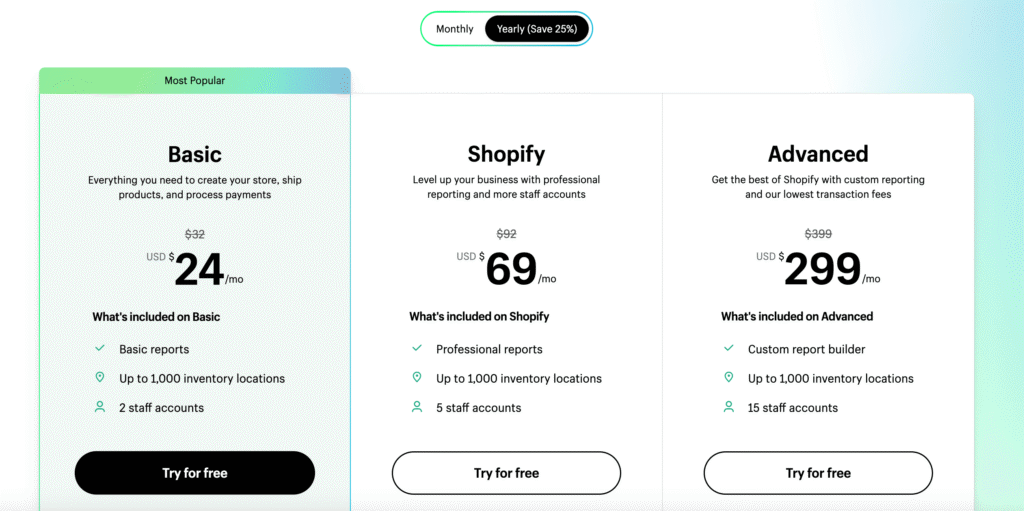
So, before you open the dashboard, it is worth understanding what you are actually paying for. Shopify currently has four main plans for standard online stores.
The Starter plan at $5 per month is not a full online store. Specifically, it gives you checkout links and a simple product page you can share on social media. So, it is fine for testing a single product on Instagram, but it is not what most people mean when they talk about building a store.
The Basic plan at $29 per month is the right starting point for most new sellers. It includes a full online store with unlimited products, a blog, discount codes, abandoned cart recovery and 24/7 support. Card processing through Shopify Payments costs 2.9% plus 30 cents per transaction. If you use a third-party payment processor instead, Shopify adds a 2% fee on top of that.
The Grow plan at $79 per month reduces the card rate to 2.7% plus 30 cents, and the third-party transaction fee drops to 1%. It also adds up to five staff accounts and better reporting. In fact, for stores turning over $10,000 or more per month, the maths often favour upgrading to Grow purely from the fee savings.
The Advanced plan at $299 per month drops card rates further to 2.5% plus 30 cents and adds advanced reporting, 15 staff accounts and the ability to calculate third-party shipping rates at checkout.
Also, all plans come with a 3-day free trial with no credit card required. Furthermore, annual billing saves 25% on the Basic, Grow and Advanced plans.
Step 1: Start Your Free Trial
So, go to shopify.com and click Start Free Trial. You will be asked for your email address and to create a password. Shopify will ask you a few questions about your business at this point. Answer them honestly so the setup wizard shows you relevant options.
Indeed, you do not need to choose a paid plan immediately. The 3-day free trial gives you access to the full platform. So, use that time to build out your store, add products and set up your payment settings before committing to a plan.
Step 2: Set Up Your Store Basics
Once you are inside the Shopify dashboard, the first step is to fill in your store details. Go to Settings and then General. Add your store name, business address, currency and time zone.
These details flow through to your invoices, tax calculations and shipping rates. Indeed, getting them right from the start prevents confusion later.
Specifically, your store name becomes your default Shopify subdomain in the format yourstore.myshopify.com. Indeed, this works fine during setup. However, for a professional store, you will want a custom domain. A .com domain costs around $12 to $15 per year, and you can purchase it directly through Shopify or connect one you have already registered elsewhere.
Step 3: Choose and Customise Your Theme
Your theme controls how your store looks. Shopify offers over a dozen free themes and a theme store with premium options typically priced between $180 and $350 as a one-time purchase.
Indeed, for most new stores, a free theme is the right starting point. Dawn is the most popular free Shopify theme, and for good reason. It is lightweight, fast-loading, fully mobile-responsive and flexible enough for most product types. Furthermore, Horizon and Refresh are also strong free options worth considering, depending on your niche.
Specifically, to apply your theme, go to Online Store and then Themes in the left-hand menu. Browse the theme library, click Add and then Customise to open the theme editor.
The Shopify theme editor is a drag-and-drop interface. You can add, remove and rearrange sections on each page without touching any code. Spend time here customising the colours, fonts and layout to match your brand.
Upload your logo to the header. Set a consistent colour palette. Ensure your homepage leads visitors naturally towards your products.
Also, preview your store on mobile before publishing. Over 60% of online shopping happens on mobile devices. In fact, if your theme looks clean on a desktop but is clunky on a phone, you are already losing potential customers before they reach the checkout.
For a detailed breakdown of which free themes work best for different store types, Shopify’s official guide to the best themes covers every free option with recommendations by niche and business type.
Step 4: Add Your Products
So, in the Shopify dashboard, go to Products and then click Add Product. Every product in your store needs a handful of key elements to perform well.
Title and description. Your product title should be descriptive and include the words your customers are likely to search for. The description below it is your selling space. Use it to explain what the product does, who it is for and why it is worth buying. Write for the customer, not for search engines. Indeed, a clear, helpful description converts better than one loaded with keywords.
Images. Product photos are the most powerful conversion tool available to you. In fact, customers cannot touch or try your product online. Clear, well-lit images from multiple angles give them the confidence to buy. Add a main image and a gallery showing different views of the product in use. Shopify supports image zoom and video on product pages.
Pricing and inventory. Set your price in the Price field. If you want to show a reduced price, enter the original in Compare at Price and the sale price in Price. Scroll down to the Inventory section and enter a SKU if you use one. Enable inventory tracking so Shopify can alert you when stock runs low.
Product type and collections. Assign each product to a collection so customers can browse by category. In practice, good collection organisation makes it easier for shoppers to find what they want and reduces the time to purchase.
Variants. If your product comes in multiple options such as size, colour or material, use Shopify’s Variants section to set those up. Each variant can have its own price, SKU and stock level.
Step 5: Configure Your Payment Settings
Before you can accept any money, you need to connect a payment method. In your Shopify dashboard, go to Settings and then Payments.
Indeed, Shopify Payments is the simplest option. It is Shopify’s own payment processor, and it activates in minutes. When you use it, there are no transaction fees beyond the card processing rate for your plan. Shopify Payments supports Visa, Mastercard, American Express, Shop Pay and Apple Pay out of the box.
However, if you prefer to use a third-party processor like PayPal or Stripe instead, you can do that too. However, Shopify adds its transaction fee on top of whatever the external processor charges. For most US-based stores starting out, Shopify Payments is the more cost-effective choice.
Indeed, PayPal is worth enabling as a secondary option regardless of your primary processor. Many shoppers default to PayPal at checkout because they trust it and their payment details are already saved. In fact, offering it alongside card payments typically improves conversion rates.
Step 6: Set Up Shipping
Indeed, if you are selling physical products, shipping configuration matters enormously. Incorrect shipping settings lead to lost sales, undercharging that eats into your margins and overcharging that sends customers to competitors.
In Shopify, go to Settings and then Shipping and Delivery. Here, you create shipping zones for different geographical regions and set the rates that apply to each one.
So, flat rate shipping is the simplest approach for new stores. Choose a rate that covers your average postage cost without significantly overcharging customers on small orders. Many sellers use $4.99 to $7.99 for domestic US orders as a starting point.
Indeed, free shipping on orders above a threshold is one of the most effective tactics in e-commerce. Setting a free shipping threshold of $50 or $75 encourages customers to add more to their cart. However, if you use this approach, factor the shipping cost into your product pricing or minimum order value so the economics still work.
For digital products, you do not need a shipping configuration. In the product settings, mark the product as a digital product and configure a download link or fulfilment service instead.
Step 7: Configure Taxes
Specifically, US-based sellers need to charge sales tax in states where they have a tax nexus, typically the state where the business is registered. Specifically, Shopify includes automatic tax calculation based on your store’s address and your customers’ shipping addresses.
In Settings and then Taxes, enable automatic tax calculation. Shopify uses current tax rates for each US state and updates them regularly. This handles the basics for most small sellers.
However, as your store grows and you sell across multiple states, tax compliance becomes more complex. Many sellers eventually use a third-party tool like TaxJar or Avalara to manage sales tax across different jurisdictions. So, at launch, Shopify’s built-in tool is sufficient.
Step 8: Set Up Your Essential Store Pages
Beyond product pages, your store needs a few supporting pages to build customer trust and meet legal requirements.
About page. People buy from people they trust. A genuine About page explaining who you are, why you started the store and what makes your products worth buying builds credibility. It does not need to be long. It needs to be honest and specific.
Contact page. Indeed, a visible contact method reduces purchase anxiety. Shopify’s Contact page template includes a simple form. Add your email address or a customer service inbox so buyers can reach you easily.
Returns and Refund Policy. In fact, a clear, fair returns policy is both a legal requirement in most US states and a proven conversion tool. Customers are more likely to buy when they know what happens if something goes wrong.
Privacy Policy. If your store collects any customer data, you need a Privacy Policy. Shopify provides a free Privacy Policy generator under Settings and then Legal.
Specifically, to create these pages, go to Online Store and then Pages. Add them to your footer navigation so they are accessible from every page on your site.
Step 9: Test Your Store Before Going Live
So, before you launch publicly, go through the full customer experience yourself. Add a product to your cart, proceed to checkout and complete a test purchase. Specifically, Shopify offers a Bogus Gateway in the payment settings for this purpose. Use it to simulate a transaction without processing real money.
During your test, check the following. Does the checkout page display correctly on mobile? Does the confirmation email arrive with the right order details?
Do all your product images load at the right size? Are the shipping rates calculating correctly for different postcodes?
Also, click through every page of your store. Check that navigation menus link to the right places. Confirm that your About page, Contact page and policy pages are accessible. So, fix anything that feels broken or confusing before you send any visitors to your store.
When you are satisfied with the experience, remove the password protection that Shopify applies to new stores by default. Go to the Online Store and then Preferences and disable the storefront password.
Step 10: Drive Traffic to Your Store
Indeed, a live store with no traffic earns nothing. This is where most new Shopify owners underestimate the work involved. Indeed, getting your store built is the beginning, not the end.
Search Engine Optimisation
Specifically, Shopify includes built-in SEO fields for every product and page. Fill in your page titles and meta descriptions for every product, collection and page on your store. Include the keywords your customers search for naturally in your product titles and descriptions.
Indeed, a blog is one of the most powerful long-term traffic tools available to a Shopify store. Specifically, writing articles that answer the questions your target customers are already searching for brings in organic traffic that compounds over time. Shopify includes a blog editor on every plan. Use it consistently, and it becomes one of your most valuable assets.
Social Media and Paid Advertising
Specifically, Shopify integrates directly with Facebook, Instagram, TikTok and Pinterest for social selling and advertising. You can sync your product catalogue to these platforms and run ads that link directly to your product pages.
So, for new stores with a small budget, organic social media content is the lower-risk starting point. Post consistently, show your products in use and build a following before investing in paid advertising. So, once you have data on which products your audience responds to, paid ads become far more predictable.
Email Marketing
So, build an email list from your first sale. Shopify connects with major email marketing tools, including Klaviyo, Mailchimp and its own Shopify Email feature. In fact, an automated welcome email to new subscribers, an abandoned cart sequence and a post-purchase email all run without ongoing effort once you set them up.
Indeed, email marketing consistently outperforms social media for converting subscribers into buyers. In fact, a small but engaged email list of 500 people is worth more than 5,000 followers on a platform whose algorithm you do not control.
For a full step-by-step walkthrough of how to start and build a successful Shopify store from the first product listing to your first sale, Shopify’s official guide to starting an online store covers the complete process in detail.
How Much Does a Shopify Store Really Cost?
Unfortunately, the headline plan price is only part of the picture. Here is a realistic breakdown of what a new Basic Shopify store actually costs per month.
The Basic plan is $29 per month, billed monthly or around $22 per month on an annual subscription. A custom domain costs approximately $15 per year, which works out to about $1.25 per month. A premium theme, if you choose one, is a one-time cost of around $200 to $350 that you amortise over years of use.
Indeed, apps add up quickly. Most new stores add at least two or three paid apps for functions like product reviews, email pop-ups and upsells. Budget $20 to $60 per month for apps once your store is running.
In fact, a realistic Basic Shopify store costs around $50 to $90 per month to run. Compare that with WooCommerce, where hosting, plugins and SSL on a comparable setup often reach $50 to $100 per month anyway, with far more technical maintenance required on your side.
For an honest comparison of what Shopify actually costs across all plans once apps and transaction fees are included, this detailed Shopify pricing breakdown covers the real numbers at each revenue level.
Common Mistakes to Avoid
Unfortunately, most new Shopify sellers make the same handful of errors. Knowing about them before you launch saves real money and frustration.
Choosing a Slow Theme
A heavily designed premium theme with complex animations and large image sliders may look impressive in the demo. In fact, it slows your page load time and hurts both your search ranking and your conversion rate. Stick with a fast, clean theme and invest in the quality of your products and copy instead.
Neglecting Mobile
Most of your visitors will arrive on a phone. If your product pages are difficult to navigate, your add-to-cart button is hard to find, or your checkout is awkward on a small screen, you are losing sales every day. Test your entire store on a phone before and after every significant change.
Weak Product Descriptions
Indeed, a product description that simply lists specifications does not sell. It just informs. Write descriptions that speak to the customer’s situation, address their hesitations and give them a clear reason to buy this product rather than a similar one.
Ignoring Abandoned Carts
Importantly, Shopify’s abandoned cart recovery is included on the Basic plan and above. So, set it up on day one. A well-written automated recovery email sent one hour after a customer abandons their cart can recover 5% to 15% of lost sales. That is revenue you would otherwise simply lose.
Not Collecting Emails
Indeed, your Shopify store can disappear tomorrow due to account issues, policy changes or platform problems. Your email list cannot be taken from you. Build it from your first customer and treat it as your most valuable business asset.
Ready to Build Your Online Business?
Knowing how to create an online store on Shopify is a great foundation. However, the broader strategy around content, marketing and growing a genuine audience matters just as much as the platform itself.
Shopify genuinely does make it easier than ever to get a store live. The interface is clean, the themes are professional, and the payment integration is seamless. However, none of that guarantees sales, but it removes the technical friction so you can focus your energy on the parts that actually drive revenue.
Knowing how to create an online store on Shopify is the starting point. What you do after launch determines whether your store earns. Write great product descriptions.
Build an email list from day one. Drive consistent traffic through SEO, social media or both. Test, learn and improve continuously.
In fact, the stores that succeed are not always the most beautifully designed or the most technically advanced. They are the ones where the owner showed up consistently, listened to customers and kept improving. Everything you need to do that is available on Shopify from your first day.
Affiliate Disclosure: This post contains affiliate links. I may earn a commission if you sign up through my links, at no additional cost to you. I only recommend tools and platforms I genuinely believe offer value to my readers.
How Much Money Can You Make With Swagbucks? The Honest Numbers Revealed
How much money can you make with Swagbucks? This is one of those questions that seems simple on the surface but deserves a much more honest answer than most articles provide. The platform has been around since 2008, has paid out hundreds of millions of dollars in rewards and is one of the most recognised names in the get-paid-to space. It is completely free to join. It asks nothing more from you than your time and your attention. Those qualities make it enormously appealing to anyone new to earning money online and looking for a low-risk starting point. But appealing and financially worthwhile are not the same thing, and understanding exactly where Swagbucks sits on the income spectrum is the most useful thing you can take from this article.
This guide covers every earning method on the platform, what each one realistically pays, how those figures add up across a month of genuine engagement and what the research shows about where Swagbucks belongs in a broader online income strategy.
What Is Swagbucks and How Does the Earning Model Work?
The Platform in Plain Language
Swagbucks is a rewards platform operated by Prodege LLC, a market research and consumer engagement company. Members earn virtual currency called SB points by completing a range of online activities. Those points are then exchanged for PayPal cash or gift cards from retailers including Amazon, Walmart, Target and Starbucks.
The conversion rate is straightforward. Every 100 SB is worth $1.00. One SB is worth one cent. This makes it easy to calculate the dollar value of any offer before you decide whether it is worth your time.
Swagbucks earns its revenue by connecting brands and market research firms with consumers. When you take a survey, the research company pays Swagbucks for your responses. When you shop through the Swagbucks portal, retailers pay Swagbucks a referral commission. When you watch videos or complete offers, advertisers pay for your attention and engagement. Swagbucks then shares a portion of those revenues with you in the form of SB points.
Swagbucks offers more earning methods than virtually any other rewards platform. Understanding what each method pays in practice is essential before you can form a realistic picture of your potential monthly income.
Surveys are the most consistently discussed earning method on the platform. Individual surveys pay between 25 SB and 300 SB, depending on their length and the specificity of the demographic being recruited. In real terms, that is between $0.25 and $3.00 per completed survey. The most common payout range for a standard survey sits between $0.50 and $1.50. Longer surveys paying $2.00 or more do exist, but they are less frequent and come with stricter eligibility requirements.
Shopping cashback earns SB points as a percentage of purchases made through the Swagbucks portal. Cashback rates typically range from 1% to 10%, depending on the retailer. For users who already shop online regularly, this can be one of the more passive and consistent earning methods, though it requires that you remember to activate the Swagbucks portal before each purchase.
Watching videos earns small amounts of SB for viewing short clips on topics like news, entertainment and lifestyle. The earnings are very low, typically 1 to 5 SB per video. This method is best treated as background activity rather than a focused income strategy.
Search engine rewards are earned randomly by using the Swagbucks search function powered by Yahoo. Points are awarded on a random basis rather than for every search. The income from this method is modest and unpredictable, but it requires no additional effort beyond switching your default search engine.
Daily polls award 1 SB per day for answering a single-question poll. The income is negligible, but it takes around 5 seconds to complete and contributes to daily goal streaks.
Offer walls provide some of the highest individual SB payouts on the platform. These involve completing specific tasks such as signing up for a free trial, downloading an app and reaching a set level, or subscribing to a service. Individual offers can pay hundreds or even thousands of SB. They require more commitment and sometimes carry a risk of receiving unwanted marketing communications from third-party advertisers.
Receipt scanning through the Magic Receipts feature rewards SB for uploading photos of shopping receipts that include qualifying products. Earnings depend on the specific offers available, which rotate regularly.
Referring friends earns 10% of your referral’s SB for as long as they remain active on the platform. For users with a large network or any kind of social media presence, this passive referral income can add meaningfully to monthly totals.
The Real Earning Figures: What Swagbucks Actually Pays Per Month
What the Research Shows
Independent reviews and user reports consistently place the realistic monthly earning range for Swagbucks at $20 to $100 per month for most active users. The exact figure depends heavily on which activities you prioritise, how much time you invest and your demographic profile.
This range is not a floor or a ceiling for every user. Casual users who spend 15 to 20 minutes per day primarily on polls and passive video watching might earn $10 to $20 per month. Highly dedicated users who prioritise surveys, complete offer walls strategically, and shop regularly through the cashback portal have reported earnings above $100 per month. However, reaching and sustaining the higher end of this range requires a level of daily effort that most users are not willing or able to maintain indefinitely.
Breaking Down the Numbers by Activity
To understand how monthly income is built on Swagbucks, it helps to examine the earning contribution of each method individually.
A user completing four surveys per day, five days per week, at an average payout of $0.75 per survey, earns approximately $60 per month from surveys alone before accounting for screening failures. Once screening failures are factored in, and most active survey takers are screened out of two or three surveys for every one they complete, the realistic monthly total from surveys drops to closer to $25 to $40.
Shopping cashback at 3% on $200 of monthly online spending contributes $6. A 5% cashback rate on $300 of spending adds $15. For heavy online shoppers, cashback can contribute $20 to $40 per month. For light shoppers, the contribution is minimal.
Daily polls and passive search earnings contribute perhaps $2 to $5 per month combined. Watching videos, unless run in the background continuously, adds another $2 to $5.
One or two well-chosen offer wall completions per month can add $5 to $30, depending on the specific offers available and whether you are comfortable with the requirements involved.
Adding these together, a motivated user who engages across multiple earning methods consistently can realistically earn $50 to $80 per month without extraordinary effort. Reaching $100 per month requires a combination of daily survey focus, regular cashback shopping and occasional offer wall engagement, sustained consistently across the full month.
The figure that matters most for anyone evaluating Swagbucks honestly is the effective hourly rate. Calculating how much you earn per hour invested reveals something that the monthly totals can obscure.
A survey paying $0.75 and taking 12 minutes to complete represents an effective hourly rate of $3.75. A survey paying $1.00 for 15 minutes of your time works out to $4.00 per hour. Both figures sit below the federal minimum wage in the United States and well below the minimum wage in most individual states. When you add the time spent on screening questionnaires that do not result in a completed survey, the effective hourly rate drops further still.
This is not a flaw unique to Swagbucks. It reflects the economics of the market research industry, where individual data points have modest commercial value. But it is important to understand clearly, rather than allowing the monthly totals to create a misleading impression of what an hour of your time is actually worth on the platform.
Swagbucks vs. Similar Platforms: How Does It Compare?
Swagbucks vs. Survey Junkie
Survey Junkie is a more focused platform that concentrates almost entirely on paid surveys. Its interface is generally reported as cleaner and more intuitive than Swagbucks. Some users find that Survey Junkie offers higher survey availability for certain demographics. However, it lacks the earning diversity of Swagbucks. Users who want to earn from shopping, videos and offers alongside surveys will find Swagbucks more versatile overall.
Swagbucks vs. InboxDollars
InboxDollars is directly owned by the same parent company as Swagbucks, Prodege LLC, and operates on a similar model. The key difference is that InboxDollars pays in cash directly rather than using a points system. Some users find this simpler to track. The earning potential across both platforms is broadly similar. Users who dislike the abstraction of points systems may prefer InboxDollars for its straightforward cash display.
Swagbucks vs. MyPoints
MyPoints is another Prodege platform focused primarily on shopping rewards and surveys. Its cashback rates for shopping are competitive with Swagbucks, and some users report stronger earning potential from the shopping component specifically. For users whose primary interest is cashback rather than surveys, MyPoints may be a better fit.
The Multi-Platform Strategy
Many experienced rewards earners use Swagbucks alongside one or two other platforms rather than committing exclusively to one. Each platform has a different survey inventory at any given time. A survey you do not qualify for on Swagbucks may be available on Survey Junkie. Running two or three platforms simultaneously increases total monthly earnings without proportionally increasing the time invested, which is the most practical way to push past the natural earning ceiling of any single platform.
Maximising Your Swagbucks Earnings: Practical Tips That Actually Work
Complete Your Profile Immediately
Swagbucks uses your profile data to pre-match you with relevant surveys before displaying them. A fully completed profile that includes accurate information about your age, household income, employment status, household composition and purchasing behaviour reduces screening failures and increases the proportion of surveys you can actually complete. Most users who complain about high screening rates have incomplete profiles.
Prioritise by Value Per Minute
Swagbucks displays the estimated time and SB value for each survey before you begin. Before accepting any survey, quickly calculate the value per minute by dividing the SB payout by the estimated minutes. A survey offering 60 SB for 10 minutes is worth $0.06 per minute. One offering 100 SB for the same 10 minutes is worth $0.10 per minute and should be chosen ahead of the lower-paying option. Building this habit ensures you consistently choose the highest-efficiency surveys from whatever is available at any given time.
Install the SwagButton Browser Extension
The SwagButton is a free browser extension that automatically alerts you to cashback opportunities whenever you visit a partner retailer. Without it, you will regularly shop at partner stores without activating the cashback and miss points you could have earned passively. Installing the extension takes two minutes, and the ongoing benefit is entirely passive.
Hit Your Daily Goal Every Day
Swagbucks assigns a daily SB earning goal to every user. Hitting your goal each day earns a small bonus. Hitting it consistently for 7, 14 or 30 consecutive days triggers a Winning Streak bonus that can add $5 to $10 per month purely for showing up regularly. For a platform where every dollar counts, streak bonuses represent some of the easiest additional income available.
Use Multiple Earning Methods Rather Than Just One
Users who focus exclusively on surveys often burn out quickly and hit the ceiling of available survey inventory within a few hours. Diversifying across surveys, cashback, daily goals, receipt scanning and an occasional offer wall completion smooths out the day-to-day variability and keeps total monthly earnings more consistent.
Set Up a Separate Email for Offer Wall Activity
Completing offer walls and signing up for third-party trials can generate a significant volume of promotional emails. Setting up a dedicated email address for Swagbucks offer activity separates these from your main inbox and makes it easier to track offers without cluttering your primary email account.
The Honest Assessment: Is Swagbucks Worth Your Time in 2026?
What Swagbucks Does Well
Swagbucks is a legitimate platform with a strong track record. It has been paying members since 2008. The payment system is reliable. PayPal transfers and gift card redemptions are processed consistently. The variety of earning methods makes it more flexible than most comparable platforms, and the cashback shopping component has genuine value for regular online shoppers who would be spending that money anyway.
For someone who wants to earn a small amount of extra money during time that would otherwise produce nothing, such as commutes, lunch breaks or evenings when the television is on in the background, Swagbucks delivers on its promise reliably. The barrier to entry is zero, and the risk of participating is negligible.
The Core Limitations
Swagbucks income has a hard ceiling that most active users hit within their first few months of serious engagement. The platform’s survey inventory is finite. Screening failures are a consistent friction point that reduces the effective hourly rate below what the headline per-survey figures suggest. The earning rate from most activities sits below the minimum wage. And no matter how much time you invest, the income does not compound or grow over time the way that content or skill-based income does.
This last point is the most important structural limitation. Swagbucks’ income is entirely dependent on your continued active participation. Stop using the platform, and the income stops instantly. There is no carryover benefit from past effort. Every month starts from zero regardless of how long you have been a member.
Who Swagbucks Is Actually Right For
Swagbucks works best as a supplemental activity for users who have a clear-eyed understanding of what it is designed to do. It converts idle time into small amounts of cash. It is not a business model, and it is not a side hustle with genuine income growth potential. It is a way of earning a few extra dollars from time that would otherwise produce nothing.
If your goal is $20 to $50 per month in gift cards or PayPal cash earned during genuinely idle time, Swagbucks is a practical and legitimate way to achieve it. If your goal is meaningful financial improvement or income that grows over time, Swagbucks cannot take you there.
Beyond Swagbucks: Building Online Income That Actually Grows
The Difference Between Micro-Earning and Income Building
The gap between Swagbucks and a genuine online income strategy is not a gap in effort. Users who dedicate two hours per day to Swagbucks are working hard. The gap is in the underlying architecture of what each approach builds. Swagbucks converts time into small, fixed-rate cash. A skill-based or content-based income strategy converts time into an asset that grows and pays out over the years.
The NerdWallet guide to 19 ways to make money online puts survey platforms and micro-earning apps in a useful context alongside alternatives with genuine income potential. Reading it before committing significant time to any earning platform helps you make a more informed decision about where your effort is most strategically placed.
Affiliate Marketing as a Scalable Alternative
Affiliate marketing through a content blog is the most accessible, scalable income model for someone starting from zero. You write content that helps readers make decisions. You recommend products and services within that content. When a reader follows your recommendation and makes a purchase, you earn a commission. You do not need to create your own product. You do not need inventory, customer service or logistics. You need a focused niche, a willingness to publish content consistently and a basic understanding of how search engine optimisation works.
The income trajectory of an affiliate blog is fundamentally different from the income trajectory of a Swagbucks account. A Swagbucks account earns roughly the same $50 per month in month one and month twelve. An affiliate blog earns next to nothing in month one and potentially $500 to $2,000 per month by month twelve if it has been managed consistently. By month twenty-four, a well-run blog in a commercially relevant niche can generate passive income that Swagbucks could never approach, regardless of how many hours you invested.
SaaS affiliate programmes are particularly attractive within this model. They pay recurring commissions of 30% to 60% on monthly subscriptions. A single customer referred to a $97 per month software platform at a 40% commission, which earns you $38.80 every month for as long as they remain subscribed. Refer 50 such customers over the course of a year, and the monthly passive income from that base approaches $2,000 without any further work required.
The Passive Income Mindset Shift
The NerdWallet guide to passive income ideas for 2026 provides a useful overview of income models that generate ongoing returns from upfront effort rather than requiring continuous active participation. Affiliate marketing, content publishing and digital products all appear in this category. Swagbucks does not, because it produces no income without ongoing active engagement.
The distinction matters because passive income compounds over time in a way that active micro-earning never can. An article you publish today can generate affiliate commissions for years without any additional effort. A survey you complete today generates income once and only once.
Building a Blog That Grows
A content blog starts slowly and builds with time. The first three months typically generate very little organic traffic from search engines. Months six through twelve bring the first meaningful search visibility gains as earlier articles begin to rank and accumulate authority. By month eighteen, a consistently published blog in a focused niche has enough content and domain strength to generate meaningful passive income every month.
The Backlinko guide to getting more traffic to your blog is one of the most practical free resources available on growing a new blog’s readership through SEO. The techniques it covers are directly applicable to any niche content site and explain clearly why consistent, strategic publishing produces compounding traffic growth rather than the flat, time-dependent income of micro-earning platforms.
There are no courses to buy and no inflated income claims. Just a clear, grounded framework for people who are ready to build something that compounds over time instead of something that resets to zero at the start of every month.
The Final Word
How much money can you make with Swagbucks? Most active users earn between $20 and $100 per month, depending on how consistently they engage and which earning methods they prioritise. Highly dedicated users who combine surveys, cashback shopping, offer walls, and daily goal streaks can push closer to $150 per month in good conditions. The platform is legitimate, payments are reliable, and the variety of earning methods makes it more flexible than most comparable sites. For converting idle time into small amounts of cash, it does what it promises.
How much money can you make with Swagbucks if your goal is something more than pocket money? Not enough to matter. The income is flat, the effective hourly rate is below minimum wage, and the earnings stop the moment you stop. Understanding that clearly from the beginning is not a reason to avoid Swagbucks entirely. It is a reason to use it for exactly what it is good at, while investing the majority of your time and energy in something with a ceiling high enough to actually change your financial situation.
How Much Money Can You Make With Pampered Chef? The Honest Numbers for 2026
How much money can you make with Pampered Chef? It is a question worth asking carefully before you sign up, buy the starter kit or recruit your first party host. Pampered Chef has been around since 1980, and it operates one of the most recognisable direct sales businesses in the United States. The products are genuinely good. The brand is legitimate. But good products and legitimate branding do not automatically mean that becoming a Pampered Chef consultant is a smart financial decision for the average person. The real income picture is more complicated than the company’s recruitment materials suggest, and understanding it clearly before you commit is the most important thing you can do.
This article gives you the complete picture. It covers how the Pampered Chef business model works, what consultants actually earn at different levels, what the company’s own income disclosure statement reveals and what the alternatives look like for anyone whose real goal is building a meaningful, flexible online income.
What Is Pampered Chef and How Does It Work?
The Company and Its Products
Pampered Chef was founded in 1980 by Doris Christopher, a home economist from Illinois who wanted to help busy families prepare good meals more easily. The company sells kitchen tools, cookware, bakeware, food products and recipe resources. In 1994, Warren Buffett’s Berkshire Hathaway acquired it, which gives the company an unusual degree of financial credibility compared to most direct sales businesses.
The products themselves have a strong reputation. Many of the kitchen tools are genuinely well-made and practically useful. The brand’s association with quality cooking and home entertaining has kept it relevant for over four decades. This is not a company selling dubious supplements or overpriced cosmetics. Pampered Chef sells things people actually use in their kitchens.
Pampered Chef sells exclusively through independent consultants rather than through retail stores. Consultants earn income by hosting or facilitating cooking shows, either in person at someone’s home or online through virtual cooking demonstrations. Guests at these shows browse the catalogue, place orders and the consultant earns a commission on the total sales generated.
The hosting model creates a social dynamic that differs from most sales environments. Guests are attending a friend’s or neighbour’s event rather than being approached by a salesperson. This lowers the resistance to purchasing. It also means that a consultant’s income depends almost entirely on their ability to maintain a consistent schedule of booked shows and keep their social network engaged enough to host events repeatedly.
The Recruitment Element
Like most direct sales companies, Pampered Chef has a recruitment component. Consultants can earn additional income by recruiting new consultants into their downline and earning a percentage of those recruits’ sales. This multi-level element is where Pampered Chef’s structure becomes more complex and where a clear-eyed analysis becomes especially important.
The company is technically classified as a multi-level marketing business, or MLM. This does not make it illegal or fraudulent. However, it does mean that the business model has structural characteristics that significantly influence what most consultants can realistically earn, and those characteristics are worth understanding before making any financial commitment.
How Much Do Pampered Chef Consultants Earn?
The Commission Structure
Pampered Chef consultants earn commissions on personal sales at the following rates. New consultants earn 20% on personal sales. Once cumulative career sales reach $15,000, the rate increases to 22%. At $30,000 in cumulative career sales, it rises to 23% and at $100,000, it reaches 25%.
These percentages apply to the base price of products. A cooking show generating $500 in sales at the 20% rate earns the consultant $100 before expenses. A show generating $1,000 earns $200. These figures look reasonable until you factor in the costs involved in running the business.
The Real Cost of Running a Pampered Chef Business
The starter kit costs $109 at its most basic level, rising to $159 for a more comprehensive package. This upfront cost is modest compared to many MLM businesses. However, the ongoing costs of running an active consultancy add up quickly.
Demonstration products need to be replaced or updated as the catalogue changes. Cooking ingredients for each show represent a recurring cost. Printed materials, packaging and postage add small but consistent expenses. Travel to and from in-person shows costs money. Any investment in online advertising or promotional materials comes out of the consultant’s own pocket.
When these costs are honestly accounted for, the effective net earnings per show are lower than the headline commission rate suggests. A $100 commission from a $500 show may net $60 to $70 after costs, depending on the specific circumstances.
What the Income Disclosure Statement Actually Says
Pampered Chef publishes an annual income disclosure statement. This document is one of the most useful tools available for anyone assessing the realistic income potential of joining the business. The figures it contains are worth reading carefully rather than relying on the income claims made by enthusiastic recruiters.
The disclosure statement consistently shows that the majority of active Pampered Chef consultants earn modest amounts. Most active consultants earn between $500 and $3,000 per year from the business. That works out to roughly $42 to $250 per month. A significant proportion of consultants earn even less than this, and many who sign up stop selling within their first year.
The higher income figures that appear in recruitment materials and on social media typically belong to the top 1% to 5% of consultants, those who have been in the business for many years, have built large downline teams and are working the business at a near-full-time level.
Earning at Different Levels
Hobbyist level – 1 to 2 shows per month: A consultant running 1 or 2 cooking shows per month, each generating around $400 to $600 in sales, might earn $80 to $240 per month in commissions. After expenses, net income is likely to be $50 to $180 per month. This is useful supplemental income for someone who genuinely enjoys hosting cooking events and would be socialising in this way regardless of the income component.
Active level – 4 to 6 shows per month: A more active consultant running four to six shows per month with average sales of $500 per show earns $400 to $750 per month in commissions. After expenses, the net figure is closer to $300 to $600. Reaching and maintaining this level requires consistent booking effort, a reliable network of willing hosts and the time to prepare and deliver multiple events each week.
Director level – with a downline: Consultants who reach the Director level and maintain a productive downline team can earn $1,000 to $3,000 per month or more. This income includes personal sales commissions plus overrides on the sales generated by their team. Reaching this level typically requires years of sustained effort, strong recruitment skills and the ability to lead and motivate a team of other consultants.
Senior Director and above: The highest-earning Pampered Chef consultants, those at the Senior Director level and above with large, active downlines, can earn $5,000 to $10,000 per month or more. These consultants represent a very small percentage of the total consultant base, and their income is heavily tied to the continued activity of their downline teams.
The MLM Reality: What the Structure Means for Most People
Why Most Consultants Earn Modestly
The income concentration at the top of MLM structures is not accidental. It is a predictable consequence of how these businesses are designed. In a market saturation model, the people who join first have access to larger untapped networks. As more consultants are recruited into the same social circles, the pool of potential customers and hosts available to each consultant shrinks.
This dynamic makes it increasingly difficult for newer consultants to build the kind of active show schedule needed to generate significant income from personal sales alone. It also makes recruitment of new consultants more competitive because the same people are being approached by multiple consultants within the same social network.
Running an active Pampered Chef business requires a significant time investment that is not always reflected in the income figures. Booking shows involves follow-up calls and messages. Preparing for each show takes time. Attending the show and travelling to and from the venue takes time. Processing orders and handling any customer service queries takes time. Following up after events to book future shows takes time.
When total hours are honestly measured against net income, many active Pampered Chef consultants are earning less than the minimum wage on an hourly basis. This does not mean the business is worthless. For someone who values the social experience and genuinely enjoys cooking demonstrations, the income may be a secondary consideration. But for someone whose primary goal is earning meaningful money efficiently, the maths often does not add up.
The Recruitment Pressure
Because the highest income levels in Pampered Chef are tied to building a downline, consultants are strongly incentivised to recruit new members. This creates a dynamic where part of the consultant’s social energy is directed towards recruiting friends and family rather than purely towards selling products or hosting events.
This recruitment pressure is one of the most common reasons people report feeling uncomfortable with direct sales businesses. It can strain relationships if the people being recruited feel pressured or if they later struggle to earn what they were led to expect when joining.
Pampered Chef vs. Genuine Online Income Models
The Core Difference in Income Architecture
The fundamental difference between Pampered Chef income and digital income models like affiliate marketing or content blogging is the scalability of the underlying asset. A Pampered Chef consultant’s income depends on their ongoing active participation. Stop hosting shows, and income stops immediately. There are no residual returns from past effort beyond the downline override, which itself depends on your recruits continuing to work the business.
Affiliate marketing and content blogging work differently. An article you write today and publish on a well-optimised blog can generate passive income from affiliate clicks and advertising revenue for years without any further effort. The asset grows in value as it accumulates traffic and backlinks. Your income does not stop when you stop working. It continues, and in many cases grows, while you focus on other things.
The Income Ceiling Comparison
A successful Pampered Chef consultant at the active level, running six shows per month with average sales of $500, earns around $600 per month in commissions. Reaching and sustaining this level requires consistent bookings, travel and social energy week after week.
A content blogger in a focused niche with twelve months of consistent publishing behind them might be earning $1,000 to $3,000 per month in affiliate commissions and advertising income. At the eighteen-month mark, that figure can be significantly higher. The blogger’s income grows as the content library grows. The consultant’s income stays roughly flat unless they invest more time in shows or recruiting.
The Location and Flexibility Comparison
Pampered Chef shows, even virtual ones, require scheduled time commitments. In-person shows require travel. The business is fundamentally tied to your personal presence and social calendar.
A blog or affiliate income stream requires an internet connection and a willingness to write and publish content. It can be worked on at any hour of the day or night. It generates income whether you are at your desk or on a beach. The flexibility advantage of digital income over direct sales income is significant and grows more valuable over time.
Who Is Pampered Chef Actually Right For?
The Genuine Use Case
Pampered Chef is a reasonable choice for a very specific type of person. Someone who genuinely loves cooking and entertaining, who has an active social network of people who enjoy cooking events and who is looking for a modest supplemental income rather than a primary income source may find it genuinely enjoyable and mildly profitable.
For this person, the social dimension of the business is a feature rather than a burden. Hosting cooking shows is something they would enjoy doing regardless of the income. The commissions and occasional product perks make the activity more financially rewarding without requiring the person to fundamentally change their social behaviour.
Who Should Think Carefully Before Joining
Anyone whose primary motivation is financial independence, meaningful income replacement or building a business that grows over time should think carefully before committing to Pampered Chef. The income ceiling at the consultant level is low relative to the time and social capital investment required. Reaching the higher income levels demands years of sustained recruiting and team management, which is a very different skill set from cooking and entertaining.
Anyone who has a limited existing social network, lives in an area with low appetite for cooking shows or is not comfortable with the ongoing social obligation of booking and hosting events is likely to find the business frustrating and financially disappointing.
Why Digital Models Outperform Direct Sales for Most People
The most durable online income models share a set of characteristics that direct sales businesses cannot match. They generate passive income from assets rather than requiring ongoing active participation. They scale with effort rather than plateauing once a social network is exhausted. They do not require a personal relationship with every customer. They can be built quietly, from home, without recruiting friends or family into anything.
Affiliate marketing is the most accessible of these models for someone starting from zero. The mechanics are straightforward. You create content that helps readers solve a specific problem or make a specific decision. You recommend relevant products or services within that content. When a reader clicks your affiliate link and makes a purchase, you earn a commission.
The commission rates on quality SaaS affiliate programmes range from 30% to 60% of monthly subscription fees, recurring every month for as long as the customer remains subscribed. A single customer referred to a $97 per month software tool at a 40% commission, which earns you $38.80 per month indefinitely. Refer 100 such customers over the course of a year, and the monthly passive income from that base approaches $4,000, without any further work required beyond the initial content that generated those referrals.
A niche blog is one of the most powerful vehicles for building long-term passive income. Each article you publish is a permanent asset that can attract search traffic and generate affiliate income for years. A blog with 100 well-optimised articles in a focused niche represents 100 separate entry points into search results, 100 opportunities to earn affiliate commissions and 100 pieces of evidence that Google should treat your site as a relevant, authoritative source.
The time investment in the first year is real. Most blogs generate very little income in months one through six. Months six through twelve typically bring the first meaningful traffic growth. By year two, a consistently managed blog in a well-chosen niche can generate income that far exceeds what a Pampered Chef consultant earns at the active level, with a fraction of the ongoing time commitment.
The Backlinko guide to building blog traffic through SEO covers the practical mechanics of attracting organic search visitors to a new blog and is one of the most detailed free resources available on the subject.
Getting Started Without Spending Money
One of the most significant advantages of digital income models over direct sales businesses is the minimal upfront cost. You do not need a starter kit. You do not need demonstration products. You do not need to travel anywhere or recruit anyone.
Starting a blog requires a domain name, basic hosting and a willingness to write. The combined cost of domain and hosting for a year is typically around $50 to $100, depending on the provider. The rest of the investment is time and consistency. There are no ongoing expenses beyond the annual hosting fee until the site is generating income and you choose to reinvest some of it.
There are no inflated promises and nothing to buy. Just clear, honest guidance built around what genuinely works for people building online income alongside their everyday lives.
How much money can you make with Pampered Chef? At the hobbyist level, running one or two shows per month, the realistic net figure is $50 to $180 per month after expenses. At the active level with a consistent schedule of four to six shows per month, a net income of $300 to $600 per month is achievable. Director-level consultants with active downlines can earn $1,000 to $3,000 per month. The top tier of Senior Directors earns more, but they represent a tiny fraction of the total consultant base and have typically been building their business for many years.
The products are real, the company is legitimate, and some people genuinely enjoy the social dimension of the business. But how much money can you make with Pampered Chef if your goal is a meaningful, flexible income that grows over time without depending on your social calendar? Honestly, not much. The income ceiling is low, the time investment is high, and the structural characteristics of the MLM model mean that the majority of consultants earn modest supplemental income rather than life-changing money. Understanding that clearly before you sign up is the most important step you can take.
How Much Money Can You Make With Squidoo? What Happened and What to Do Instead
How much money can you make with Squidoo? It is a question that still gets searched regularly, which tells you something interesting about how persistent online advice can be. Articles recommending Squidoo as a legitimate income platform still circulate across the web. Some of them are years out of date, and nobody has taken them down. The problem is that Squidoo does not exist anymore. It shut down in August 2014. Every lens, every article and every account on the platform was either migrated to HubPages or deleted entirely.
If you landed here because someone recommended Squidoo as a way to make money online, you have been given old information. This article explains what Squidoo was, how it paid its members while it existed, why it failed and what the genuine alternatives look like today for anyone who wants to earn money from writing and publishing content online.
What Was Squidoo?
The Original Concept
Squidoo launched in 2005. Seth Godin, the well-known marketing author, co-founded it. The idea was simple. Anyone could create a single-topic page called a “lens” on any subject they knew well. A lens might cover how to train a dog, the best science fiction novels of the decade or a guide to a specific city. The platform hosted these pages, provided the publishing tools and shared a portion of its advertising revenue with the people who created the content.
At its peak, Squidoo attracted millions of pages and a large community of writers. Many of them earned modest but real income from the platform. It was one of the earliest examples of a content-sharing model where ordinary people could earn money from writing without needing their own website or any technical knowledge.
Squidoo shared revenue with lens creators in two main ways. The first was through the SquidRoo payment pool, which distributed a portion of the platform’s total advertising income each month. Your share of that pool depended on how well your lens ranked within Squidoo’s own internal scoring system. Higher-ranked lenses earned more. Lower-ranked ones earned little or nothing.
The second route was affiliate income. Lens creators could embed Amazon product modules, eBay listings and other affiliate links directly into their pages. When a visitor clicked through and made a purchase, the lens creator earned a commission. This made Squidoo one of the more flexible content platforms of its era because it combined passive ad revenue with active affiliate earnings.
What Writers Actually Earned
Income on Squidoo varied enormously. Writers with well-ranked lenses on popular commercial topics could earn $50 to $200 per month from a single strong lens. A handful of power users with large portfolios of high-ranking lenses reported earning $500 to $1,000 per month or more. Most casual writers earned far less. Many earned under $10 per month from the revenue pool, with occasional affiliate commissions adding a small amount on top.
The platform also donated a portion of its revenue to charity, which was part of its founding philosophy. Writers could choose to direct some of their earnings to a nominated charity rather than taking the full amount themselves. For many writers, this social dimension was part of the appeal.
Why Squidoo Shut Down
The Quality Problem
By 2012 and 2013, Squidoo had accumulated a serious quality problem. The platform had grown very rapidly, and the open publishing model meant that anyone could create any kind of content with very little oversight. The result was a large volume of thin, low-quality and spam-heavy lenses that dragged the overall reputation of the platform down.
Google’s algorithm updates in 2011 and 2012, particularly the Panda update, specifically targeted content farms and platforms hosting large amounts of thin or duplicated content. Squidoo suffered significant traffic losses as a direct result. Less traffic meant less advertising revenue. Less advertising revenue meant smaller payments to writers. Smaller payments meant less incentive for quality writers to invest time in the platform.
The Decline in Traffic and Revenue
The Panda update hit Squidoo hard. Organic search traffic dropped sharply. The platform struggled to recover. The community of dedicated writers began to shrink as earnings fell. New writers found it harder to build income on a platform that was losing its search visibility. The feedback loop between lower traffic, lower revenue and lower writer motivation made recovery extremely difficult.
The HubPages Acquisition
In August 2014, Squidoo announced it was merging with HubPages. The combined decision was effectively a shutdown and acquisition. Squidoo’s content was migrated to HubPages, where former Squidoo writers could claim their transferred pages and continue publishing. Many did. Others found that their migrated content performed poorly on the new platform and eventually gave up.
HubPages itself had faced similar challenges. It had also been hit by Google’s quality-focused algorithm updates and was working to improve its overall content quality standards. The merger made strategic sense for both platforms, even if it was a blow to the Squidoo community.
What Happened to the Writers?
The Transition to HubPages
Writers who had built significant Squidoo income faced a difficult transition. Migrated content did not always retain its search rankings on HubPages. The internal scoring and payment systems were different. Writers who had learned to optimise for Squidoo had to learn a new set of rules.
Some writers made the transition successfully and rebuilt their earnings on HubPages over time. Others found that the income they had depended on simply did not transfer and moved on to other platforms or built their own independent websites instead.
The Lesson Squidoo Taught the Content Community
The collapse of Squidoo reinforced a lesson that the online writing community has had to learn repeatedly: building your income on a platform you do not own is a genuine financial risk. When Squidoo closed, writers who had invested hundreds of hours building their content on the platform lost access to everything they had created unless they acted quickly to migrate or repurpose it.
Writers who had used Squidoo as a supplement to their own websites were in a much stronger position. They lost the Squidoo income but retained everything on their own domains. The experience pushed many content creators towards owning their platforms rather than renting space on someone else’s.
HubPages is the most direct successor to Squidoo, and it is still operating today. The platform allows writers to publish articles called hubs on a wide range of topics and earn income through a combination of Google AdSense revenue sharing and the HubPages Ad Programme.
Writers on HubPages can realistically earn between $2 and $10 per thousand page views, depending on their niche, the quality of their content and the performance of their individual hubs. Well-established writers with large portfolios of high-quality hubs in commercially strong niches report earning $200 to $1,000 per month. Most writers earn considerably less, particularly in the early stages.
HubPages has its own quality control system. Articles that do not meet the platform’s standards are moved to a lower-visibility category or unfeatured entirely. This is a direct response to the thin content problem that contributed to Squidoo’s decline. The quality bar is genuinely higher than it was on Squidoo in its later years.
Medium
Medium is a different kind of platform from Squidoo or HubPages. It focuses on essays, opinions and longer-form writing rather than how-to guides and product-focused content. Writers can earn through the Medium Partner Programme, which pays based on how much time paying Medium subscribers spend reading your articles.
Earnings on Medium vary widely. Writers who attract large followings and produce content that resonates strongly with the platform’s reader base can earn $500 to $2,000 or more per month. Most writers earn between $5 and $50 per month. The platform rewards engagement rather than search traffic, which means the skills needed to succeed on Medium are different from those that worked on Squidoo.
Vocal Media
Vocal Media is another content platform that pays writers per read. The rate is low, typically around $3.80 per thousand reads on the free tier and $6.00 per thousand reads for Vocal Plus subscribers. Building meaningful income on Vocal requires a very large readership. Most writers use it as a supplementary platform rather than a primary income source.
Why Building Your Own Platform Is Smarter
The Platform Dependency Risk
The Squidoo story is a clear illustration of what happens when you build your income entirely on someone else’s platform. The platform can change its payment structure, get hit by algorithm updates, decline in traffic or simply shut down. Any of these outcomes can eliminate your income overnight through no fault of your own.
Building your own blog or website removes this risk. Your content lives on your domain. No platform decision can delete it. No algorithm targeting a specific site can wipe out your traffic entirely. You own the asset.
What Owning Your Platform Looks Like
A self-hosted WordPress blog gives you full control over your content and how you monetise it. You can write on any topic. You can join any affiliate programme. You can display advertising, sell digital products, offer services or build an email list. None of these options is gated behind a platform’s approval process or subject to a platform’s revenue-sharing formula.
The trade-off is that a self-hosted blog requires more setup than publishing on Squidoo or HubPages did. You need to choose a domain name and a hosting provider. You need to install WordPress and choose a theme. You need to learn the basics of SEO to attract search traffic. None of this is technically complicated, but it does require a greater initial investment of time.
The Income Potential Comparison
Compare the income ceiling of HubPages, Squidoo’s closest successor, with the income ceiling of a well-run affiliate blog. A HubPages writer earning $500 per month is doing well by the platform’s standards. An affiliate blogger in a commercially strong niche with 12 to 18 months of consistent publishing can realistically target $1,000 to $5,000 per month. At the three-year mark, bloggers in strong niches regularly report monthly income of $5,000 to $20,000.
The difference is not primarily about writing skills. It is about ownership, audience control and the range of monetisation options available to someone who owns their platform versus someone publishing on someone else’s.
How to Build a Content Income That Does Not Depend on Any Single Platform
Start With a Niche You Can Own
The writers who earn the most from content are specialists. A blog that covers digital marketing tools for small business owners attracts a more valuable audience than one that covers digital marketing in general. A blog focused specifically on personal finance for freelancers serves a more defined group than one covering personal finance broadly.
Choosing a tight niche makes it easier to rank in search results because you are competing against fewer authoritative sites. It also makes it easier to choose affiliate programmes whose products genuinely match what your readers are looking for.
Build Content That Earns Consistently
The content that generates reliable income is content that answers specific questions people are actively searching for. Before writing any article, research whether people are actually looking for that topic using a keyword research tool. Target keywords with enough monthly searches to be worth your time and low enough competition for a newer site to rank within six to twelve months.
One well-researched article targeting the right keyword can generate consistent traffic and affiliate income for years without any further effort. That compounding quality is what makes content-based businesses so financially attractive compared to time-for-money models. The work you do in year one continues paying you in year three.
Use Affiliate Marketing as Your Primary Monetisation Model
Affiliate marketing is the most accessible form of monetisation for a new content business. You do not need to create your own product. You do not need to handle customer service or logistics. You simply recommend products and services that genuinely help your readers and earn a commission when they follow your recommendation.
The most attractive affiliate programmes for content creators are in the SaaS space, where companies offer recurring commissions of 30% to 60% on monthly subscription fees. A single customer referred to a $97 per month software product at a 40% commission earns you $38.80 every month for as long as they remain a subscriber. Refer 50 such customers, and the monthly passive income from that base reaches nearly $2,000 before any new referrals are added.
The Shopify beginner’s guide to affiliate marketing covers the mechanics of this model in practical detail and is one of the most useful free resources available for writers who want to build affiliate income through content.
Be Patient With the Timeline
The most common reason content businesses fail is not poor writing or poor SEO. It is quitting too early. A new blog typically generates very little traffic in its first three months. Month six usually brings the first meaningful signs of growth. Month twelve brings compounding results as older articles begin to rank and accumulate backlinks.
Writers who stick with a consistent publishing schedule for twelve to eighteen months almost always begin to see real returns. Writers who stop after month three almost always conclude that the model does not work, when in reality, they simply did not give it enough time.
Every visitor who reads your content and leaves without subscribing may never return. Building an email list converts casual readers into a direct communication channel that you own and control completely. An email list of engaged subscribers is not subject to algorithm changes or platform decisions. It is yours.
Offer a free resource relevant to your niche in exchange for a subscription. A checklist, a short guide or a template all work well as lead magnets. Even a small email list of 500 to 1,000 engaged subscribers gives you a meaningful audience for new content, new product recommendations and future digital product launches.
Platforms Worth Using Today
HubPages – for Writers Who Prefer a Ready-Made Audience
HubPages is a legitimate option for writers who want to start publishing immediately without the setup involved in building a self-hosted site. The platform provides the infrastructure, an existing reader base and a built-in payment system. The income potential is lower than with an independent blog, but the barrier to entry is also lower.
Use HubPages as a starting point if you are completely new to online writing and want to build confidence and a basic portfolio before investing in your own site. Do not treat it as your long-term primary income platform. The same risk that undid Squidoo applies to any third-party platform, including HubPages.
Medium – for Writers With a Strong Voice
Medium works best for writers with a distinctive voice and a strong perspective on topics that educated, curious readers care about. It rewards depth, originality and genuine insight rather than keyword-optimised how-to content. If your writing style is more essay than tutorial, Medium is a better natural fit than HubPages.
Your Own WordPress Blog – for Writers Who Want Long-Term Income
A self-hosted WordPress blog is the best long-term choice for any writer who wants to build an income that grows over time, cannot be taken away by a platform decision and is not subject to anyone else’s revenue-sharing formula. The setup takes a few hours. The content creation is ongoing. The returns compound in a way that no third-party platform can match.
There are no inflated promises and nothing to buy. Just clear, grounded guidance built around what genuinely works for real people building online income alongside their everyday lives.
How much money can you make with Squidoo? Nothing at all, because the platform closed over a decade ago. Understanding why it closed, what replaced it and what the stronger alternatives look like today is far more useful than any answer about Squidoo’s old payment rates.
The writers who built the most resilient online incomes were never the ones who found the best third-party platform to publish on. They were the ones who used platforms as stepping stones while building something they owned. A self-hosted blog with strong SEO, a growing affiliate income and an email list has no equivalent in the third-party platform world. It compounds over time, belongs entirely to you and cannot be taken away by a single business decision made by someone else.
How much money can you make with Squidoo is a question with a historical answer. The better question to ask in 2026 is which content income strategy gives you the most control, the most upside, and the most resilience against the kind of platform failures that ended Squidoo’s community so abruptly. The answer to that question is the same as it always has been: own your platform and own your audience.
Disclosure: This article contains affiliate links. If you purchase a product or service through one of the links in this article, we may receive a commission at no additional cost to you. We only recommend tools and resources we have researched and believe offer genuine value.
How Much Money Can You Make With Opinion Outpost? The Honest Truth for 2026
How much money can you make with Opinion Outpost? It is one of the most searched questions in the online income space. Thousands of people ask it every month. The appeal makes total sense. Opinion Outpost pays you to share your views. No skills are needed. No schedule to follow. You just answer questions and collect points. As entry-level online earning goes, it barely gets easier than this.
But easy to start and worth your time are very different things. The lower the barrier to entry, the more people flood in and the less each person earns. Opinion Outpost follows this pattern exactly. Knowing what the platform actually pays, how the payment system works and what the realistic monthly ceiling looks like will save you from wasting hours on something that can never deliver what you are hoping for.
This article covers all of it. It breaks down the real income figures at every level of use, compares Opinion Outpost to similar platforms and gives you an honest answer to the question that really matters: is this actually worth your time?
Opinion Outpost is an online survey panel run by Kantar, one of the world’s biggest market research companies. Members receive survey invitations on topics like consumer products, advertising and social issues. Each completed survey earns points. Those points can be exchanged for cash via PayPal, gift cards or Amazon vouchers.
Surveys typically take between 5 and 20 minutes. Shorter ones earn fewer points. Longer ones earn more. The platform also offers product tests and focus groups occasionally. These pay better than standard surveys, but they come up far less often.
The Points System
Opinion Outpost does not pay you directly in dollars. Instead, it uses a points system. The conversion rate is 10 points per $1. This makes the maths simple. A survey worth 30 points pays $0.30. One worth 100 points pays $1.00.
You can only cash out once your balance reaches $10. That means earning 100 points before you see a penny. For anyone completing surveys only a few times a week, that threshold can take several weeks to reach.
Eligibility and Screening
Not everyone qualifies for every survey. At the start of each one, Opinion Outpost asks screening questions. These check whether you match the demographic the research client wants. If you do not match, the survey boots you out. You earn nothing for the time spent getting there.
This is one of the most frustrating parts of using the platform. It is entirely possible to attempt five surveys in a row and get screened out of all five. That is real time spent with zero compensation. It also drags your effective hourly rate down considerably, often in ways that are not obvious until you actually track the numbers.
The Real Earning Rates: What Opinion Outpost Actually Pays
Per-Survey Earnings
Most standard surveys on Opinion Outpost pay between $0.30 and $3.00 per completed survey. The sweet spot sits between $0.50 and $1.50. Higher-paying surveys at $3.00 or above do appear, but they are rare and come with stricter eligibility requirements.
Consider what those numbers mean in practice. A $1.00 survey taking 15 minutes works out to $4.00 per hour. A $0.50 survey for the same time comes to just $2.00 per hour. Both figures sit below the federal minimum wage. In most US states, the gap is even wider.
The Screening Problem Makes It Worse
Factor in screening failures, and the hourly rate drops further. Suppose you attempt 4 surveys and get screened out of three. You spend around 25 to 30 minutes total, including the failed screens, and earn $1.00. That works out to roughly $2.00 to $2.40 per hour.
This problem is not unique to Opinion Outpost. Every survey platform works this way. But it is important to account for it honestly rather than using the best-case per-survey figures to estimate what you will actually earn.
Monthly Earnings Scenarios
Here are three realistic monthly outcomes based on different levels of use.
Casual user- 30 minutes per day: Completing two or three surveys daily produces roughly $1.50 to $3.00 on a good day. In practice, after accounting for screening failures and low-availability days, most casual users earn $30 to $60 per month. The upper end requires almost ideal conditions.
Regular user- one to two hours per day: Completing 4 to 8 surveys daily can produce $3.00 to $8.00 on good days. Over a full month, this translates to $90 to $240. Hitting the top of that range depends on consistent survey availability and a strong demographic match. Neither is guaranteed.
Heavy user- three or more hours per day: At this level, you will quickly run out of qualifying surveys. The platform has a finite supply. Dedicated users consistently find they exhaust their daily options well before reaching their time target. Even the most active Opinion Outpost members rarely earn more than $200 to $300 per month. Most report earning significantly less.
How Opinion Outpost Compares to Similar Survey Sites
The Survey Platform Market
Opinion Outpost competes with Swagbucks, Survey Junkie, InboxDollars, Toluna and Pinecone Research, among others. Each platform uses a slightly different points system and has different survey availability. Overall earning potential is broadly similar across all of them.
Swagbucks earns points through more activities than just surveys. Watching videos, using its search engine and cashback shopping all add to your balance. This makes it more flexible for users who want to maximise earnings from a single platform. Survey Junkie offers a cleaner interface and tends to get better reviews for survey availability in some demographics. Pinecone Research is harder to join but pays a flat $3.00 per survey, which removes the guesswork around variable pay.
Where Opinion Outpost Stands Out
Opinion Outpost has been running since 2007. Its parent company, Kantar, is one of the most respected names in global market research. That history brings a level of payment reliability that newer platforms cannot always match. Redemptions are straightforward, and PayPal payments arrive quickly once requested.
The survey quality is also generally higher than on lesser-known platforms. Research questions are professionally designed and consistently structured. For anyone who cares about the quality of the research they contribute to, this matters.
Where It Falls Short
Survey availability on Opinion Outpost is inconsistent. Some days bring a healthy variety of qualifying surveys. Other days produce almost nothing for certain demographics. Planning a reliable income around that inconsistency is very difficult.
Screening failure rates are another common complaint. Users outside the typical 25 to 54 target age range often face more rejections. People outside the key household income brackets that most research clients want experience similar issues. Both groups end up with a lower effective rate than the headline figures suggest.
There is also no mechanism for earning more over time. On a freelance platform, building your reputation unlocks higher-paying clients. On a blog, publishing more content grows your traffic and income. On Opinion Outpost, your earning rate today is essentially your earning rate in two years. The platform has no progression built into it. You earn the same per survey regardless of how long you have been a member or how many surveys you have completed. For anyone who values income growth, this is a significant structural limitation.
Maximising Your Earnings on Opinion Outpost: Practical Tips
Fill In Your Profile Completely
Opinion Outpost uses your profile to match you with relevant surveys before you even see them. A complete profile with accurate details about your age, income, job status, household makeup and buying habits improves the match rate. Better matches mean fewer screening failures and a higher proportion of surveys you can actually complete.
Act on Invitations Quickly
Survey quotas close fast. A survey available at 9 am can be full by noon. Check your email and your account daily. Acting on invitations within the first hour or two gives you a much better chance of qualifying before the quota fills. Members who log in regularly and respond quickly earn noticeably more than those who check in only a few times a week.
Join Multiple Platforms at Once
Relying on a single survey site limits your daily earning potential. Joining Opinion Outpost, Survey Junkie, and Swagbucks simultaneously gives you access to a much larger pool of available surveys. Different platforms target different demographics. A survey you do not qualify for on one platform may well be available on another. Using three platforms at once also protects you from the dry spells that every individual platform goes through.
Choose Surveys by Value Per Minute
When several surveys are available at once, pick by value per minute rather than by total payout. A $3.00 survey taking 10 minutes beats a $2.00 survey taking 20 minutes every time. Calculate the per-minute value before accepting any survey and build the habit of always choosing the most efficient option.
Track Your Real Hourly Rate
Track the time you spend on Opinion Outpost each week, including the time lost to failed screening questions. Then divide your weekly earnings bythe total time spent. Most users who do this are surprised by how low the number is. The awareness alone is useful. It helps you decide exactly how much of your time the platform deserves relative to everything else competing for it.
The Honest Assessment: Is Opinion Outpost Worth Your Time?
What It Does Well
Opinion Outpost works well for a specific type of user. Short gaps in your day during commutes, lunch breaks or waiting rooms become mildly productive instead of idle. The platform genuinely delivers on its narrow promise. Share your opinions, earn small amounts of cash. That exchange is real and payments arrive reliably.
For someone brand new to earning online, there is also a psychological value. Completing your first survey and cashing out your first $10 via PayPal proves that the concept of making money online is real. That first payment, small as it is, can be the nudge that motivates someone to explore more ambitious options.
What It Cannot Do
Opinion Outpost cannot replace a meaningful income. The monthly ceiling is too low. The supply of surveys is too limited. No amount of extra effort unlocks higher rates. Spending more hours on the platform does not produce proportionally more money because the surveys run out before your time does.
Anyone looking to build financial breathing room, pay off debt or replace employment income will not find what they need here. Opinion Outpost tops out at a pocket-money level regardless of how dedicated you are.
Think about what $200 per month actually means. It covers a grocery run. It covers a phone bill. It does not cover rent. It does not build savings. It does not move you toward any meaningful financial goal on its own. That does not make it useless, but it does mean you should be completely clear about what role it can play in your overall income picture before investing significant time in it.
The Opportunity Cost Problem
Here is the question that matters most: what else could you do with the same two hours per day? 2 hours on Opinion Outpost produces $4 to $8. Two hours spent writing freelance content, building a niche blog or learning a digital skill produces almost nothing in week one but far more by month 6. Survey income stays flat forever. Skill-based income compounds over time.
The comparison is stark once you lay it out this way. Both options cost you the same time. One offers a permanent ceiling of a few hundred dollars per month at the absolute best. The other has no ceiling at all.
What to Do Instead: Building Income That Actually Grows
The Income Models That Scale
The time you invest in earning $50 from surveys could instead go towards building something that grows. Freelance writing starts paying within weeks for anyone willing to practise and pitch. Affiliate marketing through a blog takes longer but builds a content asset that earns in the background for years. Selling a digital product combines upfront effort with the ability to sell the same thing thousands of times without extra work.
None of these is as simple as answering a survey. All of them require effort before the rewards appear. The return on that effort, though, is completely different from anything survey income can match.
The Foundation Mistake Most Beginners Make
Most beginners choose the easiest option rather than the smartest one. Platforms like Opinion Outpost attract beginners because the barrier is zero. No skill, no commitment, no content required. The cost of that accessibility is a permanent income ceiling that most users hit within their first few weeks.
Building content or skill-based income asks more of you upfront. Month one is slow. Month 6 is noticeably better. By month 12, the gap between what a well-chosen online income strategy produces and what survey platforms produce has become obvious to anyone who has tried both.
Here is a simple side-by-side comparison to make this concrete.
Opinion Outpost after 12 months of daily use: $30 to $200 per month, depending on engagement level. No growth trajectory. No compounding. The same ceiling on day one as on day 365.
A niche affiliate blog after 12 months of weekly publishing: Potentially $500 to $2,000 per month by the end of year one in a well-chosen niche, growing as the content library builds and search rankings improve. The same articles generating traffic in month 6 continue to generate traffic in month 18 without any extra effort.
Freelance writing after 12 months of regular pitching: A writer who started with zero experience and built a portfolio over a year could be earning $2,000 to $5,000 per month by month 12, with rates continuing to rise as their reputation grows.
These comparisons are not presented to make surveys look bad for the sake of it. They are presented to help you make a clear-eyed decision about where your time is most strategically placed.
The NerdWallet guide to legitimate ways to make money online compares income methods by realistic earning potential and time investment. It puts survey platforms like Opinion Outpost in the proper context alongside options that actually scale.
For a practical look at how affiliate marketing compares to survey income as a beginner starting point, the Shopify affiliate marketing guide for beginners is one of the clearest free resources available on building content-based income from scratch. It covers the mechanics of the model, realistic timelines and the compounding logic that makes it a far stronger long-term choice than any survey platform can be.
Using Opinion Outpost as a Starting Point, Not a Destination
The Right Role for Survey Income
The smartest way to use Opinion Outpost is as one tiny part of a bigger plan. While your blog, freelance profile or digital product is in its early stages, survey platforms fill otherwise empty minutes with a small cash flow. That framing removes the frustration. You are not relying on surveys. You are just making idle time mildly productive while your real income strategy builds momentum.
Opinion Outpost earns you money during spare minutes. Your primary strategy earns you money on a compounding trajectory. Both have a role. Only one of them can take you somewhere meaningful.
Your Next Step
If you are researching Opinion Outpost, you are probably in the early stages of figuring out how online income works. That curiosity is a good sign. The gap between “I want to earn a bit online” and “I want to build a real income stream” is smaller than it feels at the start.
Your next step should be choosing one of those alternatives and committing to it for 6 months before evaluating the results. That single decision, taken today, will matter far more to your financial situation a year from now than any number of surveys ever could.
There are no inflated promises and nothing to buy. Just a grounded, clear framework for people who want to build something that lasts. There are no inflated promises and nothing to buy. Just a grounded, clear framework for people who want to build something that lasts.
For an independent view of the broader survey platform market, the Survey Junkie review on Business Insider gives a useful perspective on what this category of platform can and cannot deliver for regular users.
The Final Word
So, how much money can you make with Opinion Outpost? Casual daily use produces $30 to $60 per month in realistic conditions. Regular, consistent engagement across a full month can reach $90 to $150 for members with a good demographic fit. The absolute ceiling, even for the most dedicated users, sits at around $200 to $300 per month. Most active members earn well below that.
The platform is legitimate. Payments are reliable. The barrier to entry is zero. For converting spare minutes into small amounts of cash, it does exactly what it promises. But how much money can you make with Opinion Outpost if you are looking for something that changes your financial situation? Not enough. Knowing that clearly from the start is the most useful thing this article can give you.
Opinion City, an Illinois-based marketing research firm founded in 2017, serves as a liaison between its members and other research firms. It suggests paying survey websites like Panda Research and Ipsos so people may earn money and contribute priceless market research data.
But for this GPT site, that’s about all. Truth be told, not much is known about the company to the general public. The majority of this information was gleaned from Opinion City reviews that other personal finance websites had posted. And for anyone wanting to make money by taking surveys in their leisure time, it should be the first warning sign.
Every shady program advertises that they can make you money without any real work on your side. But is this actually a viable means of generating real income? Not at all.
However, the appeal of not having to lift a finger while earning lots of money seems to attract unknowing victims quite frequently. That said, it’s understandable to be wary of websites like Opinion City.
A service called My Super Affiliate Mentor makes the bold promise that, even if you have little to no prior expertise in online marketing, it can help you earn thousands of dollars from the comfort of your own home.
Imagine waking up one day and discovering hundreds and thousands of dollars waiting for you in your bank account. All you did was work two hours a day for 90 days, and presto! You are now suddenly rich beyond your wildest dreams. Apparently, My Super Affiliate Mentor makes this feasible.
But are their claims true or is it just another online scam to avoid? You’ve come to the correct spot to find out since I’ve done the research and will be revealing the truth in this review.