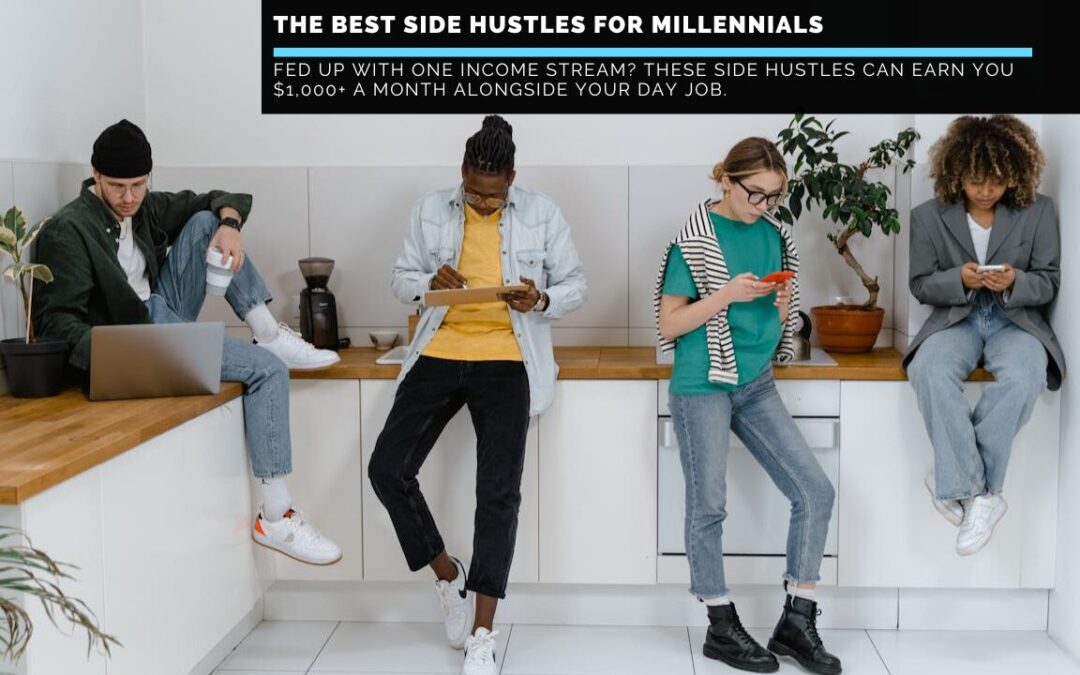
The Best Side Hustles For Millennials That Actually Pay in 2026
More Millennials Are Earning Outside Their 9-to-5 Than Ever Before
If you are a millennial trying to stretch your income further, you are in good company. The best side hustles for millennials are not some pipe dream cooked up by influencers. In fact, they are real income streams that millions of people are building alongside their regular jobs right now.
According to a LendingTree survey, millennials with side hustles earn an average of $1,119 per month in extra income.
That is not pocket change. So if you have been thinking about starting a side hustle, the timing has never been better.

Why So Many Millennials Are Turning to Side Income
Student loan debt is still biting hard for many people in their late 20s and 30s. The cost of renting has shot up in most major cities. Wage growth has not kept pace with the rising cost of living.
So it is no surprise that more millennials are looking for ways to earn outside their day job. In fact, 31% of millennials currently have a side hustle, according to Bankrate’s side hustle survey.
Importantly, many are not just dabbling. They are treating their side hustle as a long-term financial strategy rather than a short-term fix.
The motivations vary widely. Some millennials start a side hustle to pay off debt faster. Others want to build savings without cutting their lifestyle. Still others are using side income as a stepping stone toward full financial freedom.
Fortunately, the digital economy has removed most of the old barriers to entry. You do not need a shop, a warehouse or much startup capital to earn money online.
In practice, your laptop and a reliable internet connection are enough to get started with most of the options on this list. So let us look at the best ones available right now. First, though, it helps to know why this moment is such a good time to act.
The Get Started Here page pulls together the clearest guidance available on the tools and approaches that give beginners the best chance of building real, recurring online income.
1. Affiliate Marketing
Affiliate marketing is one of the most scalable side hustles available to millennials today. The model is simple. You promote other people’s products or services online.
When someone buys through your link, you earn a commission. There is no stock to manage, no customer service to handle and no deliveries to worry about.
In fact, the real appeal lies in the potential for recurring income. Many software and digital tool companies pay commissions every single month for as long as the customer stays subscribed.
So one successful referral can keep paying you for years. That is a very different model from simply trading your time for money.
Systeme.io is a strong example of this. It is an all-in-one marketing platform covering sales funnels, email marketing, online courses and more.
It pays a 60% recurring commission to affiliates. So if someone signs up for its $27-a-month plan through your link, you earn around $16 every single month from that single customer.

Stack enough referrals, and you are looking at a meaningful passive income stream. Notably, the key to success is building an audience that trusts your recommendations.
That usually means starting a blog, a YouTube channel or a social media presence in a niche you know well. You write helpful content, share honest reviews and let the commissions build over time.
It is not instant money. However, those who stick with it are building an asset that compounds for years to come.
If you want a clear path to getting started with affiliate marketing, the Get Started Here page is the best starting point.
2. Freelance Writing and Content Creation
Freelance writing is one of the most accessible side hustles for millennials with solid communication skills. Businesses, blogs and marketing agencies all need a steady stream of written content. Many of them struggle to produce it in-house.
So that gap creates a real opportunity for writers. The rates vary depending on your niche and experience.
Beginners often start at $0.05 to $0.10 per word and work upward from there. Experienced writers in areas like finance, technology or healthcare can charge $0.25 to $0.50 per word or more.
In practice, a single 2,000-word article at those rates can earn $500 or more. That alone makes this one of the best side hustles for millennials who enjoy writing.
Platforms like Upwork and Fiverr are good places to find your first clients. Job boards like ProBlogger and Contena are also worth checking.
The more you write, the faster you get and the better your rates become. Importantly, many freelance writers earn $2,000 to $5,000 a month once they have a roster of regular clients.
Beyond writing, content creation also covers video scripts, social media copy, email newsletters and podcast show notes. So if you enjoy creating in any format, there is almost certainly a type of content work that suits your strengths.

3. Selling Digital Products
Digital products are one of the most scalable side hustles because you create them once and sell them repeatedly. There are no printing costs, no shipping fees and no stock to manage.
So once the product exists, every sale is almost pure profit. The most popular digital products include e-books, templates, Canva graphics, Lightroom presets, spreadsheets and online courses.
If you have expertise in anything from personal finance to graphic design to fitness, you can package that knowledge into something people will pay for. For example, a template that saves a small business owner 3 hours of admin work every week is worth paying for.
Platforms like Gumroad, Etsy and Teachable make it easy to list and sell without any technical knowledge. Many creators start with a simple PDF guide priced at $10 to $30.
In fact, they use that initial product to test demand before building something larger. That is a smart, low-risk way to start.
The key is to focus on solving a specific problem for a specific type of person. Think about the problems you have already solved in your own life. Then consider whether other people would pay to solve the same problem faster.
4. Virtual Assistant Work
Virtual assistance has become one of the most in-demand side hustles of the past few years. As more businesses move online, the need for remote admin support has grown sharply.
In practice, a virtual assistant typically handles tasks like email management, calendar scheduling, social media posting, data entry and customer service. The work is flexible and can usually be done from anywhere with a laptop.
Rates typically start at $15 to $25 an hour for general admin tasks. However, specialist VAs who handle areas like bookkeeping, copywriting or podcast editing can charge $40 to $75 an hour or more.
Sites like Zirtual, Fancy Hands and Upwork regularly list VA opportunities. Many VAs also find clients through LinkedIn or by reaching out directly to small business owners.
So if you are organised, reliable and comfortable with digital tools, virtual assistance is one of the quickest ways to start earning on the side. Interestingly, some VAs build a full-time income from it within 6 months.
The Get Started Here page pulls together the clearest guidance available on the tools and approaches that give beginners the best chance of building real, recurring online income.
5. Online Tutoring and Coaching
If you have expertise in any subject, online tutoring is a side hustle worth taking seriously. The demand for online education has grown sharply in recent years.
Students at every level need support in areas from maths and science to test preparation and foreign languages. Tutoring platforms like Wyzant, Chegg Tutors and Tutor.com connect tutors with students quickly.
Rates typically range from $20 to $80 an hour, depending on the subject and level. Advanced maths, science and test prep tutors often command the higher end of that range.
Beyond academic tutoring, coaching is a much broader opportunity. Life coaches, career coaches, business coaches and fitness coaches all serve a huge and growing market.
In fact, if you have built real expertise in any area of life or business, you can package that knowledge into coaching sessions. Many coaches charge $100 to $300 per hour once they have an established client base.
The overhead is minimal. You need a video calling tool like Zoom, a payment method and the ability to deliver real value to your clients.
Start with a few clients at a lower rate. Then collect testimonials and raise your prices as demand grows.
6. Blogging and Niche Websites
Blogging takes longer to monetise than some of the other options on this list. However, it is also one of the most powerful long-term side hustles for millennials.
A well-built blog in the right niche can generate income through affiliate marketing, display advertising, sponsored posts and digital product sales at the same time. In practice, the typical blogging timeline involves 6 to 12 months of consistent content creation before meaningful traffic arrives.
Once you break through that initial phase, the compound effect kicks in. Old articles continue to rank on Google and earn commissions long after you wrote them.
New articles keep adding to the total. So the income from a blog tends to grow without a matching increase in effort over time. That is the compound effect at work.
The most successful bloggers choose a niche they understand well and serve a specific audience. They research and answer the questions people are already searching for online.
Building trust over time through honest and helpful content is what sets them apart. So they never try to sell something on every single page.
If you want to understand how to build a blog that earns real affiliate income, the Get Started Here page is an excellent place to begin.

7. Print on Demand
Print on demand lets you sell custom-designed products without holding any stock. You create a design, a customer orders a product with your design on it and the print-on-demand company handles the rest.
In practice, they print, pack and ship the order directly to the customer. You keep the difference between the retail price and the production cost.
Popular print-on-demand platforms include Printful, Redbubble and Merch by Amazon. You can sell T-shirts, hoodies, mugs, phone cases and tote bags, among many other items.
Margins are modest per item, typically $3 to $10 per sale. However, successful sellers build large catalogues and earn from hundreds of designs at once.
The work is front-loaded. You spend time upfront creating designs and listing them on platforms.
Once they are live, sales can come in without much ongoing effort. Notably, many sellers use Canva or simple design tools to create their graphics, so you do not need to be a professional designer to start.
The Get Started Here page pulls together the clearest guidance available on the tools and approaches that give beginners the best chance of building real, recurring online income.
8. Social Media Management
Most small businesses understand they need a social media presence. However, far fewer of them have the time or skills to manage it well. That gap is a real opportunity for skilled millennials.
Social media managers handle content creation, scheduling, engagement and strategy for business accounts across platforms like Instagram, TikTok, Facebook and LinkedIn.
Rates for social media management typically range from $300 to $1,000 a month per client for a standard package. Larger clients may pay $2,000 or more per month.
So if you can manage 3 to 5 clients at once, that adds up to a solid side income or even a full salary replacement.
Finding clients is usually the hardest part at the start. Begin by reaching out to local businesses whose social media clearly needs work.
Offer to manage one account for a month at a reduced rate in exchange for a testimonial. Then use that result to attract paying clients at your full rates.

9. Dropshipping and E-Commerce
Dropshipping is a model where you sell physical products online without holding any stock yourself. When a customer places an order on your store, you purchase the item from a supplier who ships it directly to the customer.
Your profit is the margin between your selling price and the supplier cost. The attraction of dropshipping is the low startup cost.
You do not need to invest in bulk stock upfront. However, margins can be tight, and competition is fierce in popular product categories.
In practice, the most successful dropshippers focus on specific niches with less competition. That is a smarter approach than chasing trending products that everyone else is also selling.
Shopify is the most widely used platform for building a dropshipping store. Many sellers source products from suppliers on AliExpress or through dedicated platforms like Spocket or SaleHoo.
Still, expect to spend 3 to 6 months testing and refining your approach before seeing steady profits.
10. Transcription and Proofreading
Transcription is one of the quickest side hustles to start because the barrier to entry is low. Transcriptionists listen to audio or video recordings and convert them into written text.
Legal, medical and general transcription are the 3 main categories. Legal and medical transcription pays the most, often $20 to $40 per audio hour. However, they may require some specialist training.
General transcription pays less, typically $10 to $25 per audio hour. It is easier to break into without prior experience.
Platforms like Rev, TranscribeMe and GoTranscript accept new transcriptionists regularly. So this is a good option if you want to start earning quickly without a big learning curve.
Proofreading is a closely related skill. In fact, many people combine both to maximise their earning potential. Proofreaders check written documents for errors in grammar, spelling and formatting before publication.
Many publishers, businesses and self-published authors hire proofreaders on a freelance basis. Rates typically range from $25 to $50 an hour for experienced proofreaders.
Both of these options suit millennials who are detail-focused and prefer quiet, concentrated work.

11. Affiliate Marketing for Software Tools
It is worth returning to affiliate marketing specifically in the context of software tools, because this niche offers some of the highest commission rates available anywhere.
Software companies operate on high margins. So they are willing to pay generous recurring commissions to affiliates who send them paying customers.
According to Hostinger’s side hustle statistics, the affiliate marketing industry is now valued at $18.5 billion. In addition, over 80% of businesses now incorporate affiliate marketing into their digital strategy.
So the opportunity for affiliates has never been larger. The types of tools that pay strong commissions include email marketing platforms, website builders, funnel software, AI writing tools and online course platforms.
For example, Systeme.io offers a 60% lifetime recurring commission. Similarly, Copy.ai offers 45% recurring, and ClickFunnels pays 40% recurring.
These are not one-time payments. They are monthly commissions that continue for as long as your referral stays subscribed. That means the income compounds month after month.
Building an affiliate income from software tools takes time and consistent effort. However, the growing nature of recurring commissions makes it one of the most financially rewarding side hustles available for millennials with an interest in digital business.
The Get Started Here page pulls together the clearest guidance available on the tools and approaches that give beginners the best chance of building real, recurring online income.
How to Choose the Right Side Hustle For You
With so many options available, choosing where to focus your energy is one of the most important decisions you will make. In practice, a side hustle that suits someone else’s skills and schedule may be completely wrong for yours.
Here are 4 questions worth asking before you commit.
What skills do you already have? The fastest route to earning money on the side is almost always through skills you have already built in your day job or personal life. Writers, designers, analysts and teachers all have directly transferable skills that clients will pay for.
How much time can you realistically commit? Some side hustles, like freelancing and VA work, can earn money quickly but require ongoing time input. Others, like blogging and affiliate marketing, require heavy upfront work for a delayed payoff. So be honest about your schedule before choosing.
Do you want active or passive income? Active side hustles pay you for your time. Passive side hustles, like affiliate marketing and digital products, pay you for assets you have already built. In practice, the best long-term strategy usually combines both.
What is your risk tolerance? Some side hustles are low risk and low reward. Others, like dropshipping or e-commerce, require testing and may involve some upfront investment. So know what you are comfortable risking before you start.
There is no single right answer here. The best side hustle is the one you will actually stick with long enough to see real results. That means picking something you can see yourself doing steadily for at least 6 months.

Getting Started: The Practical Next Step
Starting a side hustle feels overwhelming when you are staring at a blank page. However, the trick is to pick one option, commit to it for at least 6 months and measure your progress honestly.
If you are drawn to digital business models like affiliate marketing, blogging or selling digital products, the groundwork you lay in the first few months determines your long-term results.
Choosing the right tools, setting things up correctly from the start and understanding how to build an audience all make a big difference to how quickly you earn. So do not skip the setup phase in a rush to see results.
The Get Started Here page pulls together the clearest guidance available on the tools and approaches that give beginners the best chance of building real, recurring online income.
Final Thoughts
The best side hustles for millennials are not secret formulas or overnight success stories. In fact, they are practical income streams built by ordinary people who decided to show up steadily and play the long game.
So whether you choose affiliate marketing, freelancing, digital products or something else entirely, the principle is the same. Pick something that suits your skills and schedule. Build it steadily. Give it enough time to compound.
The data is clear. Millennials are the highest-earning generation of side hustlers right now. The digital tools available today make it more achievable than ever before.
The only thing standing between you and a meaningful second income is the decision to start.