

The Digital Product Opportunity You Can’t Ignore
If you’re searching for information on how to sell digital products with Systeme.io, you’ve discovered one of the most profitable and scalable business models available in 2025. Digital products represent the perfect business opportunity: zero inventory costs, no shipping headaches, instant delivery, unlimited scalability and profit margins that can exceed 90%. Yet most aspiring digital product sellers struggle because they’re overwhelmed by the technical complexity of payment processing, product delivery, email marketing and customer management across multiple disconnected platforms.
Systeme.io eliminates this complexity entirely. It’s an all-in-one platform that handles everything from product hosting to payment processing to automated delivery to customer communication through a single dashboard. You don’t need separate tools for your website, shopping cart, email marketing, course hosting and analytics. Everything lives in one affordable platform that starts completely free and scales with your business growth.
I’ve spent considerable time researching digital product businesses, testing Systeme.io’s capabilities and implementing complete product launches from scratch. This comprehensive guide will show you exactly how to create, launch and scale your digital product business using Systeme.io. You’ll learn which types of digital products sell best, how to set up your products properly, how to create sales funnels that convert, how to automate delivery and follow-up and how to scale from your first sale to consistent monthly revenue.

By the end of this guide, you’ll have a complete roadmap for building a profitable digital product business without technical overwhelm or budget-breaking tool subscriptions.
Learn why Systeme.io is the all-in-one solution that actually delivers
Why Digital Products Are the Perfect Online Business Model
Before diving into the Systeme.io specifics, let’s understand why digital products create such extraordinary business opportunities.
Advantage 1: Zero Marginal Cost
Once you create a digital product, selling it costs essentially nothing. Your 100th sale is as profitable as your first. Compare this to physical products, where every sale requires manufacturing, inventory and shipping costs that reduce your margins.
Advantage 2: Instant Gratification for Customers
Customers receive products immediately after purchase. No waiting for shipping. No lost packages. This instant delivery increases satisfaction and reduces refund requests.
Advantage 3: Global Scalability Without Complexity
Sell to customers in London, New York, Sydney and Tokyo without worrying about international shipping, customs or logistics. Your digital product reaches anyone with internet access.
Advantage 4: Automation Enables Passive Income
Set up your sales funnel once, and it works 24/7. Customers can discover your product, purchase it and receive delivery whilst you sleep. True passive income becomes possible.
Advantage 5: No Inventory Risk
You never worry about unsold inventory, storage costs or products becoming obsolete. Create once and sell indefinitely.
Advantage 6: Easy Updates and Improvements
Physical products require expensive redesigns and manufacturing. Digital products can be updated instantly based on customer feedback or market changes.
The Most Profitable Types of Digital Products to Sell
Not all digital products perform equally well. Let’s examine the highest-converting categories.
Category 1: Online Courses and Training Programmes
What They Are: Structured educational content teaching specific skills or knowledge.
Why They Sell: People invest in themselves and value transformation over information. A course promising to help someone earn £5,000 monthly can command £200-2,000+ pricing.
Best Topics:
- Business and entrepreneurship skills
- Marketing and sales training
- Technical skills (programming, design, video editing)
- Creative skills (writing, photography, music)
- Health and fitness coaching
- Personal development and productivity
Pricing Range: £50-2,000+
Systeme.io Advantage: Built-in course hosting with video upload, drip content scheduling and student management.
Category 2: Ebooks and Digital Guides
What They Are: Comprehensive written resources on specific topics.
Why They Sell: Lower commitment than courses, but still provide deep value. Easy to consume at the reader’s pace.
Best Topics:
- How-to guides and tutorials
- Industry-specific strategies
- Problem-solving frameworks
- Research compilations
- Recipe collections
- Travel guides
Pricing Range: £7-97
Systeme.io Advantage: Simple file delivery with automated email containing download links.
Category 3: Templates and Swipe Files
What They Are: Ready-to-use documents, designs or resources customers can customise.
Why They Sell: Save customers time and eliminate the blank page problem. Immediate practical value.
Examples:
- Business document templates (contracts, invoices, proposals)
- Marketing templates (email sequences, social media posts)
- Design templates (presentations, graphics, websites)
- Spreadsheet calculators and trackers
- Writing templates and frameworks
Pricing Range: £10-100
Systeme.io Advantage: Easy file hosting and delivery with unlimited storage on the free plan.

Category 4: Membership Sites and Subscription Content
What They Are: Recurring access to ongoing content, community or resources.
Why They Sell: Predictable recurring revenue. Members pay monthly for continued access and new content.
Best Models:
- Monthly content libraries
- Exclusive communities with expert access
- Ongoing training and skill development
- Curated resources and tools
- Accountability and support groups
Pricing Range: £10-200/month
Systeme.io Advantage: Built-in membership site functionality with recurring billing and content dripping.
Category 5: Software and Apps
What They Are: Digital tools that solve specific problems or automate tasks.
Why They Sell: Ongoing utility creates high perceived value. Customers pay for time saved or problems solved.
Examples:
- Productivity tools and calculators
- Business automation software
- Design and creative tools
- Analytics and reporting tools
- Management and organisation apps
Pricing Range: £10-500+ or £10-100/month
Systeme.io Consideration: Systeme.io handles sales and delivery, but software development requires separate technical skills or hiring developers.
Category 6: Audio Products and Podcasts
What They Are: Audio training, meditations, music or exclusive podcast content.
Why They Sell: Convenient consumption during commutes, workouts or chores. Growing demand for audio content.
Examples:
- Audio courses and training
- Meditation and hypnosis recordings
- Music tracks and loops
- Audiobook versions of written content
- Exclusive podcast series
Pricing Range: £10-200
Systeme.io Advantage: File hosting supports audio formats with easy download or streaming delivery.
Learn why Systeme.io is the all-in-one solution that actually delivers
Step-by-Step: Setting Up Your Digital Product in Systeme.io
Let’s walk through the complete setup from account creation to the first sale.
Step 1: Create Your Systeme.io Account
Process:
- Visit Systeme.io
- Click “Get Started” or “Start Free”
- Enter your email address
- Create a secure password
- Verify email address
- Complete basic profile information
Free Plan Includes:
- Host 1 course or membership
- Unlimited email marketing (2,000 contacts)
- 3 sales funnels
- Unlimited file storage
- Payment processing integration
No credit card required. Start building immediately.
Step 2: Create Your Digital Product
Navigate to the “Courses” section (this section handles all digital products, not just courses).
For Course-Based Products:
- Click “Create a Course”
- Enter product name (clear and benefit-focused)
- Add product description (what students will learn or achieve)
- Upload product image (professional 1200×628px recommended)
- Select access type:
- One-time payment: Customer pays once for lifetime access
- Subscription: Recurring monthly or yearly access
- Free: Build a list or offer a lead magnet
For Downloadable Products (Ebooks, Templates, Files):
- Create a course as a container
- Add a single module called “Download Your Product”
- Upload your file (PDF, ZIP, audio, video formats supported)
- Add a brief lesson with a download button
- Set immediate access (no drip delay)
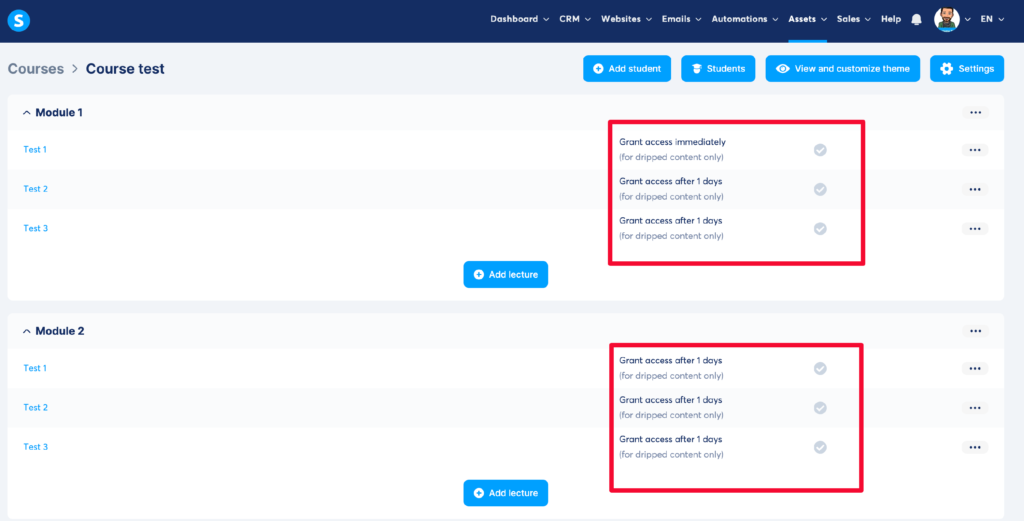
For Membership Sites:
- Create a course with multiple modules
- Add ongoing content to modules
- Set drip schedule for content release:
- Immediate (all content available)
- Daily, weekly or monthly dripping
- Specific date releases
- Continue adding new content monthly for members
Step 3: Set Up Your Product Pricing
In your product settings, navigate to the “Pricing” section.
Configure Your Price:
Product Name: What appears on checkout (e.g., “Complete Sales Funnel Mastery Course”)
Price Amount: Your product price in your chosen currency
Currency: GBP, USD, EUR or other supported currencies
Billing Type:
- One-time: Single payment for permanent access
- Recurring: Monthly or annual subscription
- Payment plan: Split into instalments (e.g., 3 payments of £100)
Optional Settings:
Free Trial: Offer a 7-day or 14-day free trial before charging (good for memberships)
Limited Quantity: Create scarcity by limiting available copies
Setup Fee: Add one-time fee to subscriptions (e.g., £50 setup + £30/month)
Price Variations:
Consider offering multiple pricing options:
- Basic: £97 (course only)
- Premium: £197 (course + templates + bonuses)
- VIP: £497 (everything + one-on-one coaching call)
Multiple options increase total revenue as some customers choose higher tiers.
Step 4: Connect Your Payment Processor
Systeme.io integrates with Stripe and PayPal for payment processing.
Stripe Setup (Recommended):
- Go to Settings → Payment Gateways
- Click “Connect Stripe”
- Follow the authentication process
- Stripe account will be created or linked
- Configure payout schedule (daily, weekly or monthly)
Fees: Stripe charges 2.9% + 30p per transaction (industry standard)
PayPal Setup:
- Go to Settings → Payment Gateways
- Click “Connect PayPal”
- Enter your PayPal email address
- Save configuration
Fees: PayPal charges similar rates to Stripe
Recommendation: Connect both to offer customers a payment choice. This increases conversion rates by 10-15% as some customers strongly prefer one method.
Step 5: Create Your Sales Funnel
A sales funnel guides visitors from discovery to purchase. Systeme.io includes a funnel builder.
Basic Funnel Structure:
Page 1: Sales Page
- Compelling headline highlighting transformation
- Explain what the product is and who it’s for
- List specific benefits and features
- Include testimonials and social proof
- Address common objections
- Clear call-to-action with pricing
- Money-back guarantee
Page 2: Checkout Page
- Simple form collecting necessary information
- Display pricing and payment options
- Show trust badges and security indicators
- Confirm what the customer receives
- Process payment
Page 3: Thank You Page
- Confirm purchase
- Explain how to access the product
- Set expectations for delivery
- Provide login credentials for course access
- Include next steps or quick start guide
- Optional: Offer an upsell or a complementary product
Creating Your Funnel:
- Navigate to the “Funnels” section
- Click “Create Funnel”
- Choose the “Sales Funnel” template
- Systeme.io provides pre-built pages
- Customise each page with your content
- Link your product to the checkout page
- Connect pages in logical sequence
- Test the complete purchase process

Step 6: Set Up Automated Product Delivery
Automation ensures customers receive products immediately without manual intervention.
For Course-Based Products:
Delivery is automatic. After purchase:
- Customer receives confirmation email
- Account is created automatically
- Product appears in their student dashboard
- They can log in and access content immediately
For Downloadable Products:
Method A: Course Delivery Package download as a lesson within the course. Customer logs in and downloads.
Method B: Email Delivery
- Create email automation
- Trigger: “Tag added” when someone purchases
- Email includes:
- Thank you message
- Download link to product files
- Instructions for access
- Support contact information
- Send immediately after purchase
Method C: Thank You Page Delivery
- Add a download button to the thank you page
- Customer downloads immediately after purchase
- Backup email delivery for those who close the browser
Recommended: Combine all three methods for reliability.
Learn why Systeme.io is the all-in-one solution that actually delivers
Step 7: Create Post-Purchase Email Sequence
The sale isn’t the end of your relationship. Nurture customers for repeat purchases and referrals.
Suggested Sequence:
Email 1 (Immediate): Purchase Confirmation
- Thank customer
- Confirm what they purchased
- Provide access instructions
- Set expectations for support
Email 2 (Day 1): Getting Started Guide
- Help them take first steps
- Reduce overwhelm with a simple action plan
- Invite questions or support requests
Email 3 (Day 3): Quick Win
- Share the easiest/fastest result they can achieve
- Build momentum and engagement
- Celebrate progress
Email 4 (Day 7): Check-In
- Ask about progress
- Offer assistance with any challenges
- Request feedback
Email 5 (Day 14): Advanced Tips
- Share advanced strategies
- Demonstrate additional value
- Build towards an upsell opportunity
Email 6 (Day 21): Testimonial Request
- If the customer is succeeding, request a testimonial
- Offer an incentive (small bonus or discount)
- Make the submission process simple
Email 7 (Day 30): Upsell or Related Product
- Introduce a complementary product
- Special customer-only pricing
- Natural progression from initial purchase
If you’re feeling excited about the potential of digital products but want comprehensive guidance on building your complete online business strategy, I’ve created a detailed getting started roadmap that covers everything from choosing your niche through to scaling your first revenue streams. It’s the perfect complement to the technical setup you’re learning here.
Creating High-Converting Sales Copy for Your Digital Product
Your funnel setup is technical. Your sales copy is what actually converts visitors into buyers.
Element 1: The Transformation-Focused Headline
Weak headlines focus on the product. Strong headlines focus on the transformation.
Weak: “My Complete Digital Marketing Course”
Strong: “From Zero to £5K/Month: The Step-by-Step Digital Marketing System That’s Helped 847 Beginners Build Profitable Online Businesses”
Formula: [Specific Outcome] + [Timeframe or Proof] + [Social Proof or Credibility]
Element 2: The Story That Builds Connection
People buy from those they trust. Share your story:
- What problem did you face?
- What did you try that didn’t work?
- What breakthrough did you discover?
- How did it transform your results?
- Why are you sharing it now?
This story creates relatability and positions your product as the solution to their problem.
Learn why Systeme.io is the all-in-one solution that actually delivers
Element 3: The Benefit-Focused Feature List
Never list features without explaining benefits.
Feature-Only (Weak):
- 8 video modules
- 50-page workbook
- Email templates included
Benefit-Focused (Strong):
- 8 Video Modules walk you through each step so you never feel confused or overwhelmed
- 50-Page Action Workbook ensures you implement rather than just consume, turning knowledge into results
- Done-For-You Email Templates eliminate writer’s block and let you start marketing immediately
Format: Feature + “so that/which means” + Benefit
Element 4: Social Proof That Removes Doubt
Include multiple forms of social proof:
Testimonials:
- Specific results (“I made my first £1,000 in 30 days”)
- Full names and locations (builds credibility)
- Photos if possible (increases trust by 35%)
Numbers:
- “Joined by 2,847 students”
- “Rated 4.8/5 stars from 340 reviews”
- “Generated over £1.2M in student revenue”
Authority Indicators:
- Media mentions or features
- Certifications or credentials
- Years of experience
- Previous successes

Element 5: The Objection-Crushing FAQ
Address common purchase objections directly:
“What if I’m a complete beginner?” This course is designed specifically for beginners. We start with the absolute basics and build progressively. No prior experience required.
“How long will it take to see results?” Most students implement the first strategy within 48 hours and see initial results within 2-4 weeks. Full implementation typically takes 60-90 days.
“What if it doesn’t work for me?” I offer a 60-day money-back guarantee. If you implement the strategies and don’t see results, I’ll refund your purchase entirely.
“How much time does this require?” Expect to invest 3-5 hours weekly. The course is designed for busy people building businesses around full-time jobs.
Element 6: The Risk-Reversing Guarantee
Strong guarantees increase conversions by 20-30%.
Standard Guarantee: “60-day money-back guarantee. If you’re not satisfied, request a refund.”
Better Guarantee: “60-day results guarantee. Implement the strategies in this course. If you don’t see measurable progress toward your goals, show me your implementation and I’ll refund your purchase and let you keep all bonuses.”
Specific, results-focused guarantees outperform generic satisfaction guarantees.
Driving Traffic to Your Digital Product Sales Funnel
You’ve built the product and funnel. Now you need customers.
Traffic Strategy 1: Content Marketing and SEO
Create valuable free content that attracts your ideal customers.
Blog Posts: Write detailed articles on topics related to your product:
- If selling a course on email marketing, write “10 Email Subject Lines That Generated 50% Open Rates”
- If selling templates, write “How to [accomplish task] in 15 Minutes Using Templates”
- If selling membership, write “The 5 Mistakes Keeping You From [desired outcome]”
Include calls-to-action in articles linking to your sales funnel.
Implementation in Systeme.io: Use built-in blog functionality to publish content on your domain.
Traffic Strategy 2: Email List Building
Build an email list and nurture subscribers before selling.
Process:
- Create a valuable lead magnet (free resource)
- Build an opt-in page offering a lead magnet
- Deliver lead magnet via email
- Send a valuable email sequence (5-10 emails)
- Introduce paid product naturally
Why This Works: Email subscribers are 3x more likely to purchase than cold traffic. You’ve built trust before asking for money.
Traffic Strategy 3: Social Media Organic Promotion
Share valuable content and promote your product naturally.
Platforms to Consider:
- Instagram: Visual products, personal brands, lifestyle niches
- LinkedIn: B2B products, professional development, business training
- Facebook Groups: Niche communities where your audience gathers
- Twitter: Thought leadership, quick tips, engagement
- YouTube: Tutorials, demonstrations, educational content
- TikTok: Quick tips, entertainment-education, reaching younger audiences
Content Strategy: 80% valuable free content, 20% promotional content. Build audience first, sell second.
Traffic Strategy 4: Paid Advertising
Invest money to accelerate growth.
Facebook/Instagram Ads:
- Target specific demographics and interests
- Start with £5-10/day testing
- Optimise for conversions, not just clicks
- Use retargeting to reach website visitors who didn’t purchase
Google Ads:
- Target search terms related to your product
- High intent traffic (people actively searching for solutions)
- More expensive per click, but often higher conversion rates
Budget Recommendation: Don’t run paid ads until you’ve validated your product converts with organic traffic. Paid ads amplify what already works. They won’t fix products or funnels that don’t convert.
Traffic Strategy 5: Affiliate and Partner Marketing
Recruit others to promote your product for commission.
Implementation in Systeme.io:
- Enable the affiliate programme in product settings
- Set commission rate (typically 20-50% for digital products)
- Provide affiliates with promotional materials
- Track sales and pay commissions
Recruitment:
- Reach out to bloggers and influencers in your niche
- Join affiliate networks
- Offer an affiliate programme to existing customers
- Create compelling affiliate onboarding

For more detailed strategies on building sustainable traffic and marketing systems, my comprehensive online business guide walks through complete customer acquisition frameworks that work for digital product businesses at any stage.
Pricing Strategies That Maximise Digital Product Revenue
Pricing impacts both sales volume and total revenue. Strategic pricing optimises both.
Strategy 1: Value-Based Pricing
Price based on the value delivered, not the cost to create.
Question to Ask: If your course helps someone earn an additional £5,000 monthly, is £200 expensive or cheap?
Answer: £200 is incredibly cheap for £5,000/month outcome. Price at 1-10% of the value delivered.
Application:
- Calculate tangible outcomes your product enables
- Price is a small fraction of that value
- Emphasise ROI in marketing
Strategy 2: Tiered Pricing
Offer multiple price points, capturing different customer segments.
Example Structure:
Basic (£97):
- Core course content
- Community access
- Email support
Premium (£297):
- Everything in Basic
- Bonus modules and training
- Template library
- Priority support
VIP (£997):
- Everything in Premium
- One-on-one coaching session
- Done-for-you implementation support
- Private mastermind access
Why This Works: Some customers will buy Basic who wouldn’t buy Premium. Some will buy Premium who would’ve bought Basic. Some will buy VIP who would’ve bought Premium. You increase total revenue without losing customers.
Learn why Systeme.io is the all-in-one solution that actually delivers
Strategy 3: Payment Plans
Reduce purchase resistance by splitting payments.
Single Payment: £297
Payment Plan: 3 payments of £109 (£327 total)
Benefits:
- Lowers entry barrier (£109 is more accessible than £297)
- You earn more total revenue (£327 vs £297)
- Customers spread the cost over time
Implementation in Systeme.io: Create a separate price option with instalment scheduling.
Strategy 4: Launch Pricing and Scarcity
Use limited-time pricing to create urgency.
Founder’s Pricing: “First 100 customers get lifetime access for £97 (regular price £197)”
Launch Discount: “48-hour launch special: £100 off regular price”
Seasonal Promotions: Black Friday, New Year, industry-specific events
Critical Rule: Scarcity must be genuine. False scarcity destroys trust and can violate consumer protection laws.
Strategy 5: Bundle Pricing
Combine multiple products for a higher perceived value.
Individual Products:
- Course A: £97
- Course B: £97
- Template Pack: £47
- Total if bought separately: £241
Bundle Price: £147 (40% savings, higher total revenue per customer)
Strategy 6: Subscription Pricing for Memberships
Recurring revenue creates predictable income.
Pricing Considerations:
Monthly vs Annual:
- Monthly: £30/month (£360/year)
- Annual: £297/year (saves £63, 17% discount)
Annual pricing provides cash flow and reduces churn.
Value Justification: Monthly price should represent 1/10th to 1/20th of the annual value members receive.

Scaling Your Digital Product Business
Once you’ve made initial sales, these strategies accelerate growth.
Scaling Strategy 1: Create Product Ladder
Develop multiple products at different price points, creating a natural progression.
Example Ladder:
Entry (£7-27): Tripwire Low-priced product converting cold traffic into customers
Core (£97-297): Main Product Your primary offer solving a specific problem
Premium (£497-997): Advanced Training, Deeper implementation or advanced strategies
High-Ticket (£2,000-10,000): Done-With-You Personal coaching or implementation support
Customers enter at the entry level and progressively purchase higher-tier products.
Scaling Strategy 2: Upsells and Order Bumps
Increase average order value through strategic additional offers.
Order Bump: Small add-on offered at checkout. Example: “Add the implementation checklist for just £17 more” (checkbox at checkout)
Upsell: Offered immediately after initial purchase. Example: After buying a £97 course, offer a £297 premium version for a £200 upgrade.
Implementation in Systeme.io: Configure upsells in funnel settings, linking products in sequence.
Expected Impact: Properly implemented upsells increase revenue per customer by 30-70%.
Scaling Strategy 3: Build Email List and Nurture
Your email list becomes increasingly valuable over time.
Strategy:
- Consistently grow the list through lead magnets
- Send valuable content weekly
- Periodically launch new products to the existing list
- Remarket existing products to new subscribers
Lifetime Value Calculation: If average subscriber purchases £300 over their lifetime and you have 5,000 subscribers, your list value is £1.5 million.
Scaling Strategy 4: Leverage Customer Success Stories
Feature customer results prominently.
Applications:
- Create a video testimonial library
- Develop case study content
- Share success stories on social media
- Include in sales funnels and email marketing
Strong social proof increases conversion rates by 20-40%.
Scaling Strategy 5: Automate Everything Possible
Automation allows you to scale without proportionally increasing workload.
What to Automate:
- Product delivery (already automatic in Systeme.io)
- Welcome sequences for new customers
- Onboarding and orientation
- Upsell sequences
- Re-engagement campaigns for inactive customers
- Affiliate commission tracking and payment
Time Investment: Spend time setting up automation once. Save hundreds of hours ongoing.
And if you’re looking for the platform that makes all this automation simple and affordable, learn why Systeme.io is the all-in-one solution that actually delivers for digital product sellers at every revenue level, from complete beginners to six-figure businesses.
Common Mistakes Digital Product Sellers Make
Avoid these pitfalls that sabotage success.
Mistake 1: Creating Product Before Validating Demand
Many people spend months creating elaborate products only to discover no one wants them.
Solution: Validate before building:
- Survey the target audience about their problems
- Create a sales page and gauge interest before building
- Pre-sell product at a discount to founding customers
- Use their feedback to build exactly what they need

Mistake 2: Overdelivering to Point of Overwhelm
A 50-hour course sounds impressive, but it often goes uncompleted. Incomplete customers rarely leave testimonials or buy again.
Solution: Create focused products delivering specific outcomes. Better to have customers complete a 5-hour course and succeed than abandon a 50-hour course feeling overwhelmed.
Learn why Systeme.io is the all-in-one solution that actually delivers
Mistake 3: No Clear Transformation Promise
Generic products like “Digital Marketing Course” fail. Specific transformation-focused products like “The 60-Day System to Your First £5K/Month Client” succeed.
Solution: Define the exact outcome your product delivers. Make this transformation obvious in all marketing.
Mistake 4: Neglecting Customer Support
Poor support damages reputation and reduces future sales.
Solution:
- Set clear support expectations (response time)
- Provide multiple contact methods (email, chat)
- Create FAQ documentation, reducing common questions
- Consider community forums where customers help each other
Mistake 5: Ignoring Product Updates
Digital products should evolve over time in response to customer feedback and market changes.
Solution:
- Collect customer feedback systematically
- Update content addressing common confusion
- Add new modules responding to customer requests
- Notify existing customers of improvements (increases perceived value)
Mistake 6: Not Building an Email List Simultaneously
Relying only on direct sales means starting from zero customers every day.
Solution: Build an email list through lead magnets. Nurture subscribers with valuable free content. Sell to a warm audience who knows and trusts you.
Measuring Success and Optimising Performance
Track these metrics to understand what’s working and what needs improvement.
Metric 1: Conversion Rate
What It Measures: Percentage of sales page visitors who purchase
Calculation: (Sales ÷ Visitors) × 100
Benchmarks:
- Cold traffic: 1-3%
- Warm traffic (email list): 3-8%
- Hot traffic (webinar attendees): 10-20%
If Below Benchmark:
- Test different headlines
- Improve social proof
- Strengthen guarantee
- Simplify the checkout process
- Ensure traffic matches product positioning
Metric 2: Average Order Value (AOV)
What It Measures: Average revenue per customer
Calculation: Total revenue ÷ Number of customers
Improvement Strategies:
- Add order bumps at checkout
- Implement upsell sequences
- Create product bundles
- Offer premium tiers
Expected Impact of Optimisation: Proper upsells and bundles can increase AOV by 50-100%.
Metric 3: Customer Lifetime Value (LTV)
What It Measures: Total revenue from the average customer over the relationship
Calculation: (Average purchase value) × (Number of repeat purchases) × (Average customer lifespan)
Importance: LTV determines how much you can afford to spend acquiring customers.
Improvement Strategies:
- Create a product ladder encouraging repeat purchases
- Launch new products to existing customers
- Develop membership or subscription products
- Maintain regular communication through email
Metric 4: Email List Growth Rate
What It Measures: How quickly your email list grows
Calculation: (New subscribers ÷ Total subscribers) × 100
Target: 5-10% monthly growth
Improvement Strategies:
- Create more compelling lead magnets
- Increase traffic to opt-in pages
- Improve opt-in page conversion rates
- Use pop-ups and exit intent offers
Metric 5: Email Open and Click Rates
What They Measure: Engagement with your email marketing
Benchmarks:
- Open rate: 20-40%
- Click-through rate: 2-5%
If Below Benchmarks:
- Improve subject lines
- Send more valuable content
- Clean inactive subscribers
- Test send times
- Segment audience for relevance
Metric 6: Product Completion Rate
What It Measures: Percentage of customers who complete your course or consume your product
Target: 30-50% for courses
Importance: Completed customers leave better reviews, provide testimonials and buy additional products.
Improvement Strategies:
- Create clear progress tracking
- Gamify completion with achievements
- Send encouragement emails to inactive students
- Simplify and focus content
- Add accountability elements

Advanced Systeme.io Features for Digital Product Sellers
Once you’ve mastered the basics, these advanced features multiply results.
Feature 1: Membership Levels and Tiered Access
Create different membership tiers within one product.
Example:
- Silver Members (£30/month): Access core training library
- Gold Members (£50/month): Core library + monthly group calls
- Platinum Members (£150/month): Everything + one-on-one coaching
Implementation: Set different pricing options with corresponding access permissions in membership settings.
Feature 2: Drip Content Scheduling
Release content progressively rather than all at once.
Benefits:
- Prevents overwhelm
- Encourages consistent engagement
- Reduces churn (members stay longer to access later content)
- Creates anticipation
Options:
- Release one module weekly
- Unlock content after previous completion
- Schedule specific release dates
Feature 3: Automation Rules and Workflows
Create sophisticated automation responding to customer behaviour.
Examples:
Completion Automation: When the student completes Module 3 → Send an email with a bonus resource
Engagement Automation: If the student is inactive for 7 days → Send an encouragement email
Upsell Automation: 30 days after purchase → Offer an advanced product at a special price
Feature 4: Coupon and Discount Codes
Create promotional codes for marketing campaigns.
Use Cases:
- Launch discounts
- Affiliate-specific codes
- Seasonal promotions
- VIP customer pricing
- Bundle deals
Implementation: Generate codes in pricing settings with specific discount amounts and expiration dates.
Feature 5: Custom Domain Integration
Use your own domain rather than a Systeme.io subdomain.
Benefits:
- Professional branding
- Better trust signals
- SEO advantages
- Full control over presence
Setup: Connect the domain through DNS settings following Systeme.io documentation.
For those just starting their digital product journey and wanting to understand the complete business-building process from initial concept through profitable scaling, I’ve created an exhaustive getting started guide that complements everything you’re learning here about the technical implementation.
Legal and Tax Considerations for Digital Product Sellers
Protect yourself and comply with regulations.
Consideration 1: Terms and Conditions
Create clear terms covering:
- What customers purchase and receive
- Refund and return policies
- Intellectual property rights
- Prohibited uses of your products
- Limitation of liability
Implementation: Add a terms and conditions page to your website. Link from checkout page requiring acceptance.
Consideration 2: Privacy Policy
Required by law if collecting email addresses or personal data.
Must Include:
- What data you collect
- How you use data
- Third parties with data access
- Customer rights regarding their data
- Contact information for privacy concerns
GDPR Compliance: If serving EU customers, ensure GDPR compliance including:
- Clear consent for email marketing
- Easy unsubscribe processes
- Data deletion on request
- Secure data storage
Consideration 3: VAT and Sales Tax
Digital products may be subject to VAT or sales tax depending on:
- Your business location
- Customer location
- Revenue thresholds
UK Considerations:
- Register for VAT if turnover exceeds £85,000
- Charge VAT to UK customers if registered
- Follow digital services VAT rules for EU customers
Recommendation: Consult an accountant familiar with digital product taxation in your jurisdiction.
Consideration 4: Copyright and Intellectual Property
Protect your digital products from unauthorised sharing.
Protections:
- Copyright automatically applies to original works
- Add copyright notice to products
- Terms prohibiting sharing or redistribution
- Consider watermarking or DRM for premium products
Reality Check: Some piracy is inevitable. Focus energy on serving paying customers rather than chasing every unauthorised copy.
Consideration 5: Refund Policies
Clear refund policies reduce disputes and chargebacks.
Example Policy: “60-day money-back guarantee. If you’re not satisfied with your purchase, request a refund within 60 days for full reimbursement. We may ask for feedback to improve our products.”
UK Consumer Rights: Digital content has specific consumer protection regulations. Ensure compliance with the Consumer Rights Act 2015.
Learn why Systeme.io is the all-in-one solution that actually delivers
Conclusion: Your Digital Product Journey Starts Now
Throughout this comprehensive guide on how to sell digital products with Systeme.io, we’ve covered everything from product selection and creation through pricing strategies, marketing approaches and scaling techniques. The opportunity is real and the path is clear. Digital products represent one of the most profitable and scalable business models available, and Systeme.io eliminates the technical barriers that previously prevented most people from succeeding in this space.
The key insights are these: start with one focused digital product that delivers a specific transformation rather than trying to create everything at once. Validate demand before investing months in creation. Set up your Systeme.io account and sales funnel systematically, following the steps outlined in this guide. Price based on value delivered rather than cost to create. Build your email list whilst selling products so you have a warm audience for future launches. Use automation extensively to scale without proportionally increasing workload.
Your implementation path should prioritise action over perfection. Choose one digital product idea from this guide that aligns with your expertise and audience needs. Create the minimum viable version that delivers genuine value. Set it up in Systeme.io using the free plan to validate your concept without financial risk. Launch it to a small audience and gather feedback. Improve based on real customer responses rather than imagined objections. Scale what works through the traffic and marketing strategies we’ve discussed.

Remember that the businesses generating six-figure incomes from digital products started exactly where you are now: with an idea, uncertainty about execution and questions about whether it would work. The difference between those who succeed and those who don’t isn’t access to better tools, secret knowledge or superior talent. It’s simply taking action despite uncertainty, learning from real-world feedback and persisting through the inevitable challenges every new business faces.
The technical setup you’ve learned in this guide removes every legitimate excuse for delay. Systeme.io provides professional functionality starting at £0. You don’t need expensive designers, developers or marketing agencies to launch. You need commitment to creating value, willingness to start before everything is perfect and persistence to improve based on results rather than giving up after initial setbacks.
Your digital product business can be live next week if you dedicate focused time to implementation. Stop researching and start building. Follow this guide systematically. Complete one step each day. Launch your product whilst it still feels imperfect. Real market feedback beats endless internal tinkering. Your customers are waiting for the solution you’re building. They don’t need perfection; they need your help solving their problems. Give them that opportunity by launching today.