
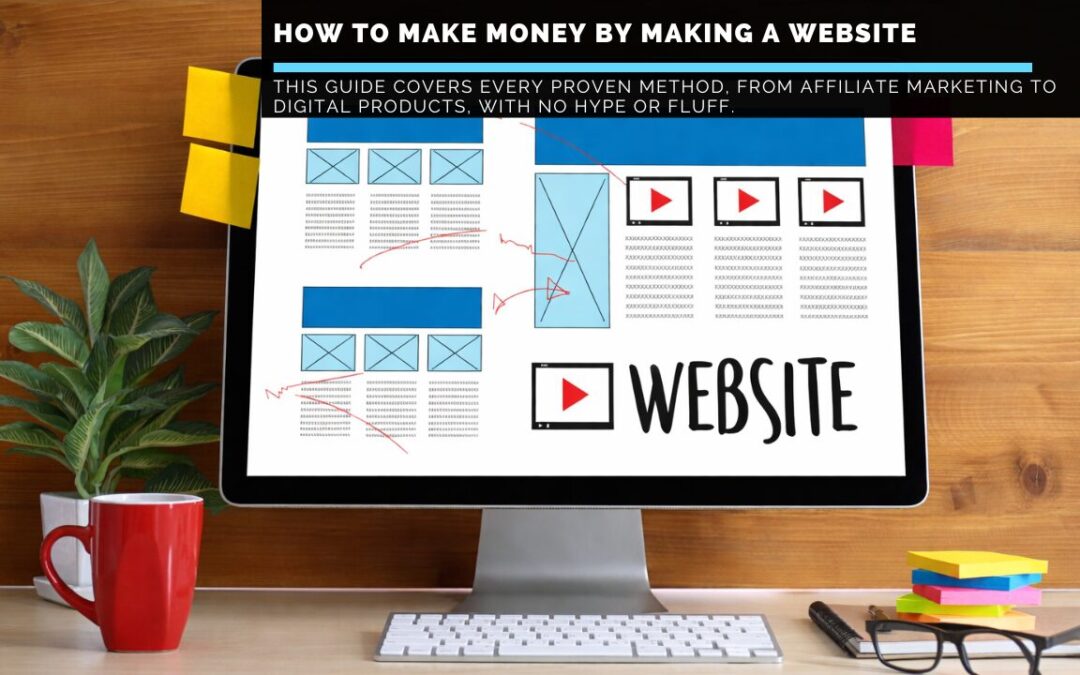
How to Make Money by Making a Website: 9 Proven Ways That Work
If you have ever wondered how to make money by making a website, you are asking a great question. It is also one of the most searched topics in online business.
The good news is that you do not need a computer science degree, a large budget, or a big following to get started.
Thousands of ordinary people build websites every year that go on to earn real income. Some use it as a side hustle. Others grow it into a full business. This guide walks you through every proven method, what each one earns and what it takes to get started.
Why a Website Is One of the Best Income Assets You Can Build
A website is different from a job. When you stop working a job, the income stops. When you build a website properly, it keeps generating income while you sleep, travel or focus on other things.
The content you publish today can attract visitors and earn commissions or ad revenue for years. That is the power of building a digital asset rather than trading time for money.
The setup cost is genuinely low. A domain name costs around $12 per year. Hosting runs from $5 to $15 per month at the entry level.
A basic WordPress site can be live in an afternoon. From there, the investment is your time and your consistency.
This does not mean websites print money by themselves. You need to build traffic, earn trust and choose a method that suits your niche.
But the ceiling on what a well-built site can earn is high. Established content sites sell for 30 to 40 times their monthly revenue. A site earning $3,000 per month can sell for $90,000 to $120,000. That is a real financial asset, not just a side income.
If you are ready to take your first practical step towards building a website that earns real income, visit my Get Started Here page
Method 1: Affiliate Marketing
Affiliate marketing is the most popular way to monetise a website. It is also the one I recommend most strongly for beginners. You write content that helps readers solve a problem, including tracking links to relevant products and earn a commission every time someone clicks through and buys.
You do not handle stock, customer service or refunds. Your job is to create helpful content and build an audience that trusts your recommendations. The commission comes from the seller, so there is no extra cost to the reader.
Commissions vary widely by niche. Physical product programmes like Amazon Associates pay 2% to 8%, depending on the category. Software and SaaS tools pay far more, often 20% to 60% recurring.
A single software referral that pays 40% on a $47 per month plan earns you $225.60 over 12 months from one click. Scale that across dozens of referrals, and the income compounds quickly.
The best niches are those where people search for recommendations before buying: software tools, online education, finance products, health supplements and home goods. If your content helps someone choose between two products or decide whether something is worth buying, you are in a strong position to earn.

Method 2: Display Advertising
Display advertising means placing ads on your site and earning money each time a visitor sees or clicks on one. Google AdSense is the most common starting point. It is beginner-friendly, easy to install and starts earning as soon as you have a reasonable amount of traffic.
The honest caveat is that display ads need volume to generate meaningful income. A site with 5,000 monthly visitors might earn $10 to $30 per month from AdSense. But a site with 100,000 monthly visitors with a premium ad network like Mediavine or Ezoic can earn $1,000 to $5,000 per month from ads alone.
Display advertising works best as a secondary income stream alongside affiliate marketing rather than the primary monetisation method from the start. As your traffic grows, your ad revenue grows with it passively. Many bloggers find that adding ads to a well-trafficked site doubles their income without any extra work.
Method 3: Selling Digital Products
Digital products are among the most profitable things you can sell from a website. You create them once and sell them repeatedly with no inventory cost, no shipping and no production overhead. A well-positioned digital product can generate income for years from a single piece of work.
The global digital goods market is valued at around $124 billion as of 2025 and is growing fast. Examples of strong digital products include e-books, templates, guides, workbooks, spreadsheets, Lightroom presets, website themes and prompt packs for AI tools. The key is to solve a specific problem for a specific audience at a price that feels like a no-brainer.
A helpful guide to digital product monetisation from Elegant Themes shows how combining digital products with other income streams is one of the fastest ways to grow website revenue.
For a personal finance site, a budgeting spreadsheet template sells well. For a fitness site, a 12-week workout plan PDF sells. Design-focused sites do well selling Canva template packs. Tools like Gumroad, Payhip and Shopify make it simple to list and deliver digital products with no technical setup.

Method 4: Online Courses
Online courses are an extension of the digital product model, but at a higher price point. Rather than selling a PDF for $27, you package your knowledge into a structured learning experience that can sell for $97, $297 or more. The e-learning market is projected to reach $491 billion by 2025. Demand for practical, well-taught courses continues to grow.
The advantage of hosting a course on your own website rather than Udemy or Skillshare is that you keep full control of pricing, your audience and your brand. You can build an email list from your students, launch follow-up products and earn recurring income through a membership tier.
Teachable and Thinkific connect directly with your site and handle course hosting, payment processing and student access. You focus on the content. They handle the technical side. A course that solves a genuine problem in your niche and is priced fairly will sell steadily once you have traffic and trust built up.
If you are ready to take your first practical step towards building a website that earns real income, visit my Get Started Here page
Method 5: Sponsored Content and Brand Partnerships
Once your site attracts a steady audience, brands in your niche will pay to get in front of that audience through sponsored posts, product reviews or banner placements. Sponsored content generates 59% more brand recognition than traditional display ads. That is why brands allocate real budget to it.
Rates vary significantly. A small niche blog with 10,000 monthly visitors might charge $200 to $500 for a sponsored post. A larger site with 100,000 monthly visitors in a premium niche can charge $2,000 to $5,000 or more per placement.
The key is to be selective. Taking money from brands whose products conflict with your audience’s interests destroys trust quickly. One poor-fit sponsorship can do more damage than ten good ones can undo.
The right approach is to only partner with brands you would genuinely recommend to a reader who trusts your advice. That standard keeps your site’s authority intact and makes your sponsorships feel like recommendations rather than advertisements.

Method 6: Membership Sites and Paid Newsletters
A membership model charges readers a recurring fee for access to premium content, a community, tools or exclusive resources. Even a modest number of paying members adds up fast. One hundred members paying $10 per month equals $1,000 in recurring monthly income. Five hundred members at the same rate equals $5,000 per month.
Membership works best when your free content is already strong. People pay for the upgrade because they trust you with what you give away. A fitness blogger might offer free weekly tips and charge members for a private group, personalised training plans and access to a recipe database. A marketing educator might offer free articles and charge members for templates, case studies and monthly Q&A calls.
WordPress has solid membership plugins like MemberPress and Restrict Content Pro. Both make setting up a gated section of your site easy. Patreon and Substack are good alternatives if you want minimal technical setup while still building a paid audience.
Method 7: Freelance Services
Your website can also serve as the front door to your own services business. A well-built site that demonstrates your expertise in writing, design, SEO, web development, photography or any other skill can attract inbound clients who are ready to pay.
This is not passive income, but it is often the fastest way to earn from a new site. You do not need high traffic to land clients. Just the right message, a strong portfolio and a contact form will do. Three or four regular clients paying $500 to $2,000 per month each can produce a full-time income from a site with very low traffic.
The smart long-term play is to use service income to fund your site’s growth and then gradually shift towards more scalable income streams like affiliate marketing or digital products as your traffic builds. Services give you the cash flow to stay in the game while the passive income catches up.

Method 8: Flipping Websites
Website flipping is the practice of building a site, growing its traffic and income and then selling it for a multiple of its monthly earnings. The standard multiple for content sites sits at 30 to 40 times monthly net revenue. A site earning $500 per month consistently can sell for $15,000 to $20,000. A site earning $3,000 per month can sell for $90,000 to $120,000.
Sites like Flippa and Empire Flippers make it easy to buy and sell websites. Buyers are usually investors who want to acquire an income-generating asset rather than build one from scratch. Sellers are often site builders who prefer to take a lump-sum payout and start the process again with a new project.
Flipping is a skill that takes time to develop. Your first site may not sell for a premium, but each one you build teaches you more about what makes a site valuable. Clean traffic data, steady affiliate income and a clear growth path make a site most attractive to buyers.
If you are ready to take your first practical step towards building a website that earns real income, visit my Get Started Here page
Method 9: Lead Generation
Lead generation websites capture contact information from visitors who are interested in a specific product or service and sell those leads to businesses that need customers. A site covering car insurance quotes, mortgage rates, or home renovation can earn $10 to $200 per lead, depending on the market.
You build a site that ranks for high-intent searches, collects enquiry forms and passes the leads to local businesses or national advertisers. The business pays you for every qualified lead, regardless of whether they close the deal. Your job is to get the right people to the right place.
This model can be highly profitable but does require more upfront research into which industries pay well for leads and what the legal requirements are in each vertical. Finance and insurance leads tend to pay the most but have stricter compliance requirements. Home services like plumbing, roofing and HVAC offer good rates with simpler compliance.

How Much Can You Realistically Earn?
The income range for website owners is enormous. A beginner site in its first six months might earn $0 to $100 per month. A site with consistent effort at 12 months typically earns $200 to $1,000 per month. At the 2-year mark, with strong content and a clear strategy, $2,000 to $5,000 per month is very achievable.
The Elementor guide to website monetisation makes the point clearly: passive income from a website requires real upfront work in content creation and traffic building. But once the foundation is in place, the income is far more stable and scalable than most people expect.
The key variable is not talent or budget. It is consistency. It is consistency and time horizon. The people who earn high incomes from websites are the ones who kept publishing and improving for 12 months or more before expecting results.
What Makes a Website Actually Earn
A website earns money when three things work together: traffic, trust and a method that matches what the audience needs. Removing any one of those three breaks the chain.
Traffic without trust produces clicks but no conversions. Trust without traffic produces no income at all. A strong monetisation method without the right audience earns nothing. Getting all three working together is the work of building a website properly.
Traffic comes from search engine optimisation, which means writing content that answers specific questions your audience is searching for. It also comes from Pinterest, email referrals and social sharing. SEO is the most reliable long-term traffic source. An article that ranks on Google’s first page for a relevant search brings visitors every day without ongoing effort.
Trust comes from being genuinely helpful over a long period. It builds slowly and compounds with every article, every honest recommendation and every email you send. It can be lost quickly with one misleading post or a poor-fit sponsorship. Protect it.
Alignment means choosing income methods that fit your audience’s buying habits. A reader looking for a free budgeting guide is unlikely to buy a $2,000 course as a first step. A reader who has followed your software reviews for six months is far more likely to click an affiliate link you recommend. Always match the offer to where your reader is in their journey.

Choosing Your Starting Point
If you are new to this and trying to work out where to begin, the answer is simpler than it might seem. Pick one niche, build a clean WordPress site, publish helpful content around the questions your audience is asking and add affiliate links as you go.
Do not try to launch five income streams at once. Start with affiliate marketing because it requires no product creation, no customer management and you can start earning from your first few articles.
Add display ads once your traffic grows. Consider a digital product or course once you have 500 or more subscribers on your email list. Layer the income streams gradually as your site grows.
For a deeper look at strategies that work across multiple income models, the Network Solutions website income guide covers the practical steps well.
The tools and platforms exist to help you build every part of this. What matters more than which tools you choose is that you start. Stay consistent and keep your readers’ interests ahead of your own short-term income goals.
If you are ready to take your first practical step towards building a website that earns real income, visit my Get Started Here page
It covers the exact starting steps I recommend, the tools worth using and the affiliate programmes that offer the best returns for content site owners.
How to Build Your Website the Right Way
Getting the foundation right makes everything that follows easier. A site built on the wrong platform, in the wrong niche or with no keyword strategy will struggle no matter how much content you publish.
Choose a Niche With Buyer Intent
The best niches for making money with a website are those where readers are trying to solve a specific problem or make a buying decision. How-to guides, product comparisons, reviews and tutorials all attract people who are close to taking action.
Avoid niches that are too broad. “Travel” is too broad. “Budget travel in Southeast Asia for solo women” is a niche. The more specific your focus, the less competition you face and the more your content stands out to the exact reader you want.
Set Up on WordPress
WordPress is the right platform for a site you want to monetise. It is flexible, well-supported and works with every affiliate programme, ad network and digital product platform available. A basic WordPress site on a reliable host like Bluehost or SiteGround can be up in under an hour.
Your site does not need to be beautiful to earn money. It needs to be fast, clean and easy to read. A simple theme with white space and clear headings is more effective than an elaborate design that slows your pages down.

Build for Search From Day One
Every article you write should target a specific keyword that your audience types into Google. Use a free tool like Google Keyword Planner or a paid tool like Jaaxy to find topics with real search volume and low competition.
Write articles that answer one question well rather than trying to cover everything in a single post. A 1,500-word article that fully answers one question will outperform a 5,000-word article that tries to cover ten questions poorly.
Consistency matters more than frequency. One well-researched article per week, published every week for a year, builds a content library of 52 articles. That is enough to generate real traffic, real affiliate clicks and real income if the topics are well-chosen.
The Mindset That Makes It Work
Many people start a website and abandon it after two or three months, when traffic is still low, and income is near zero. This is the most common point of failure. It is also the most avoidable.
A website is a long-term asset. The first three months are almost always the hardest. Traffic is slow. Revenue is small.
Progress feels invisible. But the work you do in those early months is what drives the results you see in months nine, twelve and beyond.
Keep your focus on producing one genuinely useful piece of content per week, building your email list from day one and choosing the right affiliate programmes for your niche. Everything else follows from those three habits.
If you are ready to take your first practical step towards building a website that earns real income, visit my Get Started Here page
Final Thoughts
Learning how to make money by making a website is less about secrets or shortcuts and more about understanding which methods work, matching them to your niche and putting in the consistent effort that most people give up on too early. All nine of the methods covered here work. The ones that work best for you will depend on your skills, your niche and how much time you are willing to invest upfront before the income starts to grow.
A website built with genuine care for its audience and consistent, useful content can become one of the best financial decisions you ever make. Starting costs are low. The income ceiling is high. The asset you build is yours.
That combination is hard to beat. Start today, stay consistent and revisit the question of how to make money by making a website in 12 months when your numbers tell the real story.

Affiliate Disclosure: This page contains affiliate links. If you click through and make a purchase, I may earn a commission at no extra cost to you.