
How to Create an Online Course That Sells: 9 Proven Steps
If you have been wondering how to create an online course that sells, the timing has never been better. The global e-learning market is set to surpass $375 billion by 2026. More people than ever are paying for clear, expert-led online education.
They want someone to hand them a proven path from where they are now to where they want to be. If you have knowledge, a skill or real-world experience that helps people get a specific result, you have everything you need to start.
The catch is that most courses fail not because the content is poor but because the creator skipped the steps that actually make a course sell. This guide walks you through 9 proven steps covering the full journey from idea to income.

Step 1: Choose a Topic With a Proven Market
The most common mistake new course creators make is building a course around what they know rather than what people are actively paying to learn.
A profitable course topic sits at the meeting point of 3 things: your genuine knowledge or experience, a problem your audience urgently wants to solve and a market where people are already spending money on solutions.
That last point is often overlooked. The fact that people are already buying courses, books and tools in your niche is not a reason to avoid it. It is proof that demand exists.
Strong course topics tend to be specific rather than broad. A course called “How to Lose Weight” competes with thousands of others. A course called “How to Lose 20 Pounds After 50 Without Giving Up the Foods You Love” speaks to a defined group with a specific problem.
The more clearly your topic matches a specific outcome for a specific person, the easier it becomes to market and sell.
To test your topic, spend time in the online communities where your target audience already hangs out. Reddit, Facebook Groups and Quora are useful starting points. Look for the questions people keep asking. Note the frustrations they share.
Pay attention to the exact words they use to describe their problems. That language will become the foundation of your course title, your marketing copy and your sales page.
Step 2: Validate the Idea Before You Build It
Spending 3 months building a course and then finding that nobody wants to buy it is one of the most demoralising outcomes in online business. Validation is how you avoid that entirely.
The core idea is simple. Sell the course before you create the full content. This is called a pre-sell or a beta launch. You create a basic outline, write a short sales page that describes the result your course delivers, and promote it to your audience.
If people pay, you build. If nobody pays, you have lost a few hours rather than several months.
A pre-sell does not mean delivering something unfinished. It means being upfront with early buyers that the course is in progress. They get access at a lower price in return for their early support and feedback.
Many course creators price beta enrolments at 30% to 50% below their planned full price. This makes the offer appealing to early adopters and provides cash to cover production costs.
If you do not yet have an audience, validation can also come from research. Look for similar courses on Udemy, Teachable or Coursera. Check how many reviews each course has collected.
High review counts signal strong demand. Read the negative reviews carefully too. They often reveal exactly what existing courses are getting wrong, and that is your opening to do better.

Step 3: Define the Result Your Course Delivers
People do not buy online courses. They buy the result the course promises. Nobody wakes up wanting to watch more video lessons. They wake up wanting to land their first paying client, speak confident Spanish or finally understand how to invest their savings.
Your course needs a clearly defined before-and-after outcome. This result should be the central idea around which every module and lesson is built.
Write it out as a single sentence. For example: “By the end of this course, you will have published your first blog post, set up your affiliate links and created a 3-month content plan.” That kind of clear, concrete promise is far more compelling than “you will learn everything about affiliate marketing.”
According to Shopify’s complete guide to creating an online course, using action verbs when writing your learning outcomes is one of the most effective ways to make them specific. Words like build, launch, create and earn communicate real outcomes rather than vague knowledge gains.
Once your result is defined, every content decision becomes simpler. Does this lesson contribute to the stated outcome? If not, cut it.
Does this exercise move the student measurably forward? If not, replace it with one that does.
Step 4: Structure Your Course for Completion
A course that buries students in information is not a valuable course. It is expensive confusion. The structure of your course matters as much as the content itself.
Start with the end result and work backwards. Ask yourself: what is the very last thing my student needs to know or do to reach the outcome this course promises? That becomes your final module.
Then ask: what needs to happen just before that? Work backwards step by step until you reach the starting point your student brings on day one. This approach produces a curriculum that feels logical and builds steady forward momentum.
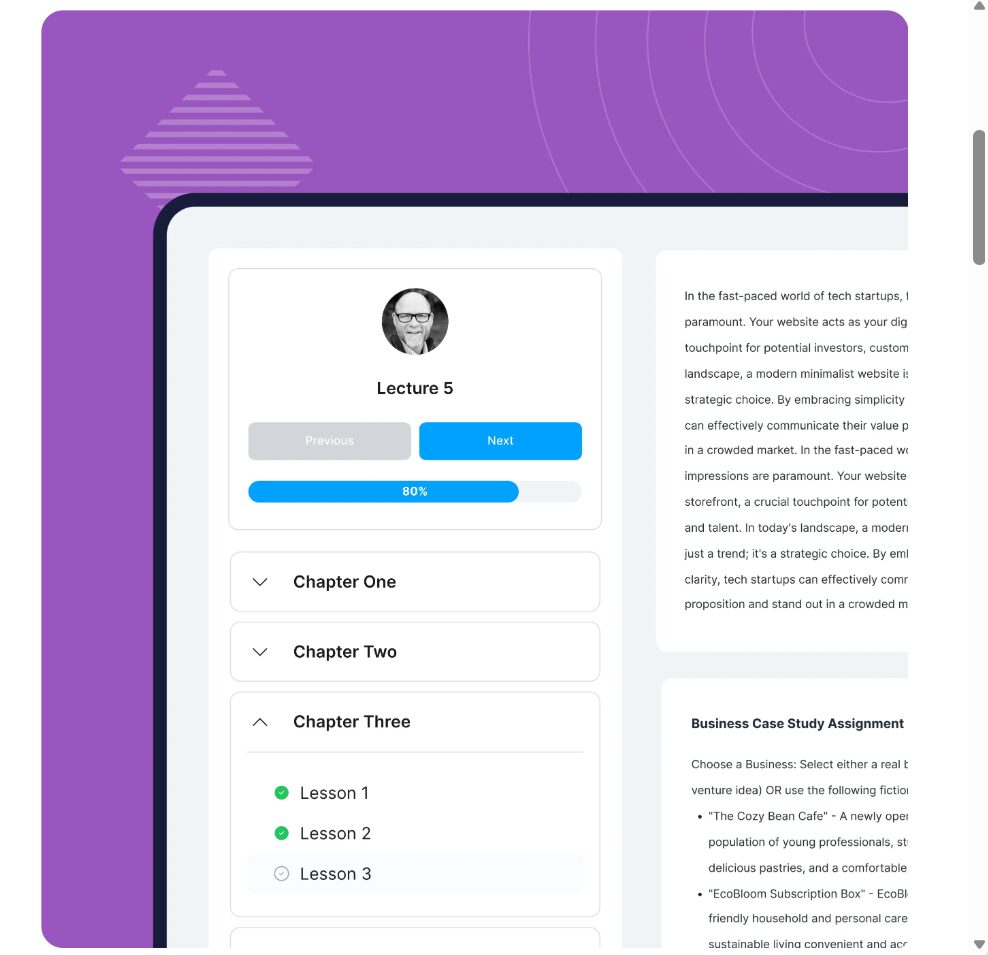
A practical structure for most online courses looks like this. Aim for 4 to 8 modules, each covering a distinct phase of the journey. Each module contains 3 to 6 short lessons, ideally 5 to 15 minutes each. Each lesson ends with a clear action step.
Short, focused lessons beat long, lecture-heavy ones because they give students something to act on straight away. Action builds momentum. Momentum drives completion. Completion produces the reviews and referrals that grow your course business.
Include a quick win in your very first module. Give students something they can act on and see results from right away. That early success creates trust and commitment.
It also reduces refund requests. A student who has already achieved something of value is far less likely to ask for their money back.
Step 5: Create Content That Keeps Students Engaged
Your course content does not need to be perfect. It needs to be clear, organised and delivered with real care for your students’ success. A course filmed on a basic webcam with honest, well-prepared teaching will outsell a slick, overproduced course with shallow content every single time.
That said, a few basics matter. Audio quality is the single most important production factor. Students will forgive an average video, but they will abandon a course the moment the audio becomes hard to follow.
Invest in a decent USB microphone before anything else. Budget options like the Blue Snowball cost less than $50 and produce clean, professional sound that is more than good enough for online courses.
For video, a modern smartphone on a tripod with natural light from a window in front of you will look professional on any screen. You do not need studio lighting or an expensive camera to get started.
For each lesson, use a simple three-part structure. Open with the context: explain what you are covering and why it matters. Deliver the core teaching with clear steps and real examples. Close with a summary and a single action for the student to take before moving on.
This pattern creates clarity and gives students a sense of progress after every lesson.
Using an AI writing tool to help script or outline your lessons can cut your preparation time sharply. Rytr is one of the most affordable options on the market and is well-suited to producing lesson outlines, slide copy and supporting written materials quickly and efficiently.

Step 6: Choose the Right Platform for Your Course
Where you host and sell your course shapes both your experience as a creator and your students’ experience as a learner. The right choice depends on your budget, your comfort with tech and how much control you want over pricing and customer data.
There are broadly two types of platforms to consider.
Course marketplaces like Udemy and Skillshare give you access to an existing audience. Students search the platform and find your course without you needing to drive all the traffic yourself.
The tradeoff is real: you have limited control over pricing, you share revenue with the platform, and you do not own the relationship with your students. Udemy is also known for heavy discounting that can undercut the perceived value of your course.
Self-hosted platforms give you full control. Tools like Teachable, Kajabi and Thinkific let you build a branded course school, set your own prices and keep your customer data. They typically charge a monthly fee rather than taking a cut of each sale.
For beginners who want to keep costs low, Systeme.io is worth a serious look. It includes a full online course builder, along with email marketing, sales funnels, and payment processing, all on a free plan. This means you can build and launch your first course without paying for separate tools.
The platform is simple to use and requires no technical knowledge.
As LearnWorlds’ comprehensive guide to selling online courses explains, the platform you choose affects not just how you deliver content but how you price, market and grow your course business over time. Think about where you want to be in 12 months rather than just what is easiest to set up today.

Step 7: Price Your Course With Confidence
Underpricing is one of the most damaging mistakes new course creators make. It is a surprising truth, but a low price often signals low value. Potential students who might have paid $197 without hesitation will scroll past a $27 course, wondering what is wrong with it.
Your price should reflect the value of the result your course delivers, not the number of hours of content it contains.
A 2-hour course that reliably helps someone land their first $1,000 freelance client is worth far more than a 20-hour course that covers everything loosely and delivers nothing concrete.
As a general guide, beginner-level courses tend to sell for $97 to $197. Courses with a clear, specific outcome for a defined audience often land between $197 and $497. More complete programmes with community access or coaching elements can comfortably reach $500 to $2,000 or more.
Tiered pricing is a smart way to serve different types of buyers. A self-study tier gives access to the core content at your standard price. A premium tier adds group Q&A sessions, a private community or work reviews at a higher price point. Many course creators find that a solid share of buyers choose the premium tier, which lifts average revenue per student.
Offer an early bird price when you first launch. This creates urgency, rewards your most loyal audience members and gives you an early cash boost to put into marketing. A 30% to 40% discount for the first 48 to 72 hours of launch is a common and effective approach.
Step 8: Build a Sales Page That Converts
Your sales page is where a curious visitor either becomes a paying student or clicks away for good. Getting this page right is not optional.
A sales page that converts follows a clear order. Start with a headline that speaks to the specific person your course is for and the specific result it delivers. Something like “How Freelance Beginners Are Landing Their First Paying Clients in 30 Days or Less” tells the right visitor they are in the right place.
Follow the headline with a short section describing the problem your ideal student is currently facing. Make them feel seen and understood. Use the same language you collected during your research phase. When a potential buyer reads your page and thinks “this is exactly how I feel,” your sign-up rate goes up sharply.
Then present your course as the solution. Walk through what is inside using bullet points that describe specific outcomes for each module rather than generic topic titles. “Module 3: How to write a pitch email that gets replies” is far more compelling than “Module 3: Email marketing.”
Include social proof early. Student testimonials, even from a small beta group, do more for your sales than several paragraphs of your own copy. A single genuine testimonial from someone who got a real result is powerful.
End with a clear call to action and a money-back guarantee. A 30-day guarantee removes the final barrier for hesitant buyers.
Most reputable course creators offer one. Most buyers never use it. The business risk is low, and the conversion benefit is high.

Step 9: Market Your Course Before and After Launch
A great course with no marketing is an invisible course. The creators who build a steady income from online education are not always the ones with the best content. They are the ones who build an audience before they launch and keep promoting consistently after.
Build your audience before you launch. An email list is the most valuable marketing tool you can have for a course business. Start building yours before your course is ready.
Offer a free resource related to your course topic in exchange for an email address. A checklist, a short guide or a mini email course all work well. Share useful content as your list grows so your subscribers know and trust you before you ever make an offer.
Use content marketing. Write blog posts, record short videos or publish on social media about topics related to your course. This builds your authority and gives potential students a taste of your teaching style.
Content that ranks in Google search creates a long-term stream of visitors that keeps delivering students months after it is published.
Run a launch sequence. In the week before your course opens, send a series of emails that build interest, address common objections and create urgency. A simple 5-email sequence works well: introduce the course, share the result it delivers, answer key questions, share a student win and close with a final reminder.
Host a free webinar or workshop. A live session covering part of your course content is one of the highest-converting tactics available. Someone who spends 60 minutes with you learning something real has experienced your teaching firsthand. They are far more likely to invest in your full course than someone who only reads a sales page.
According to Entrepreneur’s six-step guide to creating a course that sells, staying consistent on one or two chosen marketing channels matters more than spreading yourself thin across all of them. Pick one, build traction and expand once you have a system that works.
Keep selling after launch. Your course does not stop being relevant once launch week ends. Set up a simple funnel that enrols new students on a rolling basis.
Use your free resource to grow your list every day. Send new subscribers through your launch email sequence automatically so your course generates enrolments month after month.

Common Mistakes That Kill Course Sales
Even with a solid plan in place, a few consistent errors can cost new course creators significant time and income.
Waiting until the course is perfect before launching. A course that is 80% polished and launched earns feedback and income. A course that sits at 98% for 6 months while you keep tweaking earns nothing. Launch early, gather feedback and improve based on what real students actually need.
Making the course too long. More content does not mean more value. Students do not want vast. They want efficiency.
A course that delivers its promised result in 4 focused hours is worth more to a busy person than a 40-hour course they will never finish. Cut every lesson that does not directly serve the outcome you promised.
Ignoring the student experience after enrolment. Getting a student to buy is only half the job. Getting them to complete the course and achieve a result is what produces the reviews, referrals and repeat purchases that make a course business last.
Check in with students regularly. Answer questions promptly. A student who succeeds becomes your best marketing tool.
Relying on a single launch with no ongoing plan. A launch week is a sprint. A sustainable course business is a marathon.
Set up systems that generate leads and enrolments on a rolling basis. Build your email list every day. Treat your course as a living business rather than a single event.

Which Platform Should You Start With?
The best platform is the one you will actually use. Complexity is a bigger threat to your progress than any platform limitation.
For beginners building a first course alongside a full-time job, an all-in-one platform removes the technical friction that stops most people from ever launching. Systeme.io’s free plan includes everything you need to host your course, process payments, manage your email list and build a simple sales funnel.
You can go from nothing to a published, purchasable course in a single weekend without writing a line of code.
If you are ready to build the full foundation for an online business that includes a course as a core income stream, the Get Started Here page walks you through the tools, strategies and next steps clearly and honestly
No income guarantees and no unnecessary complexity.
The Bottom Line
Knowing how to create an online course that sells is one of the most valuable skills you can build as an online entrepreneur. It combines the leverage of a digital product, which you create once and sell many times, with the credibility of being seen as an expert in your field.
Done well, a single course can generate income every month for years after the initial work is complete.
The steps are clear: validate before you build, focus on the result rather than the volume of content, structure for completion and market steadily before and after launch. None of this requires a big budget, a large existing audience or years of experience.
It requires a willingness to start before you feel fully ready and the patience to keep going long enough for results to compound.
If you are ready to take the first practical step toward building your own course business, head over to the Get Started Here page. Everything you need to begin is explained in plain language, with no hype and no shortcuts.