
ClickFunnels Pricing 2025: All Plans Compared
If you’re researching sales funnel software, you’ve probably come across ClickFunnels. It’s one of the most popular funnel builders out there, and for good reason, it’s powerful, feature-rich and used by thousands of online businesses. But here’s the thing that stops most people in their tracks: the price. When you look at ClickFunnels pricing 2025, you might experience a bit of sticker shock, especially if you’re just starting out.
In this comprehensive guide, I’ll break down every ClickFunnels plan, compare what you actually get for your money and help you decide if it’s worth the investment for your specific situation. No fluff, no sales pitch, just honest analysis based on real research.
Understanding ClickFunnels: What Are You Actually Paying For?
Before we dive into the pricing, let’s quickly establish what ClickFunnels actually does. This context matters because the price makes more sense when you understand what you’re getting.
ClickFunnels is an all-in-one sales funnel platform that lets you:
Build sales funnels without coding or hiring a developer
Host landing pages on their servers (no separate hosting needed)
Process payments through integrated payment gateways
Manage email marketing with built-in automation
Create membership sites for courses or exclusive content
Run affiliate programs to recruit others to promote your products
Split test pages to optimise conversion rates
Track analytics to see what’s working and what’s not
The idea behind ClickFunnels is that instead of piecing together five or six different tools (website builder, email platform, payment processor, membership plugin, etc.), you get everything in one place. This integration is the main value proposition and why the pricing is higher than simple landing page builders.
According to the Entrepreneur’s guide to sales funnel software, integrated platforms like ClickFunnels can significantly reduce the technical complexity of running an online business, though they come at a premium compared to DIY solutions.
Check out my complete ClickFunnels review to see if this platform aligns with your business goals
ClickFunnels Pricing Structure: The Three Main Plans
As of 2025, ClickFunnels offers three primary pricing tiers. Let me break down each one in detail. Please note that their pricing structures do often change.
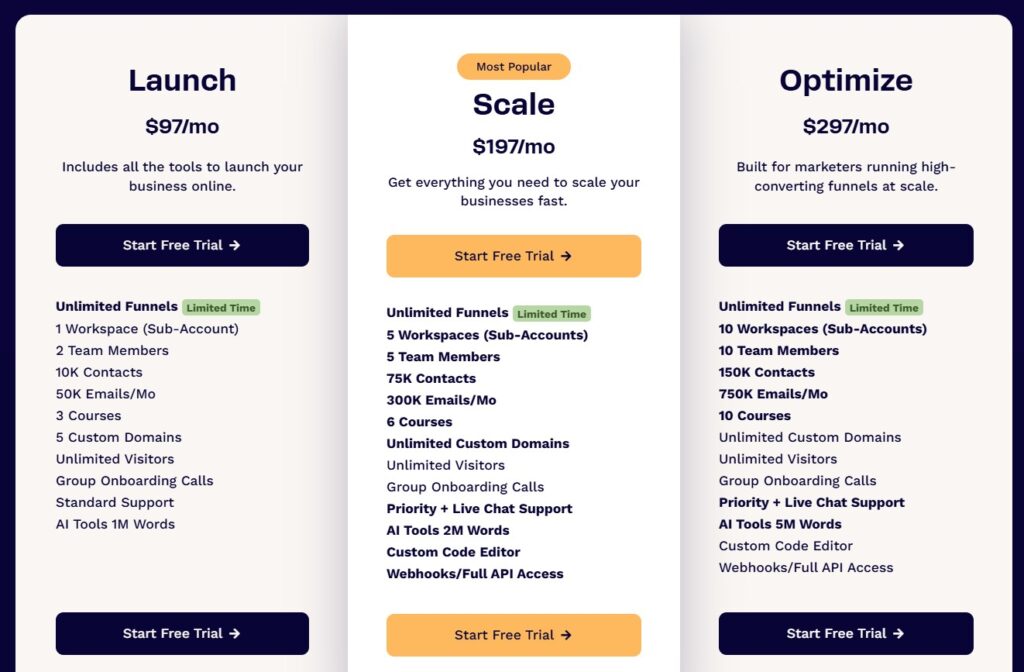
Starter Plan: $97/Month
This is ClickFunnels’ entry-level plan, and frankly, it’s pretty limited. Here’s what you get:
Core Features:
- 20 funnels
- 1 website
- 1 domain
- 10,000 contacts
- Unlimited courses
- Unlimited workflows (automation)
- Unlimited pages
What This Means in Practice:
The Starter plan is designed for someone who’s just testing ClickFunnels or running a very simple business. You can build up to 20 different funnels, which sounds like a lot but can actually fill up quickly if you’re creating separate funnels for different products, lead magnets or promotions.
The 1 website limitation is significant. If you want to build an actual website (not just standalone funnel pages), you’re limited to one. The 1 domain limitation means you can only connect one custom domain to ClickFunnels. If you run multiple businesses or want separate domains for different projects, you’ll need to upgrade.
The 10,000 contacts limit refers to your email list size. Once you hit that number, you’ll need to upgrade or start removing old contacts.
Who This Plan Is For:
Honestly? Very few people. At $97/month, this plan is too expensive for absolute beginners who aren’t making money yet and too limited for established businesses. It exists mainly as a stepping stone to get people into the ClickFunnels ecosystem.
If you’re in this category, you might want to consider whether a platform like Systeme.io (starting at $27/month with more generous limits) makes more sense for your current stage.
Pro Plan: $297/Month
This is where ClickFunnels starts to make sense for serious businesses. The Pro plan is their most popular tier and includes:
Everything in Starter, plus:
- Unlimited funnels
- 3 websites
- 3 domains
- 25,000 contacts
- API access
- Priority support
Additional Features:
- Advanced funnel features
- More template options
- Enhanced analytics
- Better integration capabilities
What This Means in Practice:
The jump from 20 funnels to unlimited is huge. Now you can create as many funnels as you need without worrying about hitting a limit. This is essential if you’re testing different offers, running multiple campaigns or serving different customer segments.
The increase to 25,000 contacts gives you more breathing room as your email list grows. For context, a list of 25,000 engaged subscribers can generate substantial revenue if you’re providing value and promoting relevant offers.
The 3 websites and 3 domains allows you to run multiple brands or separate your business units. For example, you might have one site for your main business, one for a side project and one for a partner brand.
API access is critical if you want to connect ClickFunnels to other tools in your business stack. This opens up possibilities for custom integrations with CRMs, analytics platforms or other software.
Check out my complete ClickFunnels review to see if this platform aligns with your business goals
Who This Plan Is For:
The Pro plan makes sense for:
- Established online businesses already making $5,000+ per month
- Course creators with multiple products
- Agencies managing client funnels
- Businesses with growing email lists (10,000+ subscribers)
- Companies that need custom integrations
If you’re making less than $3,000/month consistently, the $297 price tag will eat into your profits significantly. You need to be at a revenue level where this is a reasonable business expense, not a financial stretch.
Funnel Hacker Plan: $497/Month
This is ClickFunnels’ premium tier, designed for high-volume businesses and power users.
Everything in Pro, plus:
- Unlimited websites
- Unlimited domains
- 200,000 contacts
- Priority template requests
- Funnel Flix access (training library)
- Follow-up funnels (advanced automation)
What This Means in Practice:
The jump to unlimited websites and domains is game-changing for agencies or entrepreneurs running multiple brands. You can create as many distinct web properties as you want without additional cost.
The 200,000 contact limit accommodates substantial list growth. If you have a list this size and are emailing regularly, you’re likely running a seven-figure business.
Funnel Flix is ClickFunnels’ training vault, with courses on marketing, sales, traffic and business building. While useful, this shouldn’t be the primary reason you upgrade, the practical features matter more.
Follow-up funnels refer to ClickFunnels’ advanced email automation features. You can create sophisticated sequences based on customer behaviour, purchase history and engagement levels.
Who This Plan Is For:
The Funnel Hacker plan is for:
- Businesses making $15,000+ per month consistently
- Marketing agencies managing multiple clients
- Companies with large email lists (100,000+ subscribers)
- Enterprises needing unlimited scale
- Businesses requiring advanced automation
If you’re not in one of these categories, you’re probably overpaying with this plan. The features are powerful but only necessary at a certain scale.

What’s NOT Included: Hidden Costs to Consider
Here’s something most ClickFunnels reviews don’t emphasise enough: the subscription price is just the starting point. There are several additional costs you need to budget for.
Transaction Fees
ClickFunnels doesn’t charge transaction fees on top of your subscription, which is good. However, you’ll still pay standard payment processor fees to Stripe or PayPal (typically 2.9% plus 30 cents per transaction). This is unavoidable with any platform.
Email Marketing Limits and Overage Charges
While ClickFunnels includes email marketing, there are limits based on your contact count. If you exceed your plan’s contact limit, you’ll need to:
- Upgrade to the next tier
- Pay overage fees (rates vary)
- Delete contacts to get back under the limit
The overage charges can add up quickly if you’re not paying attention to your list size.
Check out my complete ClickFunnels review to see if this platform aligns with your business goals
Custom Domains
Your ClickFunnels subscription includes hosting for your funnels, but you still need to purchase your domain name separately (typically $10 to $15 per year through registrars like Namecheap or GoDaddy). If you’re on the Starter plan with only 1 domain slot, you’ll need to upgrade to connect additional domains.
Professional Template Customisation
While ClickFunnels provides templates, you might want custom design work to make your funnels stand out. Professional funnel design can cost anywhere from $500 to $5,000+, depending on complexity.
Third-Party Integrations
Some advanced integrations require third-party tools that charge their own fees. For example:
- Zapier (for connecting to apps) starts at $19.99/month
- Advanced CRMs like HubSpot or Salesforce have their own pricing
- SMS marketing tools (if you add text messaging) cost extra
Traffic Costs
ClickFunnels can’t generate traffic for you. You’ll need to budget for:
- Facebook Ads
- Google Ads
- Solo ads
- Content marketing tools
- SEO tools
This is often the biggest ongoing expense for funnel-based businesses and can range from a few hundred to tens of thousands per month, depending on your goals.
ClickFunnels vs Competitors: Price Comparison
Let’s put ClickFunnels pricing in context by comparing it to alternatives.
ClickFunnels vs Systeme.io
Systeme.io Pricing:
- Free plan: $0 (up to 2,000 contacts)
- Startup: $27/month
- Webinar: $47/month
- Unlimited: $97/month
What You Get: Systeme.io offers similar core features (funnels, email marketing, courses, automation) at a fraction of the cost. The trade-off? Less polish, fewer templates and a smaller support community.
Verdict: For beginners or bootstrappers, Systeme.io offers better value. ClickFunnels makes sense when you need the advanced features and have the budget.
ClickFunnels vs Kartra
Kartra Pricing:
- Starter: $119/month
- Silver: $229/month
- Gold: $549/month
What You Get: Kartra is similar to ClickFunnels in scope, an all-in-one platform with funnels, email, membership sites and more. Kartra includes built-in video hosting and helpdesk features that ClickFunnels lacks.
Verdict: Kartra sits in the middle ground, more expensive than budget options but comparable to ClickFunnels. The choice often comes down to interface preference and specific feature needs.
Check out my complete ClickFunnels review to see if this platform aligns with your business goals
ClickFunnels vs Leadpages
Leadpages Pricing:
- Standard: $37/month
- Pro: $74/month
- Advanced: $697/month
What You Get: Leadpages focuses specifically on landing pages and lead generation. It doesn’t include email marketing, courses or membership sites. You’ll need to piece together other tools.
Verdict: Leadpages is much cheaper but less comprehensive. It works if you already have other tools and just need landing pages.
Understanding the evolution of sales funnel software helps place where ClickFunnels fits in the competitive landscape and why their pricing reflects a premium positioning.

Real-World Scenarios: Is ClickFunnels Worth It for You?
Let’s look at specific situations to help you determine if ClickFunnels makes financial sense.
Scenario 1: You’re Just Starting Out (Making $0 to $500/Month)
Recommendation: ClickFunnels is too expensive at this stage.
Why: When you’re not making consistent revenue, spending $97 to $297 per month is unsustainable. That money could go toward paid traffic or product development instead.
Better Option: Start with Systeme.io’s free plan or $27/month Startup plan. Build your funnel, prove your concept and generate revenue first. Once you’re making $2,000+ per month consistently, then consider ClickFunnels.
Scenario 2: You’re Making $2,000 to $5,000/Month
Recommendation: ClickFunnels Starter might work but evaluate carefully.
Why: At this revenue level, the $97/month Starter plan is affordable (about 2 to 5% of revenue). However, the limitations might frustrate you quickly.
Better Option: Either stick with a cheaper platform until you hit $5,000/month or skip Starter and go straight to Pro if the features justify the cost for your business model.
Scenario 3: You’re Making $5,000 to $15,000/Month
Recommendation: ClickFunnels Pro ($297/month) starts to make sense.
Why: At this revenue level, $297/month represents about 2 to 6% of your monthly income. You likely need the scalability, unlimited funnels and larger contact limits that Pro provides.
Key Consideration: Calculate your customer acquisition cost and lifetime value. If ClickFunnels’ features help you convert better or serve customers more effectively, the ROI justifies the cost.
Scenario 4: You’re Making $15,000+/Month
Recommendation: ClickFunnels Funnel Hacker ($497/month) may be worthwhile.
Why: At this level, you need robust automation, unlimited scale and can benefit from advanced features. The $497 cost is under 4% of revenue and the efficiency gains justify it.
Key Consideration: At this revenue level, also consider whether hiring a developer to build custom solutions might offer better long-term value and flexibility.
Scenario 5: You’re an Agency
Recommendation: Funnel Hacker plan if managing multiple clients.
Why: The unlimited domains and websites allow you to manage all clients under one account. The cost can be built into your client retainers.
Better Option: Consider ClickFunnels’ agency-specific plans if available or negotiate custom pricing for high-volume use.
Check out my complete ClickFunnels review to see if this platform aligns with your business goals
The Hidden Value: What You’re Really Paying For
Beyond the features list, there are intangible benefits to ClickFunnels that justify the higher price for some users:
Community and Ecosystem
ClickFunnels has cultivated one of the largest communities in the online marketing space. When you subscribe, you gain access to:
- Active Facebook groups with 100,000+ members
- Regular virtual events and webinars
- Funnel Hacking Live (annual conference)
- Shared funnel templates from successful marketers
This community can be incredibly valuable for networking, learning and troubleshooting.
Proven Templates
ClickFunnels templates are based on millions of dollars in actual funnel performance. Russell Brunson (ClickFunnels founder) and his team have tested these structures extensively. You’re not just getting a design, you’re getting a proven conversion framework.

Support and Resources
ClickFunnels provides extensive documentation, video tutorials and support resources. For non-technical users, this educational component saves countless hours of trial and error.
Brand Recognition
There’s also something to be said for brand credibility. When you tell other marketers or potential partners that you use ClickFunnels, it signals a certain level of seriousness and investment in your business.
Are these intangibles worth hundreds of dollars per month? That depends on your situation and how much you value these benefits.
Common Objections and Counterpoints
Let me address the most common complaints about ClickFunnels pricing:
“It’s Too Expensive”
Counterpoint: Compared to what? If you pieced together separate tools for landing pages ($50/month), email marketing ($100/month for 25,000 contacts), membership sites ($50/month), payment processing and automation, you’d easily spend $200 to $300 monthly anyway.
The question isn’t whether ClickFunnels is expensive in absolute terms—it’s whether the integrated experience and time savings justify the cost compared to the DIY approach.
“There Are Cheaper Alternatives”
Counterpoint: This is absolutely true. Systeme.io, GetResponse and others offer similar functionality at lower prices. The trade-off is usually:
- Less polished interface
- Smaller template library
- Smaller community
- Fewer integrations
- Less robust support
For many people, these trade-offs are worth the savings. For others, ClickFunnels’ premium experience justifies the premium price.
“I Don’t Need All Those Features”
Counterpoint: You’re probably right. Most users utilise maybe 30% of ClickFunnels’ capabilities. However, as your business grows, having those features available without switching platforms is valuable.
That said, if you know you’ll never need courses, membership sites or advanced automation, you’re definitely overpaying for features you won’t use.
“I Can Build Funnels for Free with WordPress”
Counterpoint: You technically can, but it requires:
- Technical knowledge (or money to hire developers)
- Multiple plugins that may conflict
- Separate email marketing tool
- Payment gateway integration
- Ongoing maintenance and updates
- Separate hosting costs
The “free” option often ends up costing more in time and frustration than paying for an integrated solution. However, if you enjoy the technical aspects and have the skills, WordPress can absolutely work.
If you’re still not sure whether ClickFunnels or another platform fits your business model, I’ve put together a comprehensive getting started guide that walks you through choosing the right tools
Forbes’ comparison of funnel builders highlights that the “right” choice depends heavily on technical comfort level and business stage.
Money-Saving Tips for ClickFunnels Users
If you decide ClickFunnels is right for you, here are ways to reduce your costs:
Start with Annual Billing
ClickFunnels offers discounts for annual payments. While this requires a larger upfront investment, you’ll save 15 to 20% compared to monthly billing. For the Pro plan, this could mean saving $600+ per year.
Use the Free Trial Strategically
ClickFunnels typically offers a 14-day free trial. Use this time to:
- Build your core funnels completely
- Test all features you need
- Import your contacts
- Set up automations
By the time the trial ends, you should have everything ready to launch immediately, maximising your return from day one of paid membership.
Take Advantage of Bonuses
ClickFunnels often runs promotions offering free months, bonus training or discounts. Watch for these during major launches or holidays.
Maximise Your Plan Limits
If you’re on the Starter plan, fully utilise all 20 funnels before upgrading. On Pro, use all 3 domains and websites. Get maximum value from what you’re paying for.
Clean Your Contact List Regularly
Keeping your contact count down saves money. Regularly remove:
- Unengaged subscribers (haven’t opened in 6+ months)
- Bounced email addresses
- Duplicate contacts
- Obvious spam signups
A smaller, engaged list is more valuable and costs less than a bloated list full of dead contacts.
Split Costs with Partners
If you’re running multiple businesses with a partner, consider sharing a Funnel Hacker account to split the cost. Just ensure you’re not violating ClickFunnels’ terms of service.
When to Upgrade Your ClickFunnels Plan
Knowing when to move from one tier to the next isn’t always obvious. Here are the signs it’s time to upgrade:
From Starter to Pro:
- You’ve created 15+ funnels and need more
- Your contact list exceeds 8,000 (leaving buffer room)
- You need to connect a second or third domain
- You’re hitting technical limitations with Starter features
- You need API access for custom integrations
From Pro to Funnel Hacker:
- You’re managing 3+ separate brands or businesses
- Your contact list exceeds 20,000
- You need advanced automation capabilities beyond basic sequences
- You’re an agency managing multiple client accounts
- The cost represents less than 3% of monthly revenue
Important: Don’t upgrade just because you can afford it. Upgrade when you’re actually using the features that justify the higher price.
If you’re still not sure whether ClickFunnels or another platform fits your business model, I’ve put together a comprehensive getting started guide that walks you through choosing the right tools

Alternatives to Consider Before Committing
Before you commit to ClickFunnels pricing, consider these questions and alternatives:
Do you need an all-in-one solution? If you already have email marketing sorted with another tool you love, maybe you just need a landing page builder like Leadpages or Unbounce.
Are you comfortable with tech? If yes, WordPress with plugins like Thrive Suite or Elementor might give you more control at lower cost.
Are you just testing an idea? Use a free or low-cost tool like Systeme.io to validate your concept before investing in premium software.
Do you have a developer? Custom-built funnels on your own infrastructure give you ultimate control and potentially lower long-term costs, though higher upfront investment.
Want to See the Full ClickFunnels Picture?
I’ve created an in-depth review covering everything about ClickFunnels—features, pros, cons and real-world testing. Check out my complete ClickFunnels review to see if this platform aligns with your business goals.
Making Your Decision: A Framework
Here’s a simple framework to help you decide:
Step 1: Calculate Your Break-Even Point
How many additional sales per month would you need to cover the ClickFunnels cost? For the Pro plan at $297/month:
- If your product is $30, you need 10 extra sales
- If your product is $100, you need 3 extra sales
- If your product is $1,000, you need 1 extra sale every 3 months
If ClickFunnels’ features help you achieve that increase through better conversion rates or saved time, it pays for itself.
Step 2: Audit Your Current Tool Stack
List everything you currently pay for:
- Website hosting: $___
- Email marketing: $___
- Landing page builder: $___
- Membership plugin: $___
- Payment processing: $___
- Course platform: $___
Add it up. If you’re paying close to ClickFunnels’ price already and could consolidate, the decision becomes clearer.
Step 3: Evaluate Your Technical Skills and Time
Be honest about your abilities and available time. If setting up WordPress, connecting APIs and troubleshooting technical issues sounds miserable, paying for an integrated solution that “just works” is worth the premium.
Step 4: Consider Your Growth Trajectory
Where will your business be in 6 months? 12 months? If you’re on a strong growth path, investing in scalable infrastructure now prevents the headache of migrating platforms later.
Step 5: Test and Decide
Use the free trial to build a real funnel with real traffic. Measure actual results, not hypothetical projections. Let data inform your decision.

Final Thoughts on ClickFunnels Pricing 2025
Understanding ClickFunnels pricing 2025 comes down to context. The numbers, $97, $297 and $497 per month, seem high in isolation. But when you consider what you’re getting, compare it to alternatives and evaluate it as a percentage of revenue rather than an absolute cost, the picture becomes clearer.
For absolute beginners making little to no money, ClickFunnels is overpriced. You’re better off starting with more affordable alternatives and upgrading once you’ve proven your concept.
For established businesses making $5,000+ per month, ClickFunnels starts to make sense. The time savings, integrated features and proven frameworks can accelerate growth in ways that justify the investment.
For high-volume businesses and agencies making $15,000+ monthly, ClickFunnels often pays for itself through efficiency gains alone.
The key is being honest about where you are right now, not where you hope to be. Build on the platform that matches your current reality, not your aspirations.
Need Help Deciding What’s Right for Your Online Business?
If you’re still not sure whether ClickFunnels or another platform fits your business model, I’ve put together a comprehensive getting started guide that walks you through choosing the right tools
The bottom line: ClickFunnels is a premium tool with premium pricing. It delivers real value but only if you’re at a stage where you can leverage what it offers. Don’t buy it to look successful, buy it when you’re ready to use it effectively.
Make your decision based on numbers, not emotions. Track your results, optimize what works and scale intelligently. That’s how you build a sustainable online business, regardless of which tools you choose.