How Much Money Can You Make From Affiliate Marketing: Real Income Data And Honest Expectations
When you research how much money can you make from affiliate marketing, you encounter wildly contradictory information ranging from income claims of fifty thousand to one hundred thousand dollars monthly from successful affiliates showcasing their earnings dashboards to warnings from skeptics insisting that ninety-five percent of affiliate marketers earn nothing at all whilst the few successes result from luck rather than from replicable strategies that average people could follow. This massive range between the optimistic success stories and the pessimistic failure warnings makes it nearly impossible to understand what realistic income expectations should be for someone considering whether to invest time and effort into building an affiliate marketing business. The truth about how much money you can make from affiliate marketing lies somewhere between these extremes and depends heavily on specific factors including which products you promote, which traffic methods you use, how much time you invest, what skills you develop and frankly how much luck you experience in choosing approaches that resonate with your particular audiences in your specific niches at the particular times when you implement your strategies.
Understanding The Income Range Reality
Before examining specific income levels at different experience stages, understanding how much money you make from affiliate marketing requires acknowledging the enormous range between the lowest earners and the highest earners in this business model.
The Bottom Tier: Zero To One Hundred Dollars Monthly
The largest group of affiliate marketers earns between zero and one hundred dollars monthly, which includes everyone who has joined affiliate programmes but has not yet generated meaningful traffic or who has created some content but has not achieved the critical mass needed to produce consistent commissions. This group represents perhaps seventy to eighty percent of all people who attempt affiliate marketing, with most never progressing beyond this minimal income level before quitting.
These minimal earners typically have published fewer than twenty pieces of content, receive fewer than one thousand monthly visitors across all their platforms and have not yet developed the skills, the consistency or the strategic focus needed to generate meaningful affiliate income. Their earnings come sporadically through occasional lucky sales rather than through systematic, predictable traffic and conversion systems.
The people in this category often remain here for three to six months before either quitting entirely or breaking through to higher income levels. The determining factor is typically whether they persist through this discouraging early period, whilst continuously improving their approaches based on the limited data their small traffic provides.
The Lower-Middle Tier: One Hundred To One Thousand Dollars Monthly
The next tier earns between one hundred and one thousand dollars monthly, which represents approximately fifteen to twenty percent of affiliate marketers who have persisted long enough to build content libraries of thirty to eighty pieces and to generate three thousand to fifteen thousand monthly visitors across their various traffic sources.
These affiliates have developed basic competence in content creation and traffic generation whilst understanding fundamental conversion optimisation. They typically focus on specific niches rather than promoting products randomly, and they have begun to understand which types of content and which promotional approaches work best for their particular audiences.
The income at this level represents genuine supplementary earnings that make real differences in monthly budgets whilst paying for tools, covering small expenses or building savings. However, it remains well below what most people need to replace employment income, making it an unsatisfying middle ground between failure and success that motivates some people to push harder, whilst discouraging others who expected faster progress.
The Middle Tier: One Thousand To Five Thousand Dollars Monthly
Approximately five to ten percent of affiliate marketers reach earnings between one thousand and five thousand dollars monthly, representing income levels where affiliate marketing begins to feel like a legitimate business rather than just a side hobby generating pocket money. These affiliates typically have content libraries of one hundred to three hundred pieces, receive twenty thousand to one hundred thousand monthly visitors and have developed systematic approaches to content creation, traffic generation and conversion optimisation.
The people at this level understand their niches deeply, know their audiences well and have identified which specific products and promotional strategies generate the best results in their particular situations. They treat affiliate marketing as serious business ventures requiring consistent effort rather than as casual projects to attempt when they feel motivated.
This income level allows many affiliates to reduce their employment commitments, work part-time rather than full-time at traditional jobs or combine affiliate income with other online revenue streams to achieve financial independence from traditional employment altogether.
The Upper-Middle Tier: Five Thousand To Twenty Thousand Dollars Monthly
Perhaps two to three percent of affiliate marketers earn between five thousand and twenty thousand dollars monthly, representing income levels that exceed what most people earn through traditional employment, whilst providing the flexibility and autonomy that make online business attractive. These affiliates have built substantial platforms with content libraries exceeding five hundred pieces, audiences of hundreds of thousands across various channels and a sophisticated understanding of what drives conversions in their specific niches.
The affiliates at this level typically employ teams including writers, video editors, virtual assistants or paid advertising specialists, allowing them to scale beyond what they could accomplish alone through direct effort. They understand business operations, systematization and delegation whilst treating their affiliate marketing as professional enterprises requiring strategic planning and resource allocation.
The Top Tier: Twenty Thousand Dollars Plus Monthly
Less than one percent of affiliate marketers earn twenty thousand dollars or more monthly, with some earning fifty thousand to two hundred thousand dollars monthly or even more through promoting high-ticket products, managing large, diverse affiliate portfolios or dominating specific high-value niches. These top earners typically have teams of ten to fifty people, manage multiple websites or channels simultaneously and have developed proprietary systems and processes that allow them to identify opportunities and execute on them faster than competitors can respond.
These top-tier affiliates bear little resemblance to the beginners asking how much money they can make from affiliate marketing because they operate sophisticated businesses with substantial overhead, complex operations and risk profiles that exceed what most people imagine when they think about affiliate marketing as easy passive income requiring minimal effort.
Understanding how much money you make from affiliate marketing requires examining the specific factors that determine whether you end up in the bottom tier, earning nothing or in the top tiers, earning thousands monthly.
The Products You Choose To Promote
The commission structures of the products you promote dramatically affect how much you earn from the same amount of traffic. Physical products through Amazon Associates pay four to ten percent commissions, meaning you need to generate one thousand dollars in sales to earn forty to one hundred dollars in commissions. Digital products through platforms like ClickBank often pay forty to seventy percent commissions, meaning one thousand dollars in sales generates four hundred to seven hundred dollars in commissions.
High-ticket products like software, courses or consulting services paying commissions of five hundred to five thousand dollars per sale allow you to earn substantial income from relatively small numbers of conversions. An affiliate promoting products paying one thousand dollar commissions needs only five sales monthly to earn five thousand dollars, whilst an affiliate promoting products paying twenty dollar commissions needs two hundred fifty sales monthly to reach the same income, requiring substantially more traffic.
The Traffic Methods You Master
Affiliates relying on organic search traffic typically build more slowly but create more sustainable businesses because search traffic continues flowing as long as their content maintains rankings. Affiliates using paid advertising can scale faster, but require larger budgets and more sophisticated skills to maintain profitability whilst constantly managing campaigns.
Social media traffic grows through consistent engagement and community building, creating loyal audiences but requiring ongoing content creation and interaction. Email marketing to owned lists provides the highest conversion rates, but requires building those lists through other traffic methods first before email becomes a viable primary channel.
The most successful affiliates typically combine multiple traffic sources, creating diversification that protects against algorithm changes, platform policy shifts or other disruptions that affect any single traffic channel.
The Time You Invest Consistently
Affiliates working ten hours weekly typically progress more slowly than those working thirty to forty hours weekly, with the difference compounding over time as more hours produce more content, more testing and more optimisation. However, working more hours only accelerates progress when those hours are spent effectively on activities that directly contribute to traffic and conversions rather than on busywork that feels productive without moving metrics.
The consistency matters more than the total hours, with affiliates working ten hours weekly consistently for twelve months typically outperforming affiliates working thirty hours weekly sporadically for three to four months, then quitting for weeks before restarting. The compound effects of consistent effort accumulate, whilst sporadic efforts never build the momentum needed for meaningful income.
The Skills You Develop
Affiliate marketing success requires developing multiple skills, including content creation for engaging audiences, search engine optimisation for ranking in Google, audience psychology for understanding what motivates purchases, conversion optimisation for improving the percentage of visitors who click affiliate links and basic analytics for understanding what works and what does not work in your specific situation.
Affiliates who deliberately develop these skills through study, practice and continuous improvement typically progress faster than affiliates who create content randomly without strategic thinking about what will attract audiences or convert visitors into customers. The skill development happens partly through formal education but mostly through doing the work whilst paying attention to results and adjusting approaches based on performance data.
The Niche Selection Strategy
Affiliates choosing niches with strong commercial intent, where people actively search for product recommendations and comparisons, typically earn more than affiliates choosing informational niches where people seek knowledge without immediate purchase intent. The commercial niches are more competitive, but the higher conversion rates and the stronger buyer intent compensate for the increased competition.
Additionally, affiliates choosing niches aligned with their genuine knowledge or interests typically produce better content, sustain motivation longer and build more authentic authority than affiliates choosing niches purely based on income potential without regard for whether the topics interest them or whether they can contribute unique value beyond what existing content already provides.
The Conversion Optimization Focus
Affiliates who systematically test different promotional approaches, analyse which content converts best and optimise their strategies based on actual performance data typically earn substantially more from the same traffic than affiliates who create content without a strategic conversion focus. Small improvements in conversion rates compound dramatically when applied across thousands of monthly visitors.
The difference between a one percent conversion rate and a three percent conversion rate means that one thousand monthly visitors generate ten versus thirty conversions. If each conversion earns fifty dollars in commissions, that difference represents five hundred versus fifteen hundred dollars monthly from identical traffic, demonstrating how conversion optimisation multiplies income beyond what traffic generation alone provides.
Realistic Income Timelines For Different Commitment Levels
Understanding how much money you can make from affiliate marketing requires setting expectations based on how much time you can invest consistently over extended periods.
Part-Time Effort: Ten Hours Weekly
Affiliates investing ten hours weekly typically need twelve to eighteen months to reach one thousand dollars monthly income and twenty-four to thirty-six months to reach three thousand to five thousand dollars monthly, assuming they use their limited time efficiently focusing on high-leverage activities rather than spreading effort too thin across too many projects simultaneously.
Month three: Zero to fifty dollars monthly from minimal traffic to the five to ten pieces of content published during the first three months, whilst learning the basics of content creation and platform operations.
Month six: Fifty to two hundred dollars monthly as the content library reaches twenty to thirty pieces and as some articles begin ranking for long-tail keywords, driving small but consistent traffic.
Month twelve: Three hundred to one thousand dollars monthly with a content library of sixty to eighty pieces and traffic of five thousand to fifteen thousand monthly visitors as compounding effects of consistent publishing begin showing results.
Month twenty-four: One thousand to three thousand dollars monthly with content library reaching one hundred fifty to two hundred pieces, traffic growing to twenty thousand to fifty thousand monthly visitors and conversion optimisation improving results from existing content.
This timeline assumes consistent quality effort without major mistakes in niche selection or promotional approaches. Many part-time affiliates progress more slowly due to inefficient time use, strategic errors or life circumstances disrupting consistency.
Full-Time Effort: Forty Hours Weekly
Affiliates investing forty hours weekly can compress timelines substantially, reaching one thousand dollars monthly within six to nine months and potentially reaching five thousand to ten thousand dollars monthly within eighteen to twenty-four months, assuming they avoid common beginner mistakes and develop necessary skills efficiently.
Month three: One hundred to three hundred dollars monthly from traffic to the thirty to forty pieces of content created during the intensive three-month building period, whilst learning content creation and basic optimisation.
Month six: Five hundred to fifteen hundred dollars monthly as the content library reaches eighty to one hundred pieces, and as a focused effort on conversion optimisation begins improving results beyond what traffic growth alone provides.
Month twelve: Two thousand to five thousand dollars monthly with a content library of two hundred to three hundred pieces, traffic exceeding fifty thousand monthly visitors and a sophisticated understanding of what converts best in the specific niche.
Month twenty-four: Five thousand to fifteen thousand dollars monthly as compounding effects of a large content library combine with refined conversion optimisation, and potentially with team members handling some content creation, allowing the founder to focus on strategy and optimisation.
This accelerated timeline reflects the advantages of full-time focus, including faster skill development, more consistent publishing and greater ability to test and optimise compared to part-time effort. However, many full-time affiliates struggle financially during the early months when income remains minimal despite full-time commitment.
The Sprint Approach: Paid Advertising Focus
Affiliates using paid advertising can potentially reach meaningful income faster than organic content builders because they buy traffic immediately rather than waiting months for search rankings. However, this approach requires substantial upfront capital and carries a higher risk of complete failure through losing advertising budget before discovering profitable campaigns.
Months one to three: Typically negative income as testing campaigns cost money, whilst conversions remain low during the learning period. Many affiliates invest one thousand to five thousand dollars during this testing phase.
Months three to six: Potential to reach breakeven or modest profitability of five hundred to two thousand dollars monthly as profitable campaigns are identified and scaled, whilst unprofitable campaigns are eliminated.
Months six to twelve: Potential to scale to five thousand to twenty thousand dollars monthly by increasing advertising budgets on profitable campaigns, though this requires substantial capital for advertising spending that can reach tens of thousands of dollars monthly even at profitable return ratios.
This approach favours affiliates with substantial capital, high risk tolerance and rapid learning capabilities, whilst being unsuitable for most beginners who lack the capital to sustain losses during learning periods or who cannot afford to risk losing thousands of dollars on advertising education.
Income Examples From Different Affiliate Business Models
Understanding how much money you can make from affiliate marketing requires examining specific business models showing how different approaches generate different income levels from comparable effort investments.
The Niche Blog Model
A focused niche blog publishing two to three comprehensive articles weekly, whilst building topical authority in specific subject areas, represents the most common affiliate business model for people building without paid advertising budgets.
Example income progression:
Six months: One hundred to four hundred dollars monthly from twenty to fifty articles receiving three thousand to eight thousand monthly visitors
Twelve months: Five hundred to fifteen hundred dollars monthly from sixty to one hundred articles receiving ten thousand to twenty-five thousand monthly visitors
Twenty-four months: Two thousand to six thousand dollars monthly from one hundred fifty to two hundred fifty articles receiving forty thousand to one hundred thousand monthly visitors
The income potential depends heavily on niche selection, with commercial niches generating substantially more income per visitor than informational niches. A blog in the credit card or hosting niche might generate eight to fifteen dollars per thousand visitors, whilst a blog in the general lifestyle niche might generate one to three dollars per thousand visitors.
The YouTube Channel Model
A YouTube channel creating one to two videos weekly, whilst building subscriber audiences and promoting affiliate products through video descriptions and pinned comments, generates income through both affiliate commissions and YouTube advertising revenue, creating multiple income streams from single content pieces.
Example income progression:
Six months: Fifty to two hundred dollars monthly from twenty-five to fifty videos with one thousand to five thousand total channel views monthly, whilst still building toward monetisation thresholds
Twelve months: Three hundred to one thousand dollars monthly from sixty to one hundred videos with monetisation enabled and with ten thousand to thirty thousand monthly views
Twenty-four months: One thousand to four thousand dollars monthly from one hundred fifty to two hundred videos with a subscriber base of five thousand to twenty thousand, and with monthly views reaching fifty thousand to two hundred thousand
YouTube channels typically grow more slowly than blogs initially, but can scale faster once algorithms begin recommending videos to new audiences, creating exponential growth that blogs achieve less frequently.
The Email-First Model
Building email lists through valuable lead magnets and then monetising through affiliate promotions to subscribers represents the highest-converting affiliate approach because email subscribers demonstrate much higher conversion rates than cold traffic from search or social platforms.
Example income progression:
Six months: One hundred to three hundred dollars monthly from a list of five hundred to two thousand subscribers built through content and lead magnets, whilst learning email copywriting and promotion
Twelve months: Five hundred to two thousand dollars monthly from a list of two thousand to eight thousand subscribers, with refined promotional sequences and a better understanding of what the audience responds to
Twenty-four months: Two thousand to eight thousand dollars monthly from a list of eight thousand to thirty thousand subscribers with sophisticated segmentation and personalised promotional approaches
The challenge with email-first approaches is that building the lists requires traffic from other sources, meaning that email marketing enhances results from content or advertising rather than replacing these traffic-generation methods entirely.
Creating comprehensive product review and comparison content targeting commercial keywords where people actively search for buying advice generates high-intent traffic that converts at substantially higher rates than informational content targeting people researching topics without immediate purchase intent.
Example income progression:
Six months: Two hundred to eight hundred dollars monthly from fifteen to thirty detailed product reviews and comparison articles targeting commercial keywords
Twelve months: One thousand to four thousand dollars monthly from forty to seventy product reviews, with a strong focus on conversion optimisation and on building topical authority in specific product categories
Twenty-four months: Four thousand to fifteen thousand dollars monthly from one hundred to one hundred fifty reviews dominating specific product categories with comprehensive coverage that captures most commercial search traffic in the niche
Review sites face intense competition from established authorities and from brands themselves investing heavily in content, but the high commercial intent of traffic compensates for the competitive challenges when affiliates can rank for valuable commercial keywords.
The Factors That Prevent Higher Earnings
Understanding how much money you can make from affiliate marketing includes recognising what prevents affiliates from earning more than they currently generate and what separates the lower earners from the higher earners.
Insufficient Traffic Volume
The most common limitation is simply not generating enough traffic to produce meaningful commissions, even when conversion rates are reasonable. An affiliate converting three percent of visitors into sales but receiving only one thousand monthly visitors generates only thirty sales monthly, which might produce three hundred to fifteen hundred dollars in commissions, depending on commission rates.
Increasing that traffic to ten thousand monthly visitors whilst maintaining three percent conversion would generate three thousand to fifteen thousand dollars monthly from identical conversion rates, demonstrating how traffic volume directly determines income when conversion rates remain constant.
Poor Conversion Rates
Many affiliates generate substantial traffic but fail to convert that traffic into affiliate sales because their content does not persuade effectively, because they promote products that do not align with their audiences’ needs or because their calls to action are weak or unclear.
Improving conversion from one percent to three percent triples income from identical traffic, demonstrating how conversion optimisation can transform struggling affiliate businesses into profitable ventures without requiring any traffic growth.
Wrong Product Selection
Promoting products that pay low commissions forces affiliates to generate massive sales volumes to reach meaningful income, whilst promoting high-commission products allows generating substantial income from modest sales volumes. An affiliate promoting products paying ten-dollar commissions needs one hundred sales monthly to earn one thousand dollars, whilst an affiliate promoting products paying two hundred-dollar commissions needs only five sales monthly to reach the same income.
Additionally, promoting products that do not match audience needs results in low conversion rates, regardless of traffic volume, because visitors do not want what is being promoted to them.
Lack Of Strategic Focus
Many struggling affiliates spread their efforts too thin across too many projects, too many niches or too many promotional approaches rather than focusing intensively on one niche and one traffic method until achieving meaningful success before expanding to additional opportunities.
This lack of focus prevents building the critical mass of content and traffic needed in any single niche to generate meaningful income, whilst creating the illusion of productivity through constant activity that does not actually move income metrics.
Inadequate Persistence
Most affiliates quit before reaching the point where their efforts could generate meaningful income because they underestimate the time required to build traffic and authority, whilst expecting faster results based on promotional content suggesting that affiliate marketing generates income quickly for those who know the secrets.
The affiliates who succeed are typically not smarter or more talented than those who fail, but they simply persist through the difficult early months when income remains minimal, whilst continuing to create content and improve their approaches based on limited data from small traffic.
Understanding how much money you can make from affiliate marketing includes examining what changes are required to scale from earning one thousand to three thousand dollars monthly to earning ten thousand to thirty thousand dollars monthly.
Expanding Into Multiple Traffic Sources
Affiliates reaching four-figure monthly income typically dominate one traffic source, such as search traffic to their blogs or YouTube traffic to their channels. Scaling to five figures typically requires expanding into additional traffic sources, such as adding paid advertising to complement organic traffic or building email lists to maximise value from existing traffic.
This expansion requires developing new skills beyond what generated initial success, whilst managing increased complexity from operating multiple marketing channels simultaneously. The expanded traffic sources provide growth whilst diversifying risk by ensuring income does not depend entirely on any single platform or algorithm.
Increasing Focus On High-Ticket Products
Scaling income without proportionally scaling traffic requires promoting products with higher commission rates. An affiliate earning three thousand dollars monthly from thirty sales of products paying one hundred dollar commissions could reach ten thousand dollars monthly by shifting to products paying three hundred thirty-three dollar average commissions, whilst maintaining identical sales volume.
This shift to high-ticket products typically requires adjusting content strategy to target audiences with larger budgets, whilst building more substantial trust and authority because people purchasing expensive products conduct more research and require more persuasion than those purchasing low-cost items.
Building Or Hiring Teams
Solo affiliates can typically generate one thousand to five thousand dollars monthly through direct personal effort, but scaling to ten thousand dollars plus monthly usually requires hiring writers, video editors, virtual assistants or paid advertising specialists who handle execution whilst the founder focuses on strategy and optimisation.
The team investment requires upfront costs before generating additional revenue, meaning that scaling requires either reinvesting affiliate income back into the business or investing external capital to fund team growth. Many affiliates plateau at four-figure monthly income because they lack the capital to invest in scaling or because they prefer keeping all revenue rather than reinvesting in growth.
Systematizing And Automating Operations
Scaling beyond what personal effort can sustain requires building systems and processes that allow the business to operate without the founder’s direct involvement in every decision and every task. These systems might include content creation templates, editorial standards, advertising management processes or analytics dashboards that allow monitoring performance without manually checking every metric daily.
The systematisation work consumes substantial time initially, whilst providing no immediate income increase, but it creates the foundation that allows sustainable scaling beyond personal capacity limits that constrain most affiliate businesses to four-figure monthly income indefinitely.
The Realistic Answer To The Income Question
After examining the income ranges across different tiers, the factors determining how much affiliates earn, the realistic timelines for different commitment levels, the income examples from various business models and the factors that prevent higher earnings, the honest answer to how much money can you make from affiliate marketing shows that most affiliates earn between zero and one hundred dollars monthly because they quit before building sufficient traffic and authority whilst those who persist through the difficult early months typically reach one hundred to one thousand dollars monthly within six to twelve months and potentially reach one thousand to five thousand dollars monthly within eighteen to thirty-six months depending on their commitment levels, their strategic choices and their skill development rates.
The affiliates earning five thousand to twenty thousand dollars monthly represent approximately two to three percent of all affiliate marketers and typically require eighteen to forty-eight months to reach these levels, whilst treating affiliate marketing as a serious business requiring full-time commitment or near full-time commitment rather than as casual side projects requiring minimal effort. The top earners making twenty thousand dollars plus monthly represent less than one percent of affiliates and operate sophisticated businesses with teams, substantial overhead and complexity that bears little resemblance to the simple, easy passive income model that attracts most beginners to affiliate marketing initially.
Understanding how much money can you make from affiliate marketing ultimately requires rejecting both the pessimistic dismissals suggesting nobody earns anything and the optimistic exaggerations suggesting everyone can earn five figures monthly through simple easy systems whilst accepting the realistic middle ground showing that persistent strategic affiliates can build legitimate supplementary income of one thousand to five thousand dollars monthly within one to three years of consistent effort with a small percentage scaling to substantially higher income through additional years of building, systematizing and potentially through hiring teams that allow scaling beyond personal capacity limits. Start with realistic expectations of earning modest income during year one whilst building the foundation for potentially substantial income in years two and three rather than expecting immediate high income that promotional content suggests but that almost no beginners actually achieve regardless of which courses they purchase or which strategies they attempt to implement based on promises that emphasize possibility whilst downplaying the probability of success for typical affiliates pursuing this income model.
Is Affiliate Marketing The Easiest Way To Make Money Online? The Brutal Honest Truth
When you encounter the countless YouTube videos, blog posts and social media advertisements claiming that affiliate marketing is the easiest way to make money online, you naturally wonder whether these claims reflect genuine reality or whether they represent marketing hype from people who earn their income by selling affiliate marketing courses to hopeful beginners rather than by actually succeeding at affiliate marketing themselves. The promise is seductive because affiliate marketing theoretically requires no product creation, no customer service, no inventory management and no complicated business operations beyond sharing links and earning commissions when people make purchases through those links. This apparent simplicity makes it seem like the perfect easy income opportunity for complete beginners without business experience, technical skills or substantial capital to invest in launching traditional businesses. Is affiliate marketing the easiest way to make money online? This question requires examining not just the theoretical barriers to entry but rather the actual practical challenges that most beginners encounter when they attempt to generate meaningful income through promoting other companies’ products for commission payments.
Understanding What Affiliate Marketing Actually Involves
Before evaluating whether affiliate marketing is the easiest way to make money online, you need to understand what affiliate marketing genuinely requires beyond the simplified explanations that promotional content typically provides to make the opportunity appear more accessible than it actually is.
The Basic Mechanics Of Affiliate Marketing
At its most fundamental level, affiliate marketing works through a simple process where you join affiliate programmes offered by companies that sell products or services, receive unique tracking links that identify purchases as coming from your promotional efforts and earn commissions when people click your links and complete purchases. The companies handle all the product fulfilment, customer service and operational complexity whilst you simply focus on driving traffic to your affiliate links through whatever promotional methods you choose.
The commission structures vary dramatically across different programmes and products. Physical products through programmes like Amazon Associates typically pay four to ten percent commissions on the purchase price. Digital products through platforms like ClickBank often pay thirty to seventy-five percent commissions. Recurring subscription products can generate ongoing monthly commissions as long as customers maintain their subscriptions. High-ticket items like software, courses or consulting services might pay hundreds or even thousands of dollars per sale despite lower conversion rates.
The Skills That Success Actually Requires
Whilst affiliate marketing does not require product creation or business operations, it absolutely requires substantial skills in traffic generation and audience building because commissions only happen when people click your links and make purchases. Generating meaningful traffic requires either content creation skills to build organic audiences through search engines and social media or paid advertising skills to profitably buy traffic through platforms like Facebook Ads or Google Ads.
Content creation for affiliate marketing means writing comprehensive blog posts that rank in search engines, creating engaging videos that attract YouTube viewers, building social media followings through consistent, valuable posting or developing email lists through offering free resources that capture subscriber information. Each of these approaches requires specific skills, including writing ability, video production knowledge, social media strategy or email marketing expertise that most beginners do not possess when they start.
Paid advertising requires understanding audience targeting, crafting compelling ad creative, managing budgets to maintain profitability and optimising campaigns based on performance data. These skills take months to develop through expensive trial and error, where most beginners lose more money on advertising than they earn in commissions, whilst learning what actually works in their specific situations.
The Time Investment Before First Income
One of the biggest misconceptions about whether affiliate marketing is the easiest way to make money online concerns the timeline between starting and earning the first meaningful income. Most promotional content suggests you can start earning within weeks or even days, when the reality for most beginners is six to twelve months of consistent effort before generating even one hundred to three hundred dollars monthly.
If you choose the content creation path, you need to publish thirty to fifty high-quality articles or videos before search engines and social platforms begin sending meaningful traffic to your content. Creating this content library whilst maintaining quality standards typically requires three to six months of consistent work, producing two to four pieces weekly. Even after this content exists, it takes additional months for search rankings to improve and for audiences to discover your content through various channels.
If you choose the paid advertising path, you need to spend money on ads while learning what works through inevitable failures and losses before you discover profitable campaigns. Most beginners need to invest five hundred to two thousand dollars in advertising, whilst losing money before they find approaches that generate more in commissions than they cost in ad spending.
The Competition Reality
Affiliate marketing is one of the most competitive online income methods precisely because the barriers to entry appear so low. Millions of people are promoting the same products through the same affiliate programmes, creating intense competition for customer attention and for search engine rankings. Standing out requires either exceptional content quality, unique perspectives, established authority or advertising budgets that exceed what most beginners can afford.
The most profitable affiliate products attract the most competition, meaning that products offering fifty percent commissions on two-hundred-dollar purchases have thousands of affiliates fighting for the same customers. This competition drives up advertising costs whilst making it harder to rank organically in search results because established affiliates with larger audiences and budgets dominate the most valuable traffic sources.
Understanding whether affiliate marketing is the easiest way to make money online requires examining why this perception exists despite the practical difficulties that most beginners encounter when they actually attempt it.
No Product Creation Required
The most obvious reason affiliate marketing appears easy is that you do not need to create products, which eliminates what many people perceive as the most difficult aspect of building businesses. You do not need to develop ideas, manufacture physical items, create digital content or provide services using your own time and expertise. You simply promote existing products that other companies have already created and refined.
This elimination of product creation removes substantial barriers that prevent many people from starting businesses, including the uncertainty about whether their product ideas would actually sell, the upfront costs of development and manufacturing and the ongoing work of product improvement and customer support. By promoting existing proven products, you avoid all these challenges whilst still earning income from sales that happen through your promotional efforts.
No Customer Service Burden
Another appealing aspect is that the companies whose products you promote handle all the customer service, returns, refunds and ongoing support, meaning you never need to deal with frustrated customers, answer technical questions or resolve problems. Your only relationship is with the people you send to the products through your links, whilst the companies manage everything that happens after purchase.
This elimination of customer service appeals to people who want income without the stress and time consumption of supporting customers, particularly for products requiring technical support or ongoing assistance. You can promote software, courses or physical products without needing to understand their technical details beyond what you include in your promotional content.
Minimal Upfront Investment
Affiliate marketing requires minimal financial investment to start, particularly if you choose content creation rather than paid advertising approaches. You can join affiliate programmes for free, create content using free platforms like WordPress or YouTube and build audiences without spending money on tools or advertising, making this appear accessible even to people with extremely limited budgets.
This low financial barrier contrasts sharply with traditional businesses requiring inventory purchases, commercial space, equipment or substantial upfront investments before generating first sales. The ability to start affiliate marketing with literally zero dollars beyond internet access makes it appear perfectly suited for people who want business income but lack the capital to invest in traditional business launches.
Passive Income Potential
The promise of passive income, where content you create once continues generating commissions indefinitely, makes affiliate marketing appear easy compared to trading time directly for money through employment or service-based freelancing. The theory is that you invest effort upfront creating content, then earn ongoing income from that content without ongoing work required.
This passive income appeal attracts people who want to escape the time-for-money trap, where income stops the moment you stop working. The vision of content working for you whilst you sleep, travel or focus on other activities creates powerful motivation to attempt affiliate marketing despite warnings about the difficulty of achieving meaningful passive income.
Why Affiliate Marketing Is Actually Difficult
After understanding why affiliate marketing appears easy, examining whether affiliate marketing is the easiest way to make money online requires acknowledging the practical difficulties that contradict the perception of ease.
Traffic Generation Is Genuinely Hard
The fundamental challenge in affiliate marketing is that commissions only happen when substantial numbers of people click your affiliate links and make purchases. Generating this traffic requires either creating exceptional content that attracts organic audiences or buying advertising that converts profitably. Both approaches are genuinely difficult for beginners to execute effectively.
Organic traffic through search engines requires understanding search engine optimisation, including keyword research, content structure, technical website optimisation, and link building. Creating content that ranks requires substantial skill beyond just writing coherent sentences because the content must satisfy search intent better than competing content, whilst incorporating keywords naturally and maintaining engagement that keeps readers on pages long enough to signal quality to search algorithms.
Paid traffic requires understanding audience psychology, crafting compelling advertisements, managing budgets carefully and analysing performance data to optimise campaigns continuously. Most beginners lose money on paid advertising because they do not understand these elements well enough to create profitable campaigns before their budgets are exhausted.
Conversion Rates Are Lower Than Expected
Even when you successfully generate traffic to your affiliate links, conversion rates are typically far lower than beginners expect based on the optimistic projections that promotional content suggests. Typical affiliate conversion rates range from one to five percent meaning that ninety-five to ninety-nine percent of people who click your links do not make purchases.
These low conversion rates mean you need substantial traffic before earning a meaningful income. Generating one thousand dollars monthly in affiliate commissions from products paying fifty-dollar commissions requires approximately four hundred to two thousand visitors clicking your affiliate links monthly, depending on conversion rates. Building traffic to these levels takes months of consistent content creation or requires advertising budgets that most beginners cannot sustain while learning.
Trust Building Takes Extended Time
People rarely purchase immediately after discovering affiliate content because they need to build trust in your recommendations before spending their money based on your suggestions. Building this trust requires consistent, valuable content over months, demonstrating that you prioritise helping your audience rather than just earning commissions through any means necessary.
This extended trust-building timeline means that affiliate income typically lags substantially behind your content creation efforts. Content you publish in month three might not generate its first commission until month six or later, after people have consumed multiple pieces of your content, returned to your site or channel repeatedly and eventually decided that your recommendations warrant their trust and their purchases.
Algorithm Dependency Creates Vulnerability
Affiliate marketers relying on organic traffic depend entirely on search engine and social media algorithms that can change unpredictably, destroying rankings and traffic overnight through updates that the platforms implement without warning or recourse. This vulnerability means that successful affiliate businesses can suddenly lose fifty to ninety percent of their traffic and income through algorithm changes that penalise their specific approaches.
This algorithm dependency creates ongoing anxiety and instability that contradicts the passive income promise. You must continuously monitor your traffic, adapt to algorithm changes and create new content to maintain rankings because resting on past success leads to gradual or sudden traffic decline as algorithms evolve and competitors publish better content.
Authority Hacker Affiliate Marketing provides comprehensive, realistic information about affiliate marketing, helping you understand what success actually requires beyond the promotional hype.
Comparing Affiliate Marketing To Genuinely Easier Methods
Determining whether affiliate marketing is the easiest way to make money online requires comparing it honestly to alternative approaches that beginners might pursue instead.
Versus Freelance Services
Offering freelance services through platforms like Fiverr or Upwork is substantially easier than affiliate marketing for generating first income because you trade time directly for money without needing to build audiences or generate substantial traffic before earning commissions.
A freelance writer can create a profile and start bidding on available projects immediately, potentially earning their first fifty to two hundred dollars within their first week of effort. The skills required are straightforward, including the ability to write competently, communicate professionally and deliver work meeting client requirements. No audience building or traffic generation is required because the platform provides the customers, whilst you simply need to convince individual clients to hire you for specific projects.
The limitation is that freelance income requires ongoing work without building passive income streams, but for beginners needing to earn money quickly while learning about online business, freelancing provides a far more accessible entry point than affiliate marketing, which requires months of building before generating comparable income.
Versus Online Surveys And Microtasks
The genuinely easiest online income methods are completing surveys on platforms like Swagbucks or performing microtasks through Amazon Mechanical Turk, which require zero skills beyond basic literacy and internet navigation. People can start earning within hours of joining these platforms, making them dramatically easier than affiliate marketing, which requires months before first income.
The income from surveys and microtasks is modest, typically three to ten dollars hourly, making it a poor use of time compared to employment, but it provides immediate proof that earning online is possible while requiring no skill development or audience building. For people asking what is truly the easiest way to make money online, surveys and microtasks represent the actual answer, even though affiliate marketing is more commonly claimed to be easy.
Creating and selling your own digital products like ebooks, templates, courses, or guides is approximately equal to affiliate marketing in difficulty, but provides better income potential because you keep one hundred percent of revenue rather than earning commissions of thirty to seventy percent.
Both approaches require building audiences and generating traffic, making the difficulty level similar. The advantage of affiliate marketing is avoiding product creation, whilst the advantage of your own products is earning full revenue and building assets you control rather than depending on other companies’ products and programmes that might change or end unpredictably.
Versus Display Advertising On Content
Creating content and monetising through display advertising like Google AdSense is slightly easier than affiliate marketing because you do not need to convince readers to make purchases. You simply need to generate traffic to content with advertising inserted, earning income based purely on visitor numbers and ad impressions.
The income per visitor is lower, with advertising typically generating one to five dollars per thousand visitors, compared to affiliate marketing, which potentially generates twenty to one hundred dollars per thousand visitors, depending on products and conversion rates. However, the lower bar of simply needing traffic rather than needing traffic that converts into purchases makes advertising somewhat easier, particularly for beginners still developing persuasive content skills.
The Specific Situations Where Affiliate Marketing Works Well
Understanding whether affiliate marketing is the easiest way to make money online includes recognising the specific circumstances where it genuinely succeeds more easily than in other situations where the challenges multiply.
When You Have Existing Audiences
Affiliate marketing becomes substantially easier when you already possess established audiences from other activities, such as previous blogging, existing social media followings, email lists from past ventures or professional networks built through your career. These existing audiences provide ready traffic sources for your affiliate promotions, eliminating the months of audience-building work that make affiliate marketing difficult for complete beginners.
If you have ten thousand Instagram followers, five thousand email subscribers or a popular blog already receiving traffic, you can start affiliate marketing by promoting relevant products to these existing audiences, potentially earning commissions immediately rather than waiting six to twelve months whilst building audiences from zero.
When You Have Genuine Expertise
Affiliate marketing works more easily when you possess genuine expertise in specific topics, allowing you to create exceptional content that attracts audiences organically through its superior quality compared to competing content from less knowledgeable affiliates. Your expertise provides a natural competitive advantage because you can explain products better, anticipate customer questions more thoroughly and provide unique insights that generic affiliates cannot replicate.
A fitness professional promoting workout equipment has a natural advantage over someone promoting those same products without a fitness background because their content can include workout demonstrations, proper form instruction and training philosophy that provides value beyond simple product promotion. This additional value attracts audiences whilst building trust that converts into affiliate commissions more readily.
When You Target Underserved Niches
Affiliate marketing succeeds more easily in underserved niches with less competition, allowing you to rank in search results and build audiences without competing against thousands of established affiliates dominating the most profitable mainstream markets. These underserved niches might serve specific demographic groups, focus on emerging product categories or target geographic regions where competition remains minimal.
The challenge is that underserved niches typically have smaller audiences, meaning that even when you successfully capture meaningful market share, the total income potential might be limited. However, for beginners, easier success in smaller niches provides a better learning environment and achievable income compared to endlessly competing against established competitors in large competitive niches.
When You Invest In Paid Advertising Knowledge
Affiliate marketing becomes substantially more accessible when you invest time and money into genuinely understanding paid advertising rather than just attempting it casually with minimal budgets and hoping for lucky success. Professional-level advertising knowledge allows you to profitably buy traffic rather than depending entirely on slow organic audience building.
This path requires a larger upfront investment, typically one to three thousand dollars in advertising spending, whilst learning plus hundreds of hours studying advertising strategy, audience targeting and campaign optimisation. However, once you develop profitable advertising skills, you can generate affiliate income much faster than through organic methods because you simply buy more traffic rather than waiting for audiences to grow naturally.
The Realistic Timeline For Affiliate Marketing Success
Understanding whether affiliate marketing is the easiest way to make money online requires setting honest timeline expectations based on which approaches you pursue and how much time you can invest consistently.
First Three Months: Building Foundation
During the first three months of affiliate marketing, most people generate zero to fifty dollars in total commissions whilst focusing their effort on building the foundation, including selecting niches, joining relevant affiliate programmes, creating initial content, learning platform basics and establishing whatever systems will support their ongoing efforts.
This minimal income period discourages many beginners who expect faster results based on promotional content suggesting that affiliate marketing generates income quickly. The reality is that this foundation-building period is an essential investment in future income, but it does not generate meaningful revenue because insufficient content exists to attract traffic and because audiences have not yet developed trust in your recommendations.
Months Four Through Six: First Meaningful Income
Between months four and six, most consistent affiliates generate their first meaningful income of one hundred to five hundred dollars monthly as their content libraries reach thirty to sixty pieces and as search engines begin sending organic traffic to their best content. This income represents real progress, validating that the approach works, but it still falls short of replacing employment income or substantially improving financial situations.
This is the critical period where most affiliates quit because the six-month effort investment for three hundred dollars monthly feels inadequate compared to what they hoped to achieve. Those who persist through this period typically see accelerating growth in subsequent months as their content libraries continue working whilst new content adds to total traffic and income.
Months Seven Through Twelve: Meaningful Income Growth
Between months seven and twelve, successful affiliates typically grow from three hundred to five hundred dollars monthly income to one thousand to three thousand dollars monthly as their content libraries reach eighty to one hundred fifty pieces and as their accumulated authority improves search rankings, whilst social proof and testimonials improve conversion rates.
This income level represents genuinely meaningful supplementary income that makes real differences in financial situation,s whilst validating that affiliate marketing can work for those who persist through the difficult early months. This is also the period where compounding effects become visible,e with older content continuing to generate income whilst new content adds additional revenue streams.
Beyond Year One: Sustainable Business Income
Affiliates who persist beyond one year whilst continuing to create content and optimise their approaches typically reach three thousand to ten thousand dollars monthly income by months eighteen to twenty-four, representing income that can replace employment for many people or that can provide substantial financial security when combined with other income sources.
This extended timeline to meaningful income levels explains why most people fail at affiliate marketing despite the theoretical ease. Few beginners can maintain consistent effort for twelve to twenty-four months whilst earning minimal income during most of that period, particularly when they need money relatively urgently rather than being able to invest years building before receiving meaningful returns.
Smart Passive Income Resources provides honest, transparent information about building online income, including realistic timelines and effort requirements.
The Hidden Costs That Undermine Ease Claims
Evaluating whether affiliate marketing is the easiest way to make money online requires acknowledging costs beyond the obvious lack of product creation or customer service that promotional content emphasises, whilst downplaying these less visible burdens.
Affiliate marketing requires substantial time investment, typically ten to twenty hours weekly for six to twelve months before generating meaningful income. This time has a significant opportunity cost because you could spend those hundreds of hours on freelance work immediately, generating fifteen to fifty dollars hourly, providing substantially more total income during the building period.
A person spending fifteen hours weekly on affiliate marketing for six months invests approximately three hundred sixty hours earning perhaps five hundred dollars total during that period. Those same three hundred sixty hours spent freelancing at twenty-five dollars hourly would generate nine thousand dollars, providing a far better return during the same timeframe, even though affiliate marketing might eventually generate more passive income in future months or years.
The Psychological Cost Of Delayed Gratification
Working consistently for months whilst earning little to nothing requires exceptional psychological resilience that most people simply do not possess, particularly when they are attempting affiliate marketing, specifically because they need additional income to address current financial pressure. The stress of investing significant effort without seeing proportional results causes most people to quit before reaching the point where meaningful income becomes possible.
This psychological burden is a real cost that makes affiliate marketing substantially harder than methods providing immediate income feedback, like freelancing, where you earn money within days or weeks of starting, providing tangible validation that your efforts are producing results rather than being wasted on approaches that will never work.
The Financial Cost Of Tools And Education
Whilst affiliate marketing can theoretically start with zero financial investment, most successful affiliates eventually invest in tools like website hosting at five to twenty dollars monthly, email marketing platforms at twenty to one hundred dollars monthly, keyword research tools at fifty to two hundred dollars monthly and various other resources that improve effectiveness whilst adding ongoing costs that reduce net income until earnings substantially exceed expenses.
Additionally, many affiliates invest hundreds to thousands of dollars in courses, coaching or training programmes, attempting to accelerate their learning and avoid mistakes, even though most of these educational purchases provide minimal value beyond what free content teaches, whilst consuming capital that could have funded advertising or sustained living expenses during building periods.
The Competitive Pressure Cost
Operating in highly competitive affiliate marketing spaces creates ongoing pressure to continuously improve content quality, expand content libraries, adapt to algorithm changes and match or exceed what competing affiliates are doing. This pressure means that affiliate marketing never becomes truly passive, requiring ongoing work to maintain rankings and income even after achieving initial success.
The constant competition eliminates the passive income promise that attracted many people to affiliate marketing initially, because resting on past success leads to a gradual income decline as competitors outwork you and as algorithms favour more recently updated content. Maintaining income requires treating affiliate marketing as an ongoing business rather than as a one-time effort generating permanent passive income.
The Strategic Alternative Approach
Understanding whether affiliate marketing is the easiest way to make money online leads to recognising that the optimal strategy for most beginners combines immediate income generation through easier methods with gradual affiliate marketing building rather than pursuing affiliate marketing exclusively.
Start With Service-Based Freelancing
Begin your online income journey by offering services based on skills you already possess, earning immediate income at fifteen to fifty dollars hourly through platforms like Fiverr or Upwork. This service income provides money to live on whilst building a financial cushion and whilst proving to yourself that earning online is genuinely possible rather than just theoretical.
Spend approximately eighty percent of your available time on service work, generating consistent income whilst building your reputation and your client base. This focus provides financial security, preventing desperate situations where you need money immediately and cannot afford to invest months in affiliate marketing building.
Invest Twenty Percent In Affiliate Content
While generating primary income through services, invest approximately twenty percent of your available time creating affiliate marketing content, building your foundation gradually without depending on affiliate income to sustain yourself during the building period. This small but consistent effort accumulates into substantial content libraries over six to twelve months, whilst your service income handles immediate financial needs.
This balanced approach prevents the all-or-nothing mistake where beginners invest everything into affiliate marketing whilst having no income to sustain themselves during the months before affiliate commissions materialise. The combination provides immediate income security whilst planting seeds for future leverage that eventually reduces your dependence on trading time directly for money.
Transition As Affiliate Income Grows
Monitor both income streams over months, noting when your affiliate income begins approaching what you earn through service work. Once affiliate income reaches fifty percent of service income, you can begin reducing service commitments gradually whilst increasing time invested in affiliate content creation, accelerating the growth of your affiliate business.
This gradual transition reduces risk by ensuring you never depend entirely on untested income sources, whilst allowing natural migration towards the more leveraged business model as it proves itself through actual results rather than through optimistic projections. Most successful affiliates followed this type of hybrid path rather than diving into affiliate marketing exclusively from day one.
After comprehensively examining what affiliate marketing genuinely requires, why it appears easy, why it is actually difficult, how it compares to genuinely easier alternatives, when it works well and what realistic timelines look like, the honest answer to whether is affiliate marketing the easiest way to make money online is definitively no because methods like freelance services, online surveys and microtasks all provide substantially lower barriers to entry and faster paths to first income even though affiliate marketing potentially offers better long-term income potential through leverage and passive income generation once you successfully navigate the difficult early building period.
Affiliate marketing is not the easiest way to make money online, but rather it is one of the most commonly promoted methods because the people promoting it earn substantial income by selling courses, tools and coaching to beginners who believe the ease claims rather than earning their primary income through actual affiliate marketing success. The promoters benefit from the perception of ease because it attracts constant streams of new students purchasing educational products, whilst the actual difficulty ensures that most students fail, creating ongoing demand for more training that promises to finally unlock the success that has proven elusive despite previous educational purchases.
Understanding whether is affiliate marketing the easiest way to make money online ultimately requires rejecting the ease claims entirely and recognizing that affiliate marketing is legitimate sustainable income method for people who can persist through six to eighteen months of building before meaningful income materializes and who can treat it as serious business requiring substantial ongoing effort rather than as easy passive income opportunity requiring minimal work whilst generating substantial returns. Start with genuinely easier methods like freelancing to generate immediate income whilst building affiliate marketing gradually as long-term leverage play rather than depending on affiliate income before you have proven your ability to generate traffic and conversions through actual results rather than through optimistic projections based on promotional content that emphasizes possibility whilst downplaying probability of success for typical beginners pursuing affiliate marketing as their primary or exclusive online income strategy.
What Is Systeme.io About: Complete Guide To This All-In-One Business Platform
You’ve heard people mention Systeme.io, and you’re trying to figure out what is Systeme.io about beyond the vague promises of being an “all-in-one platform” that everyone seems to throw around. The answers you find online are frustratingly polarised. Half the content is written by enthusiastic affiliates who make it sound like the solution to every business problem, whilst conveniently earning commissions from your signup. The other half consists of brief dismissive comments from people who’ve never actually used it but assume anything priced this low must be rubbish. Neither extreme helps you understand what you’re actually getting. You need straight answers about what this platform does, who it serves well, what limitations exist that nobody wants to mention and whether it genuinely makes sense for the specific type of business you’re trying to build rather than just being the cheapest option that looks appealing until you discover it cannot handle what you actually need.
Understanding what Systeme.io is truly about requires looking beyond both the enthusiastic affiliate promotion and the reflexive scepticism to examine what the platform actually delivers, who it serves well, where genuine limitations exist and how it positions itself in a market dominated by established expensive alternatives. This isn’t another promotional piece exaggerating every feature whilst ignoring drawbacks. It’s an honest, comprehensive examination of what Systeme.io actually provides and whether it might suit your specific needs.
The Core Concept Behind Systeme.io
Before examining specific features, it’s worth understanding the fundamental premise driving Systeme.io’s creation and market positioning.
The Problem It Attempts To Solve
Building an online business typically requires cobbling together multiple separate tools. You need an email marketing platform like ConvertKit or ActiveCampaign, a sales funnel builder like ClickFunnels, a course hosting platform like Teachable or Kajabi, a website builder and potentially affiliate management software. Each tool costs a monthly fee. Each requires a separate login. Integration between tools ranges from smooth to nightmarish, depending on specific combinations.
This fragmented, expensive tool stack creates barriers for people starting businesses without substantial capital. You might spend $200-500 monthly on basic tool combinations before generating any revenue. The complexity of managing multiple platforms whilst learning business fundamentals overwhelms many entrepreneurs.
Systeme.io consolidates these separate functions into a single integrated platform. Everything happens within one system with one login and one monthly fee, dramatically lower than the combined cost of separate tools. The integration is native rather than requiring complicated connections between different platforms.
The premise is that you can launch and run an entire online business through Systeme.io without needing separate tools for different functions. Whether this premise actually works depends on your specific business model and requirements, but that’s the foundational concept driving platform development.
Who Created It and Why
Aurélien Amacker, a French entrepreneur, created Systeme.io after becoming frustrated with expensive, complicated platforms whilst building his own online businesses. The platform launched in 2018, specifically targeting entrepreneurs who need functional tools without premium pricing.
This origin story matters because it explains the platform’s positioning. Systeme.io isn’t trying to be the most sophisticated or feature-rich platform. It’s deliberately positioned as an affordable functional alternative to expensive established platforms for entrepreneurs who need adequate tools at prices they can actually afford whilst building businesses.
The Business Model Driving Low Pricing
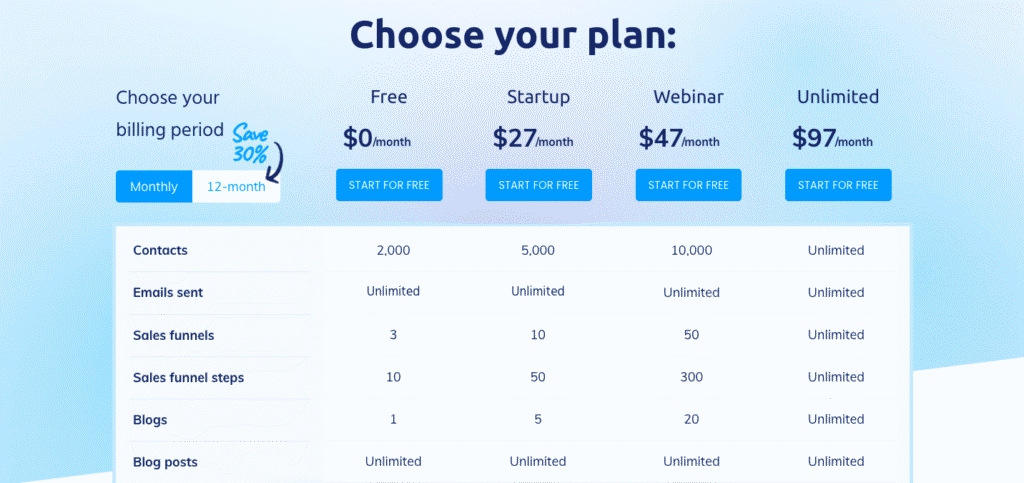
Systeme.io uses a freemium model with a genuinely functional free tier and paid plans starting at $27 monthly. Revenue comes from paid subscriptions, whilst the free plan serves as an extended trial, letting users experience the platform thoroughly before committing financially.
Additionally, Systeme.io invests heavily in affiliate marketing, paying 60% recurring commission to promoters. Rather than spending on traditional advertising, the platform incentivises word-of-mouth recommendations through a generous affiliate programme. This customer acquisition strategy works when the product is genuinely functional because satisfied users naturally promote platforms they value while earning commissions.
Breaking Down What Systeme.io Actually Provides
Understanding what Systeme.io is about requires examining each core function individually to see what’s actually delivered.
Sales Funnel Building Capabilities
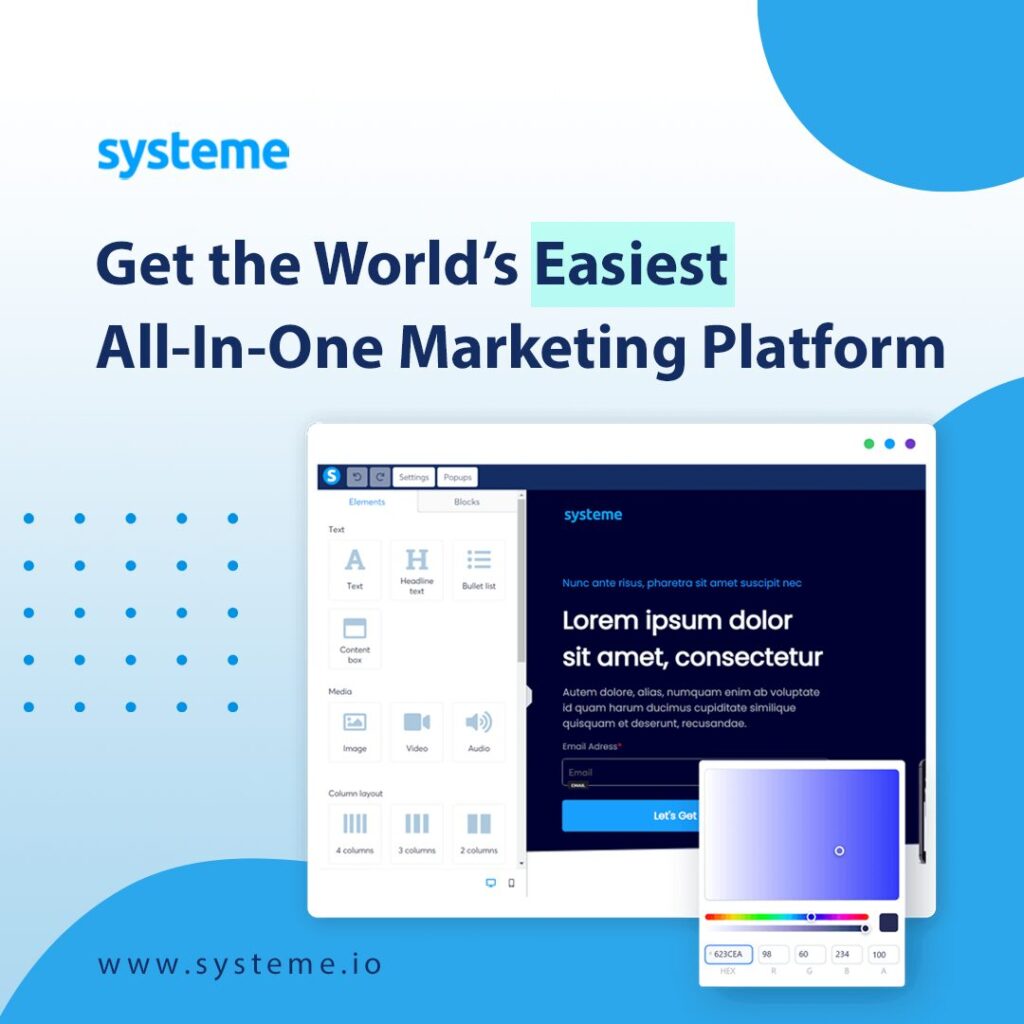
At its heart, Systeme.io is a funnel builder, letting you create multi-step sales sequences guiding visitors from initial contact through purchase and beyond.
What you can build: Opt-in funnels collecting email addresses, sales funnels presenting offers with order forms, webinar funnels with registration and replay sequences, membership area funnels with gated content and virtually any sequence of connected pages you can envision.
Template availability: Pre-built funnel templates exist for common business models, providing starting points you can customise. Templates cover lead generation, product sales, webinar registration, course launches and standard sequences most online businesses use.
Customisation depth: The drag-and-drop editor lets you modify pages within templates or build completely custom pages. Customisation options include layout changes, colour adjustments, text editing, image placement and basic design modifications.
Realistic assessment: The funnel builder genuinely functions for creating straightforward sequences. It’s not as sophisticated as ClickFunnels, with more limited design options and less flexibility. For businesses needing functional funnels without requiring cutting-edge design, it delivers adequate value. For businesses where funnel design directly impacts brand perception, limitations become more problematic.
Email Marketing System
Integrated email marketing handles list building, automation sequences, broadcast emails and basic subscriber management.
Unlimited contacts advantage: Even the free plan includes unlimited email contacts, which is a remarkable differentiator. Most email platforms charge based on subscriber count, making growth expensive. Systeme.io’s unlimited model means your email costs stay flat regardless of list growth.
Automation capabilities: Visual automation builder lets you create sequences triggered by actions like form submissions, purchases or link clicks. You can build welcome sequences, sales sequences, course delivery sequences and other automated email flows.
Broadcast functionality: Send one-time emails to the entire list or specific segments. Basic segmentation lets you target subscribers based on tags, purchases or behaviour, though segmentation is less sophisticated than dedicated email platforms.
Deliverability reality: Email deliverability depends on many factors, including sender reputation and content quality. Systeme.io’s deliverability seems comparable to budget email platforms, though it won’t match premium services like ConvertKit or ActiveCampaign that invest heavily in deliverability infrastructure.
Realistic assessment: The email marketing functions adequately for most small business needs. Unlimited contacts provide genuine value. The system lacks the sophistication of dedicated email platforms, particularly in segmentation, reporting and automation flexibility. For straightforward email sequences and broadcasts, it works fine. For complex segmentation and detailed automation, dedicated platforms offer more.
Online Course Hosting
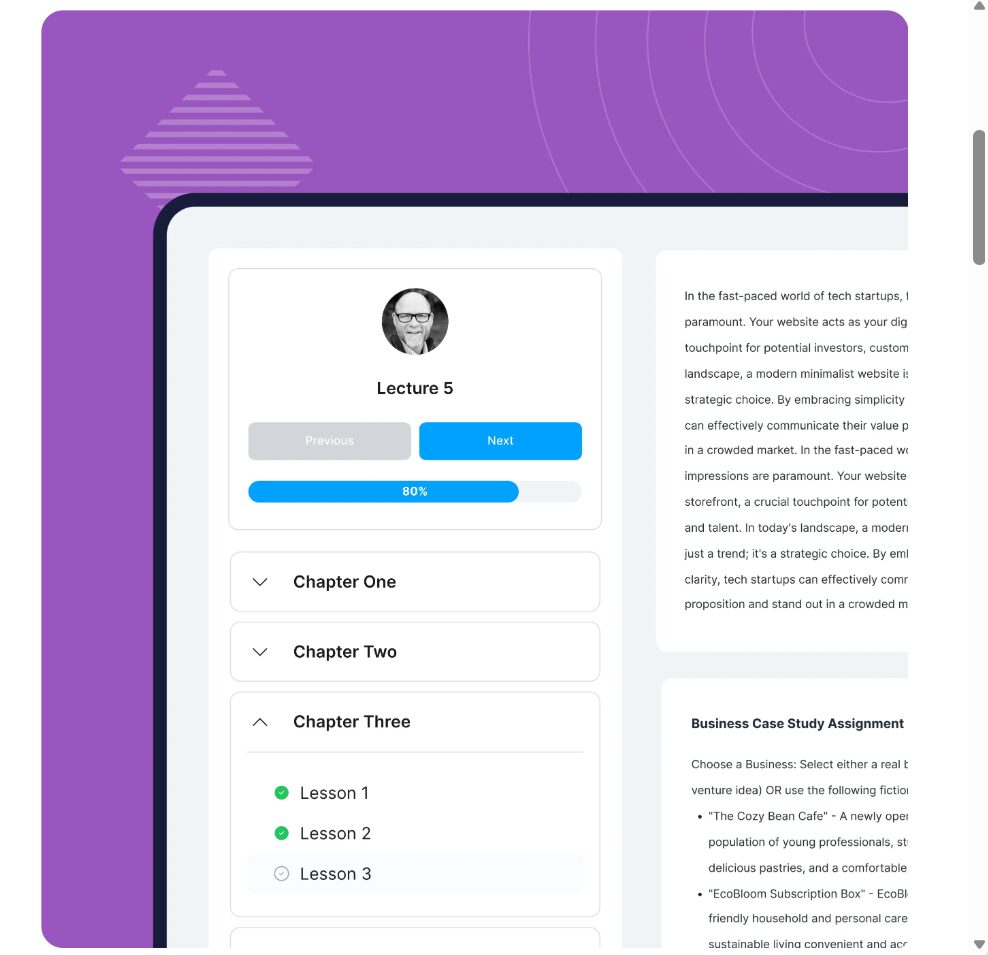
You can create, host and sell online courses directly through Systeme.io, including video content, downloadable resources and student progress tracking.
Course structure: Organise content into courses, modules and lessons with logical progression through material. Upload videos, add text lessons, attach downloadable files and structure learning paths.
Student experience: Students access purchased courses through the member area, with progress tracking showing completed lessons. The interface is functional, though not particularly modern or impressive compared to dedicated course platforms.
Integration advantages: Course access connects automatically with email sequences, letting you deliver lessons via email, send completion reminders and engage students through integrated communication.
Drip content capability: Release course content on schedule rather than providing everything immediately. Control pacing through timed release or manual unlocking of modules.
Realistic assessment: Course hosting genuinely works for delivering educational content. The student interface looks dated compared to Teachable or Kajabi. For straightforward course delivery, particularly when integrated with funnels and email, it’s adequate. For courses where student experience directly impacts retention and completion, dedicated platforms provide a better experience.
Website Building Functionality
Basic website building capability lets you create simple sites within the platform, including home pages, about pages, blog and custom pages.
Template options: Website templates provide starting points for common page types. Customisation uses the same drag-and-drop editor as funnel pages.
Blog capability: Built-in blogging functionality lets you publish articles, organise posts by category and display content through various layouts.
Domain connection: Connect custom domains to websites built in Systeme.io or use the provided subdomain for free hosting.
Realistic assessment: This is genuinely the weakest component of Systeme.io. Website building is quite limited compared to WordPress, Wix, Squarespace or actual website builders. Design options are restrictive. Sites built in Systeme.io look functional but dated. Most serious businesses would want a proper website built on WordPress or a dedicated platform with Systeme.io handling funnels, email and courses.
Affiliate Programme Management
Built-in affiliate management lets you create a referral programme where others promote your products, earning commissions you define.
Affiliate recruitment: Create an affiliate signup page, set commission rates and structure your referral programme without external software.
Tracking system: Accurate attribution tracks which affiliate generated, which sales ensuring proper commission payment. Affiliates get dedicated dashboards showing performance.
Commission flexibility: Set different commission rates for different products or affiliates. Configure one-time commissions, recurring commissions or hybrid structures.
Payment management: Track owed commissions and manage payout process, though actual payment happens outside the platform through your preferred method.
Realistic assessment: Having integrated affiliate management is genuinely useful. It’s not as sophisticated as dedicated affiliate software, but it handles basic referral programmes adequately, particularly when integrated with sales funnels.
Understanding what Systeme.io is about requires examining how pricing works and what you actually receive at each tier.
Free Plan: Permanent, Not Trial
The free plan is a genuinely permanent functional tier, not a limited-time trial. It includes unlimited email contacts, three sales funnels, one course, one website, basic automation and file storage up to 1GB.
The limitations: Systeme.io branding remains on your pages and emails. You cannot use custom domains. You’re limited in the number of funnels and courses you can create. File storage is restricted.
Who it suits: Complete beginners wanting to test the platform thoroughly, very small operations staying within free limits or anyone wanting an extended evaluation before paying.
The reality: This isn’t a crippled, unusable free plan forcing an immediate upgrade. It’s genuinely functional for small-scale operations or extended testing. Many users run legitimate small businesses entirely on the free plan.
Startup Plan at $27 Monthly
This removes Systeme.io branding, allows custom domains, increases to ten funnels and five courses and expands storage to 10GB. Support for 5,000 email contacts and more automation capabilities.
Who it suits: Small businesses launching seriously, entrepreneurs building systematically or anyone needing a branded professional presence without a budget for expensive platforms.
The value proposition: ConvertKit alone costs $29 monthly, providing only email marketing. Systeme.io at $27 adds funnels, courses, websites and automation. The value is legitimately remarkable if the functionality meets your needs.
Webinar Plan at $47 Monthly
Increases to 50 funnels, 15 courses, webinar functionality, evergreen funnels, A/B testing and 10,000 email contacts.
Who it suits: Growing businesses needing webinar capabilities, serious course creators or businesses outgrowing Startup plan limits.
The additions: Webinar functionality is a significant addition for businesses using webinars for sales. Evergreen automation lets you create perpetual funnels. A/B testing enables optimisation.
Unlimited Plan at $97 Monthly
Removes most limits, providing unlimited funnels, courses, contacts and adding priority support plus advanced features.
Who it suits: Established businesses with substantial operations, agencies managing multiple clients or enterprises needing unlimited capacity.
The comparison: ClickFunnels costs $147-297 monthly. Kajabi costs $149-399 monthly. Systeme.io at $97 with unlimited capacity is still dramatically undercutting competitors.
The Catch in Pricing
There isn’t a hidden catch in pricing. What you see is what you pay. The “catch”, if you can call it that, is that you’re getting functional basic versions of tools rather than sophisticated premium versions. You’re trading polish and advanced features for integration and affordability.
Understanding this trade-off prevents disappointment. You’re not getting ClickFunnels for $27. You’re getting a functional alternative adequate for many businesses at a fraction of the cost.
Who Systeme.io Actually Serves Best
Understanding what Systeme.io is about means recognising which businesses it serves well versus those better served by alternatives.
Ideal User Profile: Budget-Conscious Beginners
If you’re launching an online business without substantial startup capital, need multiple integrated tools and prioritise function over sophistication, Systeme.io is potentially an ideal solution.
Why it works: The free plan lets you launch without spending anything. Paid plans at $27-97 provide remarkable value. Integration means you’re not juggling multiple platforms whilst learning business fundamentals.
What you sacrifice: Sophisticated design, advanced features, premium support and polish that expensive platforms provide.
Bootstrapped Entrepreneurs Building Systematically
If you’re building a business whilst working full-time, using every spare hour and every spare dollar strategically, Systeme.io’s value proposition is compelling.
Why it works: Saving $100-200 monthly on tools matters enormously when bootstrapping. Adequate functional tools beat no tools or fragmented free alternatives cobbled together.
What you gain: Integrated system, affordable pricing and adequate functionality, letting you focus on building business rather than managing a complex tool stack.
Course Creators with Straightforward Needs
If you’re creating educational content without requiring a premium student experience or sophisticated features, Systeme.io handles basic course delivery while providing integrated marketing tools.
Why it works: Course hosting plus email marketing plus sales funnels for $27-97 monthly beats paying for separate platforms. Integration means automated course delivery and student communication.
What you sacrifice: Premium student interface, advanced course features and sophisticated reporting that dedicated platforms provide.
Small Service Businesses Needing Simple Funnels
If you provide services and need straightforward lead capture and nurture sequences, Systeme.io delivers everything required without complexity or premium pricing.
Why it works: Most service businesses need basic funnels collecting leads, then nurturing through email until prospects book consultations. Systeme.io handles this adequately.
What you don’t need: Sophisticated features designed for complex product businesses or enterprises.
Who Should Look Elsewhere
Systeme.io is a poor fit for:
Established businesses with premium brand positioning: If brand perception matters enormously and visitors judge credibility partly by funnel design, Systeme.io’s limitations become problems rather than acceptable trade-offs.
Complex businesses requiring advanced features: If you need sophisticated automation, extensive integrations, advanced segmentation or enterprise features, dedicated platforms justify higher costs.
Course creators prioritising student experience: If student experience directly impacts completion rates, revenue and satisfaction, dedicated course platforms like Kajabi or Teachable provide a better experience.
Businesses where design matters enormously: If your funnels must be absolutely cutting-edge in design, ClickFunnels or custom WordPress solutions provide more flexibility.
Software Advice Business Tools provides verified user reviews, helping you compare platforms and make informed decisions.
What Makes Systeme.io Different From Competitors
Understanding what Systeme.io is about requires examining how it differs from established alternatives beyond just pricing.
Systeme.io is intentionally less complex than competitors. This simplicity is a feature, not a bug, for the target audience of beginners and bootstrappers overwhelmed by platforms offering hundreds of features they’ll never use.
Fewer options mean faster learning: New users get a functional platform running more quickly because there’s less to learn and configure.
Simplicity reduces decision paralysis: When platforms offer infinite customisation, users spend hours tweaking rather than launching. Systeme.io’s limitations force forward progress.
The trade-off: Advanced users eventually hit limits, wanting features that don’t exist. This limitation is by design serving a specific audience rather than trying to be everything to everyone.
Integration as Primary Value Proposition
Systeme.io’s main value isn’t having the best email marketing, best funnel builder, or best course platform. It’s having adequate versions of all these tools integrated natively.
Why integration matters: When tools connect natively, data flows automatically. When you’re stitching together separate platforms, integration becomes a project requiring technical knowledge or expensive middleware like Zapier.
The convenience factor: One login, one interface and one monthly payment simplifies business operations substantially, particularly for non-technical entrepreneurs.
The limitation: Native integration means you’re locked into Systeme.io’s versions of each tool. If you need a specific feature from a dedicated platform, you either accept its absence or add a separate tool, defeating the integration purpose.
The Pricing Disruption Strategy
Systeme.io uses aggressive pricing to gain market share from established, expensive platforms. This is a deliberate competitive strategy, not a sign of an inferior product.
Why lower pricing is viable: Lower operational costs, more efficient development and a strategic decision to prioritise volume over premium margins all enable lower pricing whilst remaining profitable.
The market impact: Systeme.io forces competitors to justify premium pricing. When entrepreneurs discover a functional alternative at a fraction of the cost, expensive platforms must demonstrate value exceeding the price difference.
What this means for users: You have a genuine choice between affordable, adequate tools and expensive, sophisticated tools rather than being forced into premium pricing because no alternatives exist.
The Community and Support Model
Systeme.io provides email support with response times varying by plan, but generally adequate, not exceptional. The platform relies heavily on community support through Facebook groups where users help each other.
Advantages: The community often provides faster answers than official support. Users share real implementations and solutions to common challenges.
Disadvantages: Support isn’t as comprehensive or responsive as premium platforms providing priority support or dedicated account managers.
The reality: Support model matches pricing. Budget plans get budget support. For most users, this is adequate, particularly combined with community resources.
Common Misconceptions About What Systeme.io Is
Understanding what Systeme.io is about requires dispelling several common misunderstandings.
It’s Not a ClickFunnels Clone
While Systeme.io includes funnel building like ClickFunnels, it’s a fundamentally different platform with different positioning and philosophy.
ClickFunnels: Premium platform emphasising sophisticated design, extensive templates and an established ecosystem. Positioned for established entrepreneurs willing to invest significantly in tools.
Systeme.io: Affordable platform emphasising integration and accessibility. Positioned for beginners and bootstrappers needing adequate tools without premium investment.
Expecting Systeme.io to replicate ClickFunnels at a lower price creates disappointment. They’re different tools for different audiences.
It’s Not Just For Beginners
While Systeme.io serves beginners well, many established businesses use it successfully when their needs align with the platform’s capabilities.
Who continues using it: Businesses with straightforward models not requiring advanced features, entrepreneurs who value simplicity over sophistication and cost-conscious operators prioritising profitability over having the latest features.
The progression path: Some users start on Systeme.io, planning to upgrade to premium platforms later. Many discover they never need to upgrade because Systeme.io continues meeting needs adequately.
Free Plan Isn’t Bait-and-Switch
The genuinely functional permanent free plan isn’t a strategy to hook users, then make the platform unusable, forcing upgrades. It’s a legitimate tier serving real users running actual small businesses.
Why genuinely free: The Freemium model creates a user base, demonstrates value and converts a percentage to paid plans over time. Users staying on the free plan indefinitely still provide value through word-of-mouth and community participation.
The limitations are reasonable: Branding, limited funnels and no custom domains on the free plan are standard freemium restrictions, not punitive measures making the platform unusable.
It’s Not Too Good To Be True
Dramatic pricing difference from competitors triggers suspicion that something must be wrong. The value is legitimate, not a too-good-to-be-true scam.
Why pricing works: Different business models, lower operational costs and strategic pricing all enable legitimate value that isn’t deceptive marketing hiding major catches.
The catch exists, but it’s transparent: You’re getting functional, basic tools, not sophisticated, premium ones. This trade-off is clear, not hidden. Understanding it prevents disappointment.
G2 Software Comparison provides detailed reviews and side-by-side platform comparisons from verified users.
Realistic Expectations vs Marketing Hype
Understanding what Systeme.io is truly about requires distinguishing between what the platform actually delivers and exaggerated claims from overeager promoters.
What Systeme.io Actually Does Well
Consolidation value: Genuinely provides multiple functional tools in a single integrated platform at a remarkable price point.
Beginner accessibility: Simpler learning curve than complex premium platforms makes this accessible to non-technical entrepreneurs.
Free plan viability: The permanent free tier is legitimately functional for small operations or extended testing.
Integration convenience: Native integration between functions works smoothly, eliminating technical connection challenges.
Affordable scalability: Growing from free to $27 to $97 monthly allows graduated investment matching business growth.
Where Limitations Exist
Design sophistication: Templates and customisation options lag significantly behind premium platforms, particularly in modern aesthetic and flexibility.
Advanced features: Missing numerous advanced capabilities that sophisticated businesses require.
Support responsiveness: The budget support model means slower responses and less comprehensive assistance than premium platforms.
Polish and refinement: The interface and functionality feel less polished than established, expensive alternatives.
Ecosystem maturity: Smaller user base means fewer templates, integrations and third-party resources than established platforms.
Setting Appropriate Expectations
If you expect: ClickFunnels-level sophistication at Systeme.io pricing, you’ll be disappointed.
If you expect: Adequate functional tools consolidated affordably, you’ll likely find substantial value.
The key distinction: Systeme.io delivers what it actually promises when you understand promises correctly, rather than believing exaggerated affiliate promotions.
How Affiliate Marketing Affects Perception
High affiliate commissions create an incentive for exaggerated promotion. Many promoters present Systeme.io as a perfect solution for everyone, matching or exceeding all competitors.
The reality: Systeme.io is an excellent solution for a specific audience with specific needs. It’s not universally superior to all alternatives in all situations.
Critical evaluation: Distinguish between reviews acknowledging trade-offs and limitations versus pure promotion, ignoring any drawbacks. Honest assessment helps more than uncritical cheerleading.
Getting Started With Systeme.io
Understanding what Systeme.io is about becomes clearer through actual hands-on experience rather than just reading about it.
Testing With Free Plan
The best way to understand whether Systeme.io suits your needs is by using the free plan for an extended period, actually building funnels, email sequences and testing functionality.
What to build: Create a simple opt-in funnel capturing emails, build a basic email sequence and experiment with the interface. This hands-on experience reveals whether the platform feels usable for your specific situation.
Testing timeline: Spend at least 2-4 weeks actually using the platform, not just signing up and looking around. Real usage reveals usability and limitations better than brief exploration.
What you learn: Whether the interface makes sense to you, whether the limitations feel acceptable or frustrating and whether the value proposition matches your needs.
Evaluating Paid Plans
If the free plan proves functional but limited, testing the $27 plan for one month provides a complete experience with minimal financial risk.
What you gain: Custom domains, removed branding, expanded limits and a fuller picture of platform capabilities.
Decision timeline: One month provides adequate experience to determine whether Systeme.io suits long-term needs or whether you should investigate alternatives.
Risk assessment: $27 risk is minimal compared to the potential value of finding an affordable platform meeting your needs for years.
Comparing to Alternatives Simultaneously
Test Systeme.io alongside one or two alternatives using respective free trials to make direct comparisons.
Suggested comparisons: ClickFunnels offers a 14-day trial. Kajabi offers a similar trial. Test simultaneously to feel actual differences.
What you discover: Some people find Systeme.io adequate and prefer saving money. Others discover that premium platforms justify higher costs for their specific needs. Both conclusions are valid.
Understanding what Systeme.io is about includes evaluating whether the platform will exist long-term and continue serving users reliably.
Platform Growth and Stability
Systeme.io has grown substantially since its 2018 launch. User base continues expanding. The platform receives regular updates, adding features and improvements.
Positive indicators: Consistent development, growing user base and apparent financial sustainability all suggest a legitimate business, not a fly-by-night operation.
Reasonable concerns: The newer platform lacks a decade-plus track record of established competitors. Lower pricing raises questions about long-term sustainability, though the business model appears viable.
Data Portability and Exit Strategy
Critical consideration is whether you can leave Systeme.io, taking your data if you outgrow the platform or find a better alternative.
What you can export: Email lists, customer data and content can be exported. This portability means you’re not permanently locked into a platform.
Migration complexity: Moving to a different platform requires effort, rebuilding funnels, reconnecting automation, and potentially losing some historical data. This switching cost is real but not insurmountable.
The practical reality: Most businesses stay on platforms that work adequately even when theoretically better alternatives exist because switching costs exceed benefits. If Systeme.io meets needs, you’ll likely stay regardless of other options.
Feature Development Trajectory
The platform regularly adds features and improvements based on user feedback and the competitive landscape.
Recent additions: A/B testing, improved automation, enhanced templates and various feature expansions demonstrate ongoing development.
The question: Whether the development pace and direction continues meeting user needs or whether established competitors maintain an insurmountable advantage through larger development resources.
Current assessment: Development seems adequate for the platform serving the target audience, though it may not match the pace of premium competitors with larger teams.
Making Your Decision About Systeme.io
After understanding what Systeme.io is truly about, including genuine strengths, realistic limitations and appropriate use cases, you can make an informed decision about whether it suits your specific situation.
It’s Right For You If
You’re launching an online business without substantial capital, you need multiple integrated tools working together seamlessly, you prioritise function over sophisticated design, you want a simple platform you can learn quickly without overwhelming complexity, and you appreciate the remarkable value of consolidated tools at affordable pricing.
Look Elsewhere If
You require cutting-edge design and extensive customisation for brand positioning, you need advanced features that Systeme.io simply doesn’t provide, you prioritise premium student experience for course delivery, you expect comprehensive responsive support, or you have a budget for premium tools and want the absolute best-in-class for each function.
The Core Question
The decision ultimately comes down to whether adequate integrated tools at a remarkable price point serve your needs better than sophisticated, separated premium tools at substantially higher combined cost.
No universal answer exists: Some businesses genuinely need premium tools and should invest accordingly. Other businesses thrive using affordable, adequate alternatives, investing saved money in business growth rather than tools.
Your specific situation determines fit: Honest assessment of your actual needs, realistic evaluation of your budget and clear understanding of acceptable trade-offs all guide appropriate decisions.
Rather than endlessly researching and debating, test Systeme.io directly using the free plan. Extended hands-on experience answers fit questions far better than any review possibly can.
The investment: Time spent testing. The free plan costs nothing financially.
The return: A clear understanding of whether the platform suits your needs based on actual experience, not theoretical assessment.
The outcome: Either you discover a valuable, affordable solution or you confirm that premium alternatives justify higher investment for your specific situation. Both outcomes provide valuable clarity.
Understanding What Systeme.io Is Truly About
After examining the features, the pricing structure, the ideal users and the realistic capabilities, a clear picture emerges of what is Systeme.io about beyond the marketing claims and the affiliate promotion. The platform is a deliberate attempt to democratise the online business tools by providing an affordable, integrated alternative to the expensive established platforms that serve entrepreneurs who need adequate functional capabilities without requiring the sophisticated features or the premium pricing that create barriers to entry and prevent many aspiring business builders from launching at all. Systeme.io succeeds at this mission by offering genuinely functional versions of the essential business tools that are consolidated into a single platform at pricing that makes online business launch financially accessible, whilst accepting the trade-offs in sophistication, polish and advanced features that the premium platforms provide to their users.
The platform serves a specific audience remarkably well, including the beginners who are launching their first businesses, the bootstrapped entrepreneurs who are building strategically with limited capital, the straightforward businesses without complex needs and anyone who values the integration and the affordability over having the cutting-edge features and the absolute best-in-class tools for each individual function. Understanding whether you fit into this audience profile determines whether Systeme.io represents the ideal solution or whether the premium alternatives justify a substantially higher investment for your specific situation and your particular requirements. The question is not whether Systeme.io is objectively good or bad, but whether it matches your genuine needs given your actual constraints and your priorities.
Answering what is Systeme.io about ultimately means recognising that the platform is neither a miraculous solution that replaces all of the expensive alternatives for everyone nor an inadequate, cheap option that you should avoid at all costs, but rather a legitimate middle-market solution that serves a specific audience extremely well whilst being a poor fit for the businesses with different needs or priorities. Test the platform directly through the free plan, evaluate honestly whether the capabilities and the limitations suit your specific situation and make a decision based on the real experience rather than speculation about whether the remarkable pricing means something must be wrong. Your hands-on testing will provide far more valuable insight than any amount of research or review reading ever could about whether Systeme.io represents the right tool for building your specific business, given your unique combination of needs, constraints, priorities and preferences that distinguish your situation from everyone else who is evaluating the identical question about the platform fit and the appropriateness for their own circumstances.
Build Income On Your Terms Without Workplace Barriers
Finding the best affiliate marketing for disabled people means navigating advice written by and for able-bodied people who’ve never needed to structure work around chronic pain, fatigue, medical appointments or physical limitations that traditional employment ignores, whilst expecting you to somehow perform at the same levels as colleagues whose bodies cooperate reliably. Career advice assumes you can work consistent hours, attend in-person meetings, maintain steady energy levels and separate work from health management as if managing disability isn’t itself full-time invisible labour consuming energy and time that non-disabled people use for advancing careers or building businesses.
What makes finding genuine opportunities particularly difficult is that most online business advice ignores disability entirely or treats it as a minor inconvenience requiring slight adjustments rather than a fundamental reality reshaping everything about how you need to structure income-generating work. Gurus insist you just need to work harder and stop making excuses, whilst completely failing to understand that your body’s limitations aren’t character flaws or commitment issues but actual physical realities requiring different approaches. Meanwhile, genuinely accessible strategies exist, but they’re buried beneath advice written by people whose biggest concern is choosing between standing desks and exercise balls rather than whether they’ll have enough energy to work at all today.
This guide examines the best affiliate marketing for disabled people by acknowledging both the genuine barriers you face from disabilities and the real opportunities that exist when you build businesses specifically designed around your actual capabilities rather than forcing yourself into models that assume consistent able-bodied functioning. Everything here generates income whilst respecting that your energy, pain levels, cognitive function and physical capabilities vary in ways that make traditional work structures impossible, regardless of how motivated or capable you are.
Understanding Your Unique Position
Before examining specific strategies, it’s worth acknowledging what distinguishes building an affiliate marketing business whilst managing disability.
Your ability to work varies day to day or even hour to hour in ways that traditional employment cannot accommodate. Good days might allow several productive hours, whilst bad days might permit nothing beyond basic self-care. This unpredictability makes commitments to clients or schedules nearly impossible.
Affiliate marketing offers a genuine solution because you control your schedule completely. Work happens when you’re capable rather than according to rigid structures. Content you create during good periods continues generating income during times when you cannot work at all.
Energy Management Is a Critical Business Consideration
Every activity consumes limited energy reserves. Traditional employment forces you to spend energy commuting, maintaining workplace presence and performing tasks that could be accomplished far more efficiently if you controlled the environment and timing. This energy waste leaves nothing for actual productive work or personal life.
Affiliate marketing from home eliminates commuting energy cost, workplace performance energy cost and countless other energy drains that seem minor to able-bodied people but are genuinely prohibitive when you’re managing limited energy budgets. You invest energy directly into income-generating activities rather than workplace theatre.
Medical Needs Cannot Be Postponed
Doctor appointments, treatments, therapy sessions and managing medications all require substantial time. Traditional employers view these as inconveniences disrupting productivity. You know they’re non-negotiable survival activities that employment must accommodate rather than compete with.
Affiliate business works around medical needs rather than forcing you to choose between health and income. Schedule work when you’re available rather than trying to fit medical care into brief lunch breaks or sacrificing treatment to meet employment demands.
Accessibility Features Are Your Requirements, Not Optional Preferences
You need specific software, equipment or environmental conditions to function. Traditional employment treats these as expensive accommodations granted reluctantly after bureaucratic battles. You know they’re simply the tools required for you to work effectively.
Building your own business means implementing whatever accessibility features you need without asking permission or proving medical necessity to sceptical administrators. Voice-to-text software, screen readers, ergonomic equipment or whatever tools you require become straightforward business expenses rather than contested accommodations.
These approaches build income-generating assets whilst accommodating unpredictable capabilities and energy limitations.
Writing-Based Affiliate Content During Capable Periods
Creating written content during times when you’re capable builds assets that generate income indefinitely, including during periods when you cannot work. Blog posts, comparison articles and reviews all continue attracting traffic and generating commissions regardless of your current functioning level.
Written content accommodates various disabilities better than video or audio content. You can work at your own pace, edit extensively and use assistive technologies that make writing accessible even with physical limitations affecting typing or cognitive limitations affecting organisation.
Income potential: Modest blogs generate $400-1,800 monthly after 12-18 months of accumulated content created during capable periods. Established blogs generate $2,000-8,000+ monthly with content continuing to work during times when you cannot create new material.
Getting started: Choose a specific topic where you have knowledge or a genuine interest. Create content during periods when you’re capable without forcing work during times when you’re not. Use voice-to-text software, screen readers or whatever assistive technology makes writing accessible for your specific situation. Focus on quality over quantity since your output will naturally be limited by health realities.
Time requirements: Work only when you’re capable. During good periods, you might manage 5-10 hours weekly. During difficult periods, you might accomplish nothing. Content created during productive times generates income during both periods.
Why this works for disabled people: Complete flexibility, working only when capable. Content continues working when you cannot. Written format accommodates various assistive technologies. No performance or consistency requirements beyond what you can actually manage. Income grows even when health prevents work.
Realistic timeline: Timeline extends longer than for able-bodied people simply because you’ll have periods of no productivity. Expect 18-24 months of accumulated content before meaningful income begins. Growth accelerates once a foundation exists, as content compounds even when you cannot contribute new material regularly.
Building an email list and creating prepared email sequences in advance generates income through recommendations sent automatically, regardless of your current functioning. You create content during capable periods, then schedule it to deploy over months without requiring ongoing work.
This approach separates content creation from content delivery, letting you work in bursts when possible, whilst maintaining a consistent presence automatically.
Income potential: Email lists of 1,000-3,000 subscribers generate $300-2,000 monthly through strategic affiliate promotions in prepared sequences. Lists of 5,000+ subscribers generate $1,500-6,000+ monthly.
Getting started: Create a valuable lead magnet during a capable period. Build a simple landing page collecting emails. Write an email sequence in advance covering several weeks or months. Set up automation to send emails consistently regardless of your current capability. Add new content when possible, but don’t require constant creation.
Time requirements: Initial sequence creation requires 20-40 hours, but can be spread over whatever timeline your health allows. Ongoing additions happen only when you’re capable. Automation handles everything between your contributions.
Why this works for disabled people: Prepare content during capable periods for automatic delivery during incapable periods. No real-time requirements or consistency demands. Automation respects your variable functioning. Income continues regardless of current health status.
Realistic timeline: Building a list requires consistent lead magnet promotion, which might take 12-24 months, given variable working capability. Income begins once a few hundred engaged subscribers exist. Growth continues even during non-productive health periods.
Curated Resource Lists and Link Collections
Creating carefully curated collections of resources, tools or products in specific categories generates value whilst requiring less intensive work than comprehensive original articles. You’re organising and evaluating rather than creating entirely original, lengthy content.
This lighter approach accommodates limited energy whilst still providing genuine value that generates affiliate income when people purchase recommended products.
Income potential: Well-targeted resource lists generate $200-1,000 monthly each depending on niche and traffic. Collection of 15-20 strong resource lists generates $1,500-8,000+ monthly.
Getting started: Choose specific resource categories where your knowledge or experience provides a valuable perspective. Research thoroughly during capable periods. Create organised collections with brief explanations. Update periodically when possible, but don’t require constant maintenance.
Time requirements: Individual resource lists require 3-6 hours, depending on depth. Can be completed in small chunks spread over whatever timeline your capabilities allow.
Why this works for disabled people: Less intensive than full articles, whilst providing genuine value. Can be completed in short working periods. Doesn’t require consistency or regular updates. Your lived experience with accessibility and tools provides a valuable perspective that others lack.
Realistic timeline: Resource lists begin generating traffic within 3-6 months. Income grows as collection expands, even if expansion happens slowly due to health limitations.
Low-Energy Affiliate Strategies
These approaches require minimal ongoing energy once established whilst generating income.
Creating detailed comparison posts between products serves people making purchase decisions whilst requiring substantial effort only during initial creation. Once published, comparison content generates traffic and income for months or years with minimal maintenance.
Focus on comparing products you understand from personal experience or thorough research completed during capable periods. Your comparison continues working indefinitely after a one-time creation effort.
Income potential: Individual comparison posts generate $50-400+ monthly, each depending on products and traffic. A library of 20-30 comparison posts generates $1,500-6,000+ monthly.
Getting started: Identify products in your niche where people actively compare options. Research thoroughly during capable periods. Create detailed, honest comparisons explaining real differences. Update only when products change significantly, which happens infrequently.
Time requirements: Comprehensive comparisons require 8-15 hours each during creation, but almost nothing ongoing. Spread creation across whatever timeline your health permits.
Why this works for disabled people: High-effort creation but almost zero ongoing energy required. Content works indefinitely after publication. Can pace creation according to capabilities. No consistency requirements. Income continues during incapable periods.
Realistic timeline: Comparison content begins generating meaningful traffic within 4-8 months. Income compounds as the library grows, even if growth is slow due to health limitations.
Affiliate Review Sites With Infrequent Updates
Building review sites focused on specific product categories creates an income source requiring minimal ongoing work once the foundation exists. Products don’t change constantly, meaning reviews remain valid for extended periods without updates.
Choose product categories where changes happen slowly, like books, certain tools or established software, rather than rapidly changing technology requiring constant updates.
Income potential: Review sites with 25-40 quality reviews generate $800-3,500 monthly. Established sites generate $3,000-10,000+ monthly.
Getting started: Choose a product category with relatively stable offerings. Create thorough reviews during capable periods. Focus on quality over quantity since your output will be limited. Allow extended timelines for building review library.
Time requirements: Quality reviews require 6-12 hours each, but you work only when capable. Building an adequate review library might take 12-24 months, given health realities, but the content works continuously once created.
Why this works for disabled people: Create during capable periods for ongoing income during incapable periods. Infrequent updates suit energy limitations. Can build slowly without pressure. Each review continues generating value indefinitely.
Realistic timeline: Review sites begin generating meaningful income months 12-18 once an adequate review library exists. Timeline extends beyond able-bodied expectations, but income becomes increasingly passive.
Evergreen Tutorial and Guide Content
Creating tutorials and guides that solve specific problems generates value whilst requiring minimal updating. Once you’ve explained how to accomplish something, that content remains useful indefinitely, particularly for fundamental skills or processes that don’t change rapidly.
Your experience navigating accessibility challenges whilst accomplishing tasks provides a unique, valuable perspective that others lack.
Income potential: Tutorial content library generates $500-2,500 monthly, depending on niche and traffic. Comprehensive tutorial sites generate $2,000-8,000+ monthly.
Getting started: Identify problems in your niche where solutions aren’t adequately explained. Create step-by-step tutorials during capable periods. Recommend affiliate products as solutions where genuinely helpful. Focus on fundamental evergreen topics rather than rapidly changing subjects.
Time requirements: Quality tutorials require 5-10 hours each. Create only when capable, without forcing work during difficult periods. Once created, they work indefinitely.
Why this works for disabled people: Evergreen nature means almost zero maintenance. Create during good periods for ongoing value. Your accessibility experience provides a unique perspective. No consistency requirements. Income continues regardless of current functioning.
Realistic timeline: Tutorial content begins generating traffic within 3-6 months. Income grows as the library expands, even if expansion is slow and irregular due to health realities.
Voice-to-text technology enables content creation for people with physical limitations affecting typing. Modern speech recognition software has improved dramatically, making this a viable approach for substantial content creation.
Dragon NaturallySpeaking, Google Docs voice typing and various mobile dictation apps all provide accessible content creation methods. You speak your content during capable times rather than requiring physical keyboard interaction.
Screen Readers and Alternative Navigation
Screen readers like JAWS, NVDA or built-in operating system tools make affiliate marketing accessible for blind and visually impaired people. Most affiliate platforms, content management systems and necessary business tools work with screen readers.
Research platforms for screen reader compatibility before committing. Focus on affiliate programmes and tools that prioritise accessibility rather than fighting with inaccessible systems.
Flexible Scheduling and Batch Work Approaches
Structure your affiliate business around your actual functioning patterns rather than trying to force regular schedules that your disability won’t permit. Batch content creation during good periods. Accept that some weeks will be completely unproductive, whilst others allow substantial work.
This irregular approach still builds successful businesses because affiliate marketing doesn’t require consistent output. Content created sporadically generates income just as effectively as content created on rigid schedules once it exists.
Minimal Physical Workspace Requirements
Affiliate marketing works from bed, from adaptive furniture or from whatever physical position your disability requires. No commuting, no workplace presence requirements and no physical performance expectations that ignore your body’s actual needs.
Set up workspace exactly as you need it without concern for appearance or traditional office standards. Comfort and accessibility matter infinitely more than looking professional in a space nobody will see.
Managing Financial Support Systems
Navigating affiliate income whilst receiving disability benefits requires specific considerations.
Understanding Income Limits and Reporting
Many disability benefit programmes have strict income limits. Affiliate marketing income might affect benefit eligibility once it exceeds specific thresholds. Research your specific programme’s rules thoroughly before building substantial income.
Some programmes allow trial work periods or have graduated benefit reduction as income increases rather than immediately eliminating all support. Understanding these rules prevents accidentally losing benefits before replacement income is stable.
Distinguishing Between Employment and Self-Employment Income
Some benefit programmes treat self-employment income differently from employment income. Affiliate marketing is typically self-employment, allowing certain business expense deductions before calculating countable income.
Consult with a benefits specialist or an attorney familiar with disability benefits before your affiliate income approaches reportable levels. This expertise prevents mistakes that could jeopardise benefits.
Planning for Sustainable Transition
If your goal is to eventually replace disability benefits with affiliate income, plan conservatively for an extended transition period. Benefits provide security whilst you build income. Losing them prematurely before affiliate income is stable creates catastrophic risk.
Build affiliate income substantially above benefit levels before considering transition. Include a buffer for income variability and health periods when you cannot work. Better to maintain benefits longer than risk losing them too soon.
Protecting Benefit Eligibility During Building Period
Keep affiliate income below reportable thresholds whilst building a foundation. Focus first on creating content and systems that will generate income rather than immediately trying to maximise earnings. Build properly, then scale income deliberately whilst managing benefit implications.
Different disabilities require different accommodations in affiliate marketing approaches.
Chronic Fatigue and Energy-Limiting Conditions
Focus on content creation that can be completed in short bursts during brief capability windows. Micro-tasks of 15-30 minutes suit severe energy limitations better than extended work sessions. Batch similar tasks, reducing mental switching costs.
Prioritise content that generates passive income indefinitely from one-time creation rather than requiring ongoing maintenance. Accept that your timeline will be extended, but remain viable.
Chronic Pain and Physical Limitations
Optimise workspace ergonomics extensively. Invest in adaptive equipment, dictation software or whatever tools reduce physical demands. Structure work around pain management schedules rather than fighting through pain periods.
Voice-based content creation eliminates typing and physical demands. Curated content and link collections require less intensive work than original, lengthy articles, whilst still providing value.
Cognitive and Mental Health Disabilities
Use extensive templates, checklists and documented processes for repetitive tasks. Structure the environment to minimise cognitive demands beyond core creative work. Break projects into the smallest possible components.
Accept that productivity will vary with cognitive function and mental health. Build during good periods. Rest during difficult periods without guilt. Content created during capable times continues working during incapable periods.
Mobility Limitations and Physical Disabilities
Remote affiliate work eliminates commuting and workplace physical demands entirely. Structure the workspace exactly as your mobility needs require. Use adaptive equipment without concern for appearance or conforming to able-bodied standards.
Focus on affiliate strategies requiring zero physical presence or travel. Everything can be accomplished from wherever you are with whatever adaptive equipment you need.
Realistic Timeline Expectations
Building affiliate income whilst managing disability requires different timelines than able-bodied expectations acknowledge.
First Year: Interrupted Foundation Building
Year one is foundation building, interrupted by health realities. You’ll have productive periods creating content, followed by unproductive periods where nothing happens. This irregular progress is normal rather than failure.
Expect $0-800 monthly by month 12, acknowledging that the timeline extends significantly when health prevents consistent work. You’re building assets that will generate income long-term, even if building is slower than able-bodied comparisons.
Year Two: Compound Effects Begin Despite Interruptions
Accumulated content begins generating meaningful traffic and income even when health prevents new creation. This is where the passive income concept becomes real as work completed during year one continues generating income during year two, regardless of your productivity level.
Many disabled affiliate marketers report $500-2,500 monthly during year two as foundation content matures. This income continues during both productive and unproductive periods, providing stability that traditional employment never offered.
Years Three Plus: Sustainable Passive Income
Established content-based affiliate businesses generate $1,500-6,000+ monthly for disabled people who’ve built systematically within their actual capabilities. This income continues during hospitalisations, treatment periods or extended incapable phases, providing security impossible in traditional employment.
Some disabled affiliates reach this level faster, whilst others take longer, depending on specific disability impacts. Timeline variation is normal rather than an indication of inadequate effort or commitment.
Understanding the best affiliate marketing for disabled people means recognising that genuine opportunities exist for building income specifically designed around your actual capabilities and limitations, rather than forcing yourself into employment models that assume consistent able-bodied functioning you simply cannot provide. The strategies that work are those respecting that your energy, cognitive function, pain levels and physical capabilities vary unpredictably whilst building assets that generate income during both capable and incapable periods rather than requiring consistent performance.
What matters now is choosing specific approaches from this guide that accommodate your particular disability realities rather than attempting strategies requiring capabilities you lack or consistency you cannot maintain. Build around what you actually can do during times when you can do it, rather than trying to match able-bodied productivity standards that ignore your health realities. Accept extended timelines whilst trusting that content created during capable periods generates income during incapable periods, creating stability that traditional employment would never accommodate.
The best affiliate marketing for disabled people succeeds not by ignoring disability or pretending limitations don’t exist but by designing businesses specifically around real constraints, whilst leveraging whatever capabilities you do possess during times when you possess them. Begin this week with whatever action your current functioning permits, whether that’s researching niche options, outlining potential content or simply learning about affiliate marketing basics. Your pace will differ from able-bodied people, and your timeline will extend beyond standard expectations, but your business will be designed for your actual life rather than requiring you to conform to structures that ignore your reality. Progress at whatever pace your health permits, whilst building assets that will generate income during both your best and worst health periods, creating security and income impossible in employment demanding consistent functioning you cannot reliably provide.
Understanding the best affiliate marketing for busy people over 40 means recognising that most online business advice is written by and for 25-year-olds with no children, minimal responsibilities and unlimited time to experiment with strategies that might work eventually if you can just hustle harder and sacrifice everything else in your life for the next two years. The relentless message is that success requires posting on seven social media platforms daily, creating endless content, engaging with audiences for hours and treating affiliate marketing as a full-time job even though you already have a full-time job, plus family obligations, plus the accumulated responsibilities that come with being an adult who’s been living and working for four decades.
What makes finding realistic affiliate marketing strategies particularly difficult at this life stage is that you’re simultaneously too experienced to believe obvious nonsense, whilst too busy to waste time experimenting with approaches that sound plausible but don’t actually work. You recognise immediately when advice is impractical or when timelines being promised are completely divorced from reality. You’ve watched enough business trends come and go to be appropriately sceptical about anything promising passive income within weeks. Simultaneously, you have roughly ten hours per week available if you’re lucky, and those hours need to produce actual results rather than just keeping you busy with activities that feel productive without generating revenue.
This guide examines the best affiliate marketing for busy people over 40 by acknowledging both the advantages you bring from decades of professional experience and the genuine constraints you face from actual adult responsibilities that cannot be ignored or postponed indefinitely while you build online businesses. Everything here focuses on strategies that work within realistic time commitments of 8-12 hours weekly, whilst leveraging the judgment, communication skills and strategic thinking you’ve developed over your career, rather than requiring you to master completely foreign skills like video editing or social media algorithm manipulation.
Understanding Your Strategic Position
Before examining specific strategies, it’s worth acknowledging what distinguishes your situation from younger people building affiliate businesses.
Limited Time Is Your Primary Constraint
You have roughly 10 hours weekly available if you’re managing well and perhaps 15 hours if you’re willing to sacrifice sleep or leisure time you genuinely need for maintaining sanity. This isn’t failure or lack of commitment. It’s the reality of having an established career, family responsibilities, ageing parents who need support and accumulated obligations that simply didn’t exist when you were 25 with nothing but time.
This constraint means strategies requiring 30-40 hours weekly to produce results simply don’t work for you, regardless of how effective they might be for people with unlimited time. You need approaches that produce meaningful results within your actual available hours rather than theoretical approaches that work brilliantly if only you had different life circumstances.
Professional Experience Is Your Competitive Advantage
You’ve spent 20+ years developing expertise, communication skills and understanding of how businesses actually function. This accumulated knowledge translates directly into affiliate marketing advantages that younger marketers cannot replicate, regardless of their energy or technical skills.
You understand what makes offers credible versus suspicious. You can write with authority because you’ve actually navigated professional challenges rather than just researching topics superficially. You recognise quality products versus hype because you’ve encountered both repeatedly throughout your career. These judgment capabilities are enormous advantages when applied strategically.
Financial Stability Enables Better Decisions
Most people over 40 have some financial foundation, even if money remains tight. You’re not forced to accept the first opportunity regardless of quality simply because you desperately need immediate income. You can make strategic decisions about which affiliate programmes to promote based on genuine quality rather than which ones pay fastest.
This stability means you can invest modest amounts in necessary tools without financial panic, whilst also having the patience to build properly rather than chasing quick money through questionable methods that damage the reputation you’ve spent decades building.
Credibility Comes Built In
Grey hair and decades of professional experience signal competence and reliability to audiences in ways that youth cannot replicate. When you recommend products or explain strategies, people assume you’re speaking from genuine experience rather than just repeating what you learned from some guru’s course last month.
This built-in credibility is particularly valuable in affiliate marketing, where trust determines whether people actually purchase through your recommendations. Your age and experience are assets rather than liabilities when positioned correctly.
Content-Based Affiliate Marketing That Compounds
These strategies build assets that continue working whilst you’re sleeping, working or managing other life responsibilities.
Focused Niche Blog With Strategic Content
Building a blog around a specific topic where you possess genuine knowledge creates a foundation for affiliate income that compounds over time. Rather than trying to cover everything about a massive topic, you dominate a specific corner of a larger market where your expertise and perspective are genuinely valuable.
The key is choosing a topic narrow enough that you can actually become recognised authority, whilst broad enough that affiliate programmes and products worth promoting exist. Your decades of professional or life experience almost certainly position you as an expert in specific areas where beginning bloggers have nothing meaningful to contribute.
Income potential: Modest blogs generate $500-2,000 monthly after 12-18 months of consistent work. Successful blogs generate $3,000-8,000+ monthly, with some exceeding $10,000 monthly, though this requires both quality and some luck choosing exactly the right niche.
Time requirements: Initially, 10-12 hours weekly creating content and building a foundation. Once established, 6-8 hours weekly, maintaining and expanding. Work happens entirely on your schedule without deadlines unless you create them.
Getting started: Choose a specific topic where your knowledge exceeds available content quality. Research keywords people actually search using free tools like Google Keyword Planner or Ubersuggest. Create 25-30 comprehensive articles providing genuinely helpful information based on your real experience. Join affiliate programmes relevant to your niche. Build an email list from day one.
Realistic timeline: Expect minimal income first 6-9 months whilst building content and authority. Growth accelerates months 10-18 as search rankings improve and reputation develops. Substantial income typically appears in years 2-3 with consistent effort, though many successful bloggers report months 15-20 as inflexion points.
Why this works over 40: Your experience makes you genuinely credible rather than just repeating what others have said. You understand your topic deeply rather than superficially. Professional communication skills developed over a career translate directly into quality content. Limited time actually helps by forcing you to focus on substance rather than endless content that adds no value.
Building an email list of people who’ve specifically opted in to hear from you creates an owned audience independent of platform algorithms or search engine changes. Email remains the highest-converting marketing channel, consistently outperforming social media for actual revenue generation.
Rather than building a massive social media following, hoping some small percentage might eventually purchase something, you’re building a smaller list of genuinely interested people who chose to hear from you, making them far more receptive to recommendations.
Income potential: Email lists of 1,000-3,000 engaged subscribers generate $500-3,000+ monthly through strategic affiliate promotions. Lists of 10,000+ subscribers generate $3,000-15,000+ monthly, depending on engagement quality and promotion frequency.
Time requirements: Building a list requires creating a valuable lead magnet and consistent content to drive signups. Ongoing email writing requires 4-6 hours weekly, including content creation and list management.
Getting started: Create a genuinely valuable free resource solving a specific problem your audience faces. Build a simple landing page promoting this resource and collecting emails. Drive traffic through blog content, strategic guest posting or modest paid advertising budget. Write regular emails providing value whilst occasionally recommending affiliate products that genuinely serve your audience.
Realistic timeline: Building a list to 1,000 subscribers typically takes 6-12 months of consistent effort. Revenue begins once the list exceeds a few hundred genuinely engaged subscribers. Income grows substantially as the list expands and you refine the promotional approach.
Why this works over 40: Email writing leverages professional communication skills you’ve developed over a career. Building a smaller, engaged audience suits limited time better than chasing viral social media reach. An owned list provides business stability. Your judgment about quality products prevents damaging trust through poor recommendations.
Strategic Product Comparison Content
Creating comprehensive comparisons of products in your niche attracts people actively researching purchases rather than just casual browsers. These high-intent visitors convert at substantially higher rates than general traffic, making this an extremely time-efficient approach.
You’re not creating entertainment or building a personal brand. You’re providing genuine value to people facing specific decisions while earning commissions when they purchase through your recommendations.
Income potential: A Single comparison post can generate $100-500+ monthly indefinitely from affiliate commissions. A collection of 15-20 strong comparison posts generates $2,000-8,000+ monthly, with some individual posts substantially exceeding these figures.
Time requirements: Creating comprehensive comparison content requires 6-10 hours per article, including research, testing where possible and writing. Building a library of 20 comparison posts requires 120-200 total hours spread over 6-12 months.
Getting started: Identify products in your niche that people actively compare when making purchase decisions. Research thoroughly, understanding genuine differences, strengths and weaknesses. Create detailed, honest comparisons, helping people make informed decisions. Include affiliate links for all products mentioned. Update periodically as products change.
Realistic timeline: Individual comparison posts begin generating income within 2-4 months as they rank in search results. Income compounds substantially as you add more comparison content and existing posts mature in rankings.
Why this works over 40: Your judgment and analytical skills developed through professional life translate directly into quality comparisons. Honest assessment based on genuine evaluation builds trust that younger marketers struggle to establish. Time-efficient approach suits limited availability. Content continues working indefinitely from a one-time creation effort.
Authority Hacker provides detailed case studies and strategies for building successful affiliate marketing businesses.
Platform-Based Strategies Requiring Minimal Time
These approaches leverage existing platforms rather than requiring you to build everything from scratch.
YouTube Review Channel Without Face Filming
Creating product review videos using screen recordings, voiceovers with product footage or simple slideshow presentations builds audiences whilst keeping you anonymous if you prefer. Review and comparison content performs exceptionally well on YouTube as people research purchases.
You’re leveraging professional presentation skills developed over a career whilst teaching and helping people make informed decisions. Your experience shows through in analysis quality rather than production values.
Income potential: Small review channels generate $200-1,000 monthly once monetised through a combination of YouTube ad revenue and affiliate commissions. Growing channels generate $2,000-6,000+ monthly as the subscriber base expands.
Time requirements: Creating quality review videos requires 4-8 hours each, including research, scripting, recording and basic editing. Publishing 2-3 videos monthly requires 8-15 hours weekly.
Getting started: Choose a specific product category within your expertise. Research what review content already exists and where gaps remain. Create straightforward videos providing genuine analysis rather than just reading product specifications. Include affiliate links in descriptions. Focus on search-optimised titles rather than entertainment value.
Realistic timeline: Reaching monetisation threshold typically takes 8-15 months of consistent publishing. Affiliate income begins immediately from qualified traffic, though initially modest. Growth accelerates as the back catalogue builds and the algorithm begins recommending content.
Why this works over 40: Professional presentation and analytical skills translate directly into quality reviews. Life experience helps you evaluate products realistically rather than through hype. Anonymous format eliminates the self-consciousness that many people over 40 feel about appearing on camera. Search-focused approach suits a limited time better than chasing viral content.
Pinterest Affiliate Marketing Strategy
Pinterest functions more like a visual search engine than a traditional social media, making it ideal for affiliate marketing. Users actively search for solutions rather than passively scrolling, making them highly qualified traffic when they click through to your content.
Creating pins linking to your blog content or directly to affiliate products generates consistent traffic without requiring you to build a following or constantly engage with your audience.
Income potential: Strategic Pinterest marketing drives 5,000-20,000 monthly blog visitors within 12-18 months. This traffic typically generates $500-3,000+ monthly affiliate income depending on niche and conversion optimisation.
Time requirements: Creating and scheduling pins requires 5-8 hours weekly initially. Once systems are established, 3-5 hours weekly maintains consistent pinning and modest expansion.
Getting started: Create a business Pinterest account verified with your website. Design visually appealing pins using templates in Canva. Write compelling descriptions with relevant keywords. Schedule pins using free tools like Tailwind. Focus on product-focused and solution-oriented content. Link pins to your best affiliate content.
Realistic timeline: Pinterest traffic typically begins within 2-4 months of consistent pinning. Traffic growth compounds over time as the pin catalogue expands. Affiliate income grows proportionally with traffic increases.
Why this works over 40: The Visual platform doesn’t require being on camera or building a personal brand. Search-based nature means you’re attracting qualified traffic. Batch scheduling suits limited time availability. Professional design sense from a career often translates into effective pins.
If you already have any form of established online presence through a professional website, blog or social media, Amazon Associates provides straightforward monetisation through product links. Virtually everything is available on Amazon, making relevant product recommendations easy regardless of your niche.
Commission rates are modest, but conversion rates are high because people trust Amazon and many already have accounts, making purchase friction minimal.
Income potential: Modest traffic of 5,000-10,000 monthly visitors generates $200-1,000 monthly Amazon affiliate income. Substantial traffic of 30,000-50,000 monthly visitors generates $1,500-5,000+ monthly, depending on niche and traffic quality.
Time requirements: Adding Amazon affiliate links to existing content requires minimal ongoing time once initial setup is complete. Perhaps 2-3 hours monthly, identifying new products to mention and updating links.
Getting started: Apply to the Amazon Associates programme by providing website or traffic source details. Once approved, identify products relevant to your content and audience. Add contextual links naturally within helpful content. Focus on products you’ve actually used or thoroughly researched. Monitor reporting to understand what converts.
Realistic timeline: Income begins immediately from existing traffic. Growth comes through increasing traffic to existing content and creating additional content with affiliate links.
Why this works over 40: Leverages any existing online presence you’ve already built. Requires minimal time investment beyond content creation. Amazon’s trust and convenience drive high conversion rates. Product range means something relevant exists for virtually any niche or audience.
High-Value Affiliate Programmes Worth Your Time
These programmes pay sufficiently well that even modest traffic or small audiences generate meaningful income.
Software and SaaS Affiliate Programmes
Business software and tools often offer recurring commissions of 20-50% monthly for the lifetime of customer subscriptions. A single referral can generate $10-100+ monthly recurring income for years, making this dramatically more valuable than one-time commission programmes.
Your professional experience helps you evaluate software quality whilst credibly recommending tools to audiences facing similar business challenges you’ve navigated.
Income potential: Even modest 3-5 monthly software referrals generate $150-500 monthly recurring income. Established affiliates with strong content generate $2,000-8,000+ monthly recurring income from an accumulated customer base.
Examples: Platforms like ConvertKit (30% recurring), Semrush (40% recurring), ClickFunnels (40% recurring) and countless other business tools offer attractive recurring commission structures.
Time requirements: Creating quality software reviews and comparison content requires 8-12 hours per comprehensive piece. Building a library of 10-15 strong software-focused articles requires 80-180 total hours.
Getting started: Identify software in your niche or industry that you use or can thoroughly evaluate. Create detailed reviews explaining features, pricing, strengths and limitations honestly. Write comparison posts helping people choose between competing tools. Target keywords indicating purchase intent rather than just general research.
Why this works over 40: Professional software evaluation skills from a career translate directly. Understanding business challenges helps you explain value propositions credibly. Recurring commissions mean limited output generates substantial ongoing income. Higher price points and commission percentages make traffic requirements realistic.
Online Education and Course Platforms
Educational platforms and individual course creators often offer 30-50% commissions on course sales ranging from $20-500+ per sale. Recommending quality educational resources that genuinely help people learn aligns with providing value while earning substantial commissions.
Your professional development experience helps you evaluate educational quality rather than just promoting whatever pays most.
Income potential: Modest educational content generates $300-1,500 monthly from course referrals. Strong educational recommendation content generates $2,000-6,000+ monthly, particularly in professional development and business skills niches.
Time requirements: Creating course review and recommendation content requires 5-8 hours per piece. Building a library of educational content requires steady, consistent effort over months.
Getting started: Identify quality courses and educational platforms in areas matching your expertise or audience interests. Join affiliate programmes through platforms like Teachable, Udemy or Skillshare, plus individual course creator programmes. Create honest reviews, helping people choose appropriate learning resources. Compare alternatives to help people make informed decisions.
Why this works over 40: Professional development experience helps you evaluate educational quality. Understanding adult learning from personal experience informs better recommendations. Helping people improve aligns with providing genuine value. Commission structures make traffic requirements realistic for part-time effort.
Financial Services and Investment Platforms
Financial products, including investment platforms, credit cards, insurance and banking services, pay substantial commissions ranging from $50-300+ per qualified referral. Your credibility and life experience make you particularly well-suited to discuss financial topics authoritatively.
Many people over 40 have navigated financial decisions, providing genuine experience to share rather than just theoretical knowledge copied from other sources.
Income potential: Even modest 5-10 monthly financial referrals generate $500-2,000+ monthly. Established financial content sites generate $3,000-10,000+ monthly through a combination of various financial affiliate programmes.
Time requirements: Creating quality financial content requires research, ensuring accuracy, plus 6-10 hours per comprehensive article. Building a credible financial content library requires substantial initial investment, becoming more passive over time.
Getting started: Choose specific financial topics where you have genuine experience or knowledge. Research affiliate programmes through networks like CJ Affiliate or individual company programmes. Create detailed educational content helping people make informed financial decisions. Ensure proper disclosures and disclaimers. Focus on genuinely helping rather than just promoting the highest-paying offers.
Why this works over 40: Life experience with financial decisions provides credibility that younger marketers lack. Your age actually increases trust when discussing serious financial topics. Higher commission values mean realistic traffic requirements. Professional communication skills suit a serious topic appropriately.
Smart Passive Income provides comprehensive affiliate marketing strategies and case studies from experienced online entrepreneur Pat Flynn.
Managing Realistic Expectations
Success requires understanding what’s genuinely achievable within constraints you actually face.
First Six Months Reality
The initial six months typically generate $100-600 monthly whilst you’re building a content foundation and learning what actually works in your specific situation. This modest income is normal rather than an indication that you’ve chosen the wrong strategy or you’re failing somehow.
You’re building a foundation during this period, creating assets that will generate substantially more income in months 10-20 as compound effects begin accelerating results. Judge success based on whether you’re building systematically rather than expecting immediate substantial income.
By month 12, most people executing consistently reach $800-2,500 monthly affiliate income from 8-12 hours of weekly effort. This represents genuine supplementary income helping with specific goals rather than life-changing amounts, but meaningful money nonetheless.
More importantly, year one establishes systems, understanding and content foundation that accelerates growth substantially in year two when many affiliates report dramatic income increases from relatively modest additional effort.
Year Two Growth Trajectory
Many affiliate marketers report year two income of $2,000-6,000+ monthly as accumulated content matures in search rankings, email lists reach substantial sizes and understanding of what works lets you focus effort more effectively.
The compound effects that felt invisible during year one become dramatically visible in year two when traffic, rankings and revenue all accelerate whilst your weekly time investment remains constant or even decreases as systems improve.
Beyond Two Years
Established affiliate businesses often generate $4,000-10,000+ monthly from part-time effort for people who’ve built systematically over 24-30 months. This level creates genuine financial security whilst still accommodating full-time careers and family responsibilities.
Some affiliates transition to full-time focus at this point, whilst others maintain affiliate income as a substantial supplement to employment income, depending on personal goals and life circumstances.
Time Management Strategies That Actually Work
Limited time requires a systematic approach rather than hoping you’ll somehow find extra hours that don’t exist.
Batching Content Creation
Creating multiple pieces of content in a single focused session produces far better results than attempting to write or create something different every day. Professional writers and creators batch work because it works, not because it’s trendy.
Dedicate Saturday mornings to writing three blog posts. Use Sunday afternoons for creating a week’s worth of Pinterest pins. Batch similar work, reducing context switching that wastes time and mental energy.
Focusing on High-Leverage Activities
Not all affiliate marketing activities produce equal results. Creating one excellent comparison post generates more income than ten mediocre general articles. Focus limited time on activities that directly drive revenue rather than just keeping you busy.
Audit your activities quarterly, asking honestly whether each task contributes meaningfully to income or just feels productive. Eliminate everything that doesn’t clearly contribute to results.
Automating and Systematising Ruthlessly
Any task you’ll repeat should be systematised using templates, checklists or simple documented processes. Email sequences, pin creation, content formatting and countless other repetitive tasks all benefit from systematic approaches, reducing time requirements whilst improving consistency.
Your professional experience almost certainly includes project management and process improvement skills. Apply them to your affiliate business, treating it as seriously as you’d treat any professional project.
Accepting “Good Enough” Over Perfect
Perfectionism prevents progress when time is limited. Published “good enough” content generates income, whilst perfect, unpublished content generates nothing. Your professional judgment can distinguish between quality standards that matter versus perfectionist tendencies that just waste time.
Ship work at a good enough standard, then improve based on actual feedback and results, rather than endless refinement, hoping to achieve perfection before publishing anything.
Leveraging Professional Networks Strategically
Your decades of professional relationships are assets that most younger affiliate marketers completely lack.
Guest Posting on Established Sites
Pitching guest posts to established websites in your industry provides immediate access to audiences whilst building backlinks that improve your own content’s search rankings. Your professional credentials make you an attractive contributor to sites seeking expert content.
A single guest post on the right site can drive hundreds of targeted visitors whilst establishing your credibility in ways that months of social media posting cannot match.
Leveraging LinkedIn Professionally
LinkedIn remains underutilised for affiliate marketing despite being a perfect platform for reaching professional audiences. Sharing genuinely helpful content whilst mentioning relevant tools and products feels natural rather than promotional.
Your established professional network provides an immediate audience rather than requiring you to build a following from zero like on other platforms.
Professional Association Participation
Industry associations, conferences and professional groups all provide access to highly targeted audiences. Contributing valuable content to association publications or speaking at events establishes authority while driving qualified traffic to your affiliate content.
Your professional standing makes you a credible contributor rather than a random marketer trying to infiltrate the community for commercial purposes.
The best affiliate marketing for busy people over 40 succeeds not through sacrificing everything else in pursuit of online income but through leveraging exactly what makes you valuable at this life stage to build income streams that compound systematically over reasonable timeframes. Your professional experience, accumulated judgment, communication skills and built-in credibility are genuine competitive advantages that younger marketers cannot replicate, regardless of their energy or technical capabilities, when you position yourself appropriately and focus on strategies that reward depth over breadth.
What matters now is choosing one or two specific approaches from this guide that align with the expertise you possess, interests that sustain motivation and time constraints you actually face, rather than pretending you have availability you don’t. Execute chosen strategies consistently within a realistic 8-12 hours weekly using systems and approaches that respect both your professional capabilities and your genuine limitations from adult responsibilities that cannot be ignored or postponed indefinitely.
The best affiliate marketing for busy people over 40 works precisely because it acknowledges reality rather than requiring you to transform into a different person with unlimited time and energy. Your experience matters, your credibility has value, and your judgment about quality over hype is exactly what audiences seek when making purchase decisions. Begin this week with one concrete action toward one specific strategy, whether that’s outlining the first comparison post, creating a lead magnet for your email list or researching high-value affiliate programmes matching your expertise. Success comes through systematic execution, leveraging your actual strengths rather than trying to compete with 25-year-olds on their terms, whilst accomplishing everything they do despite having a fraction of their available time and energy.
The Best Part Time Online Business For Women: Real Income On Your Schedule
When you’re searching for the best part time online business for women, you’re probably drowning in contradictory advice from people who’ve never actually juggled the competing demands that shape women’s lives. The business gurus insist you must work sixty-hour workweeks building your empire. The work-life balance experts claim you can earn a substantial income working just five hours weekly. Neither camp acknowledges the reality that most women need something between these extremes: genuine income from work that fits around responsibilities you cannot and will not abandon, built at a pace that doesn’t destroy your health or relationships in pursuit of entrepreneurial success.
What makes this harder is that much business advice assumes everyone has identical constraints and priorities. It ignores that women disproportionately handle childcare, elder care and household management regardless of employment status. It pretends that simply wanting business success badly enough makes time and energy materialise from nowhere. It dismisses as excuses the very real structural barriers women face when trying to build businesses, whilst managing everything else society expects them to handle without complaint or support.
This guide examines the best part-time online business options for women by acknowledging these realities rather than pretending they don’t exist. Everything here can genuinely be built part-time, generates actual income within reasonable timeframes and respects that you have priorities beyond maximising revenue. None of these suggestions will make you wealthy overnight, but all of them create real businesses producing real income whilst accommodating real life.
Understanding What Part-Time Actually Means
Before examining specific opportunities, let’s define what a part-time business genuinely requires versus what marketers claim.
Realistic Time Requirements
Part-time business means roughly 10-20 hours weekly rather than 40-60 hours. This time needs to fit around other commitments in fragments rather than requiring uninterrupted eight-hour days. You work early mornings before children wake, during school hours, in evenings after bedtime or across weekends in whatever configuration your life allows.
The businesses that work part-time are those where effort compounds over time rather than requiring constant presence. Content you create continues working after publication. Systems you build run automatically. Clients you serve don’t need daily interaction. Your hours generate ongoing value rather than immediate payment, which stops the moment you stop working.
Income Expectations Need Calibration
Part-time effort generates part-time income initially. Expect $500-2,000 monthly in your first year from genuine part-time work. This is legitimate supplementary income, but it’s not replacing full-time salaries. Building to $3,000-5,000 monthly typically requires 12-24 months of consistent part-time effort.
Some people build faster through advantages they rarely mention: previous experience providing unfair head starts, financial cushions letting them invest in tools and advertising, partners handling all household responsibilities or simply luck of choosing exactly the right niche at the right moment. Your timeline will be uniquely yours based on your specific constraints and capabilities.
The Compound Effect Principle
Part-time businesses succeed through compounding rather than intensity. Working 15 hours weekly for two years produces far more than working 60 hours weekly for three months before burning out completely. Sustainable modest effort beats unsustainable heroic effort every single time.
This matters particularly for women, whose research shows they are more likely to abandon businesses not because they lack capability but because unsustainable paces make continuation impossible. Building businesses at speeds that preserve your sanity and relationships means you’re still building in two years rather than having quit in six months.
Content-Based Businesses Building Long-Term Assets
These opportunities create value that continues generating income long after the initial work is complete.
Building a blog around a specific topic you know about or find genuinely interesting creates a foundation for multiple income streams, including affiliate marketing, sponsored content, digital product sales and advertising revenue. Content you publish continues attracting readers for months or years, making this a genuinely part-time sustainable business model.
Choose a niche specific enough to establish expertise but broad enough to sustain long-term content creation. Sustainable living for busy families, budget decorating for renters, career advice for women in technology or financial planning for divorced women all work better than overly broad topics like “lifestyle” or impossibly narrow topics you’ll exhaust after twenty articles.
Income potential: First year typically generates $200-1,500 monthly. Year two might reach $1,500-4,000 monthly with consistent effort. Established blogs generate $4,000-10,000+ monthly from multiple revenue sources.
Time requirements: Initially, 12-15 hours weekly, creating content and learning basics. Once established, 8-12 hours weekly, maintaining and expanding.
Getting started: Choose a niche with commercial potential. Research keywords people search for. Create 15-20 comprehensive articles targeting those keywords. Set up an email list from day one. Join relevant affiliate programmes. Monetise through multiple streams rather than depending on a single source.
Why this works part-time: Work happens entirely on your schedule. Content creation fits into available time blocks. Old articles continue generating traffic and income whilst you create new ones. Systems can be automated, handling many tasks without your direct involvement.
Realistic timeline: Expect minimal income for the first 6-9 months whilst building a content base and authority. Growth accelerates months 10-18 as compounding effects begin. Substantial income typically appears in years 2-3 with consistent effort.
Video content offers excellent income potential through advertising revenue, affiliate marketing and sponsorships. Contrary to popular belief, you don’t need to show your face or have expensive equipment. Many successful channels use screen recordings, stock footage, voiceovers or simple product demonstrations.
Choose a content format matching your capabilities and comfort level. Tutorial videos teaching skills you possess, product reviews in niches you understand, compilation videos curating interesting content or educational content explaining topics you’re knowledgeable about all work without requiring you to appear on camera.
Income potential: Channels with 10,000 subscribers typically earn $200-800 monthly from advertising plus additional income from affiliate links and sponsorships. Channels with 100,000+ subscribers can generate $3,000-10,000+ monthly.
Time requirements: Initially, 10-15 hours weekly for learning video creation and building a content library. Once established, 6-10 hours weekly for ongoing content, depending on production complexity.
Getting started: Choose a niche and a content format. Learn basic video editing through free resources. Create the first 10 videos before worrying about monetisation. Focus on genuinely helping viewers rather than chasing viral success. Apply for monetisation once you meet the requirements.
Why this works part-time: Videos can be created in batches and then scheduled for regular publishing. Once uploaded, videos work continuously, attracting views and generating income. Growth compounds as older videos continue performing whilst new videos are added.
Realistic timeline: Reaching monetisation threshold typically takes 6-12 months. Building to meaningful income requires 12-24 months of consistent publishing. Growth accelerates substantially once the channel establishes momentum.
Podcasting With Strategic Monetisation
Podcast audiences are typically highly engaged, making them valuable for monetisation through sponsorships, affiliate marketing and product sales. Podcasting requires a modest time investment once systems are established and can accommodate flexible recording schedules.
Choose a format suited to your situation. Solo episodes discussing topics you know about, interview shows featuring experts in your niche or co-hosted conversations with a partner all work. Topic selection matters more than format as long as the content provides genuine value.
Income potential: Podcasts with 1,000 downloads per episode typically earn $200-600 monthly from sponsorships. Podcasts with 10,000+ downloads per episode can generate $2,000-8,000+ monthly, plus additional income from affiliate marketing and products.
Time requirements: Initially 8-12 hours weekly learning, podcasting and creating content. Once established, 4-8 hours weekly for recording, editing and publishing.
Getting started: Choose a specific niche and target audience. Learn basic audio recording and editing. Create the first 5-10 episodes, establishing content quality and style. Submit to podcast directories. Promote through your existing platforms and guest appearances on other podcasts.
Why this works part-time: Episodes can be recorded in batches and scheduled for release. Editing can be outsourced affordably once income allows. Content remains available indefinitely, continuing to attract listeners. Monetisation happens through partnerships rather than requiring you to create products.
Realistic timeline: Building audience to monetisation level typically takes 12-18 months. Income growth accelerates as the back catalogue grows and word-of-mouth increases in reach. Most successful podcasters report years 2-3 being inflexion points when income becomes substantial.
These opportunities monetise capabilities you already possess without requiring extensive new learning.
Virtual Assistant Services Specialising in Specific Tasks
Virtual assistance encompasses everything from email management to calendar scheduling to social media posting to basic bookkeeping. Rather than positioning yourself as a general assistant handling everything, specialise in specific services you can deliver confidently whilst maintaining a part-time schedule.
Choose services matching skills you already possess and that don’t require real-time availability. Email organisation and management, content scheduling, research and reporting, data organisation, invoice processing and similar backend tasks work excellently part-time because they happen asynchronously.
Income potential: Specialised virtual assistants charge $25-45 hourly. Working 15-20 hours weekly for several clients generates $1,500-3,600 monthly. Rates increase with experience and proven results.
Time requirements: Initially 12-15 hours weekly, building client base and delivering services. Once established, 10-15 hours weekly serving clients, depending on services offered.
Getting started: Identify specific services you can offer. Create a simple website or a strong profile on platforms like Upwork. Offer competitive rates initially to build a portfolio and testimonials. Deliver exceptional work. Raise rates systematically as demand increases.
Why this works part-time: Choose exactly how many clients to accept based on available time. Most work happens asynchronously without requiring specific working hours. Communication is primarily through email rather than phone calls. Scale up or down based on life circumstances.
Realistic timeline: First client typically within 4-8 weeks of active marketing. Building to 3-5 steady clients takes 3-6 months. Income becomes predictable in months 6-12 as the client base stabilises.
Freelance Writing and Content Creation
Businesses need written content constantly. Blog posts, website copy, email campaigns, social media content and articles all require writers. Clear communication and reliability matter more than journalism degrees or extensive portfolios.
Writing work happens completely independently on your schedule within deadline parameters. Once you establish client relationships, communication occurs primarily through email. Work fits naturally into available time blocks, whether that’s early mornings, evenings or scattered hours across days.
Income potential: Beginning writers earn $50-150 per article. Established writers earn $200-500+ per article. Building a steady client base generates $2,000-5,000+ monthly from part-time work.
Time requirements: Initially, 12-15 hours weekly for writing and securing clients. Once established, 10-15 hours weekly, depending on desired income level.
Getting started: Write 3-5 sample articles demonstrating ability. Create profiles on Upwork or Contently. Apply to numerous job postings. Start with reasonable rates building a portfolio, then increase systematically. Focus on niches where you have genuine knowledge or a strong interest.
Why this works part-time: Complete control over workload by accepting only projects you have time for. Deadlines are typically reasonable and negotiable. Work happens entirely on your schedule as long as quality is maintained and deadlines are met.
Realistic timeline: First paying client typically within 2-6 weeks of active applications. Building to steady income takes 3-6 months as reputation develops and repeat clients emerge. Income grows substantially in year 2 as skills improve and rates increase.
Online Tutoring and Teaching
If you have expertise in academic subjects, professional skills or specialised knowledge, online tutoring offers flexible, well-paying work. Platforms connect tutors with students needing help in everything from primary school maths to university-level subjects to professional certification preparation.
Set your own schedule, accepting only sessions when you’re available. One-on-one format is less intimidating than classroom teaching, whilst still being rewarding. Students often schedule regularly, providing a predictable income whilst maintaining flexibility.
Income potential: Tutors charge $20-50 hourly for most subjects. Specialised subjects or test preparation command $50-100+ hourly. Working 10-15 hours weekly generates $800-3,000+ monthly.
Time requirements: Just the time spent tutoring, plus minimal preparation for new students or topics.
Getting started: Create profiles on platforms like Wyzant, Tutor.com or Chegg Tutors. Set competitive initial rates, building reviews. Deliver excellent results, generating word-of-mouth referrals. Raise rates as demand increases.
Why this works part-time: Sessions are scheduled at your convenience. Clear boundaries between work time and personal time. Recurring students provide income predictability. Work is engaging and rewarding rather than draining.
Realistic timeline: First students typically within 2-4 weeks of creating profiles. Building to a steady schedule takes 2-4 months. Income becomes reliable and can grow substantially as reputation develops and rates increase.
Product-Based Businesses With Minimal Time Requirements
These opportunities involve creating or curating products that continue generating income after initial effort.
Digital Product Creation and Sales
Creating digital products like templates, guides, courses, printables, or tools generates income from a single creation effort. Products sell repeatedly without requiring ongoing work beyond occasional updates and customer support.
Choose products that solve specific problems for defined audiences. Budget spreadsheets for freelancers, meal planning templates for busy families, social media graphics for small businesses or comprehensive guides teaching skills you possess all work. Specific solutions for specific people sell better than generic products for everyone.
Income potential: Modest product catalogues generate $300-1,500 monthly. Established product businesses with multiple offerings generate $2,000-6,000+ monthly. Success requires both quality products and effective marketing.
Time requirements: Initially 15-20 hours weekly, creating first products and setting up sales infrastructure. Once established, 5-10 hours weekly creating new products, marketing and handling customer service.
Getting started: Identify a specific problem you can solve with a digital product. Create a high-quality solution. Set up shop on platforms like Gumroad, Etsy (for printables) or Teachable (for courses). Price appropriately, testing what the market accepts. Market through content creation, email lists and strategic partnerships.
Why this works part-time: Products are created on your schedule without deadline pressure. Once created, they sell continuously with minimal ongoing involvement. Marketing can be systematic rather than constant. Business scales without proportional time investment.
Realistic timeline: First sales typically within 2-4 weeks of launching. Building to meaningful income takes 6-12 months as the product catalogue expands and marketing improves. Income growth compounds as products and marketing channels multiply.
Print-on-Demand Product Business
Designing products like t-shirts, mugs, phone cases, posters, or stickers that are manufactured and shipped automatically when customers order eliminates inventory management and shipping logistics. Your role is purely creating designs and marketing.
Choose a niche with a passionate audience willing to purchase products expressing identity or interests. Designs for specific professions, hobbies, causes or identity groups work better than generic content. Understanding your audience matters more than design skills, which can be learned or outsourced.
Income potential: Part-time effort generates $200-1,000 monthly. Focused effort with substantial design catalogue and effective marketing generates $1,500-4,000+ monthly. Success requires creating numerous designs, testing what resonates.
Time requirements: Initially, 10-15 hours weekly, creating designs and setting up shop. Once established, 5-10 hours weekly creating new designs and marketing.
Getting started: Learn basic graphic design using Canva or design software. Choose a print-on-demand platform like Redbubble, TeePublic or Printful integrated with Shopify. Create initial 20-30 designs. Test what sells. Create more successful styles. Market through Pinterest, relevant online communities and paid advertising once profitable.
Why this works part-time: Design creation happens entirely on your schedule. Products are available indefinitely once uploaded. No inventory or shipping involvement. Can be managed in small time blocks. Scales through creating more designs rather than working more hours.
Realistic timeline: First sales typically within 2-6 weeks, depending on marketing efforts. Building to steady income takes 6-12 months as the design catalogue expands. Growth accelerates months 12-24 as successful designs are identified and expanded upon.
Subscription boxes delivering curated products to customers monthly create recurring revenue and engaged communities. Choose a niche you’re passionate about and knowledgeable in. Books for specific genres, artisan foods from particular regions, craft supplies for specific projects or wellness products for targeted needs all work.
Partnerships with suppliers provide products at wholesale prices. Curation and presentation are your value additions. Marketing focuses on building community around shared interests rather than just selling products.
Income potential: Modest subscriber bases of 50-100 people generate $1,000-3,000 monthly after product costs. Larger subscriber bases of 500-1,000 can generate $10,000-30,000+ monthly, though reaching this scale requires substantial time investment.
Time requirements: Initially 15-20 hours weekly developing concept, sourcing products and building initial subscriber base. Ongoing 10-15 hours weekly curating products, packing boxes and managing subscribers.
Getting started: Develop a specific concept with a clear target audience. Source products from wholesalers and artisan suppliers. Create beautiful packaging and presentation. Build pre-launch interest through content and community building. Launch with a minimum viable concept, testing market response before scaling.
Why this works part-time: Preparation and fulfilment can be batched monthly. Systems handle recurring billing and customer management. Community building happens through scheduled content rather than constant engagement. Growth is controlled by how many subscribers you accept.
Realistic timeline: Building to 50 subscribers typically takes 6-12 months. Growth accelerates through word-of-mouth and strategic marketing. Reaching substantial scale requires 18-24+ months but becomes increasingly efficient as systems improve.
Balancing Business With Everything Else
Part-time business success for women requires acknowledging and addressing the specific challenges you face.
The Mental Load Challenge
Women typically carry the mental load of household management even when partners contribute physical labour. Remembering appointments, planning meals, tracking children’s needs and managing household operations consume cognitive capacity that men in similar situations don’t experience. Building a business requires acknowledging this invisible work and actively protecting mental space for business thinking.
Create systems to offload mental load. Shared digital calendars that everyone checks, rather than you being the sole information source. Meal planning systems reduce daily decisions. Automated bill payments and reminders. Anything you can systematise frees mental capacity for business work.
Setting Boundaries That Actually Hold
Women are socialised to accommodate others’ needs, often at the expense of their own priorities. Family and friends may not respect your work time because it happens at home or because it’s “just your little business”. Establishing boundaries requires being explicit and consistent, even when it feels uncomfortable.
Communicate boundaries clearly. “I work Tuesday and Thursday mornings and Saturday afternoons. I’m not available during these times unless it’s a genuine emergency.” Then actually maintain those boundaries. The first time someone tests them, hold firm. Consistency over time trains people to respect your work time.
Resisting Perfectionism That Prevents Progress
Women often delay launching until everything is perfect, whilst men launch with minimum viable products and improve through iteration. Perfectionism feels like high standards, but it’s often fear masquerading as quality control. Your first website doesn’t need to be beautiful. Your initial offerings don’t need to be comprehensive. Good enough published beats perfect unpublished every single time.
Set completion deadlines independent of perfection. Create the first version of the product even though you see its flaws. Launch the website even though the design isn’t finished. Publish content even though you’d like to refine it further. Progress requires accepting good enough and improving through doing rather than endless preparation.
Managing Guilt About Pursuing Income
Women frequently experience guilt about prioritising business over family time, even though men pursuing businesses rarely face similar judgment. The guilt often intensifies when business isn’t immediately successful, making the time investment feel unjustified. Remember that building income serves your family even during periods when results don’t reflect the effort invested.
Frame business work as contributing to family wellbeing rather than taking from it. Your income provides security, models entrepreneurship for children and demonstrates that your time and skills have market value. These benefits exist even before income reaches substantial levels.
First-year income from part-time businesses typically ranges from $2,000-12,000 total rather than monthly. These supplements rather than replace income. Some months generate nothing whilst systems are being built. Other months generate several hundred dollars as pieces come together. Progress is uneven and often discouraging.
Expect to question whether continuing makes sense dozens of times during the first year. Most people quit during months 4-8 when they’ve invested substantial effort but haven’t seen proportional results. The ones who succeed are simply the ones who continue past this point.
The Compound Effect Timeline
Business income compounds slowly, then suddenly. Months 1-6 generate minimal income. Months 7-12 show modest improvement. Months 13-18 often show substantial acceleration as multiple systems begin working together. The patience required to reach month 13 eliminates most competition because most people quit before compounding accelerates.
Judge progress quarterly rather than weekly. Measure growth over 90-day periods where compound effects become visible. Week-to-week variation will be discouraging. Quarter-over-quarter growth becomes encouraging.
Part-time businesses can reach $2,000-4,000 monthly with genuinely part-time hours. Scaling beyond this typically requires increasing time investment or hiring help. There’s nothing wrong with staying at a comfortable part-time income level if it serves your needs without requiring life reorganisation.
Many women reach a comfortable income level and then maintain it indefinitely rather than constantly pursuing growth. This is a legitimate choice rather than a lack of ambition. Sustainable, comfortable income beats unsustainable, aggressive growth.
Practical Implementation Strategy
Knowing about opportunities accomplishes nothing without systematic action. Here’s how to begin.
Choose One Specific Path
Don’t try building blog whilst starting freelance services whilst creating products simultaneously. Choose a single approach matching your skills, interests and constraints. Give it focused effort for a minimum of six months before evaluating success or pivoting.
Scattered effort across multiple directions prevents building momentum anywhere. Focused effort in one direction creates compounding effects and genuine progress.
Block Specific Hours Weekly
Business work doesn’t happen during undefined “spare time”. Block specific hours on the calendar, treating them as seriously as employment. Perhaps Tuesday and Thursday mornings. Perhaps Saturday afternoons. Perhaps evening hours after the children sleep. Find what works for your situation and protect it.
Consistent weekly hours matter more than total hours. Ten hours weekly maintained for a year produces far more than occasional twenty-hour weeks interspersed with weeks of nothing.
Establish Minimum Viable Version
Launch with a minimum viable version rather than waiting for everything to be complete. First version of the website with five pages instead of twenty. Initial offering of three services instead of a comprehensive menu. First product, even though you envision a larger catalogue.
Launching generates feedback and revenue, whilst perfect planning generates neither. Improvement happens through iteration based on real market response rather than speculation about what might work.
Track Metrics That Matter
Monitor weekly hours invested, actions taken and results generated. Track content created, clients secured, products launched and income earned. Data reveals what works rather than what you hope works. Adjust based on actual results rather than assumptions.
Women often underestimate their accomplishments. Tracking objectively demonstrates progress that feels invisible subjectively. Reviewing quarterly progress reveals growth that weekly assessment obscures.
Identifying the best part time online business for women requires acknowledging that no single answer works universally because women’s situations vary dramatically. The single mother needs immediate income. The woman with young children needs maximum flexibility. The woman caring for ageing parents needs work that accommodates unpredictable demands. The woman hoping to eventually leave unsatisfying employment needs a scalable opportunity with growth potential. These different situations require different business models, despite all being part-time.
What matters more than finding a perfect opportunity is choosing a viable option that matches your actual constraints and beginning systematically rather than waiting for circumstances to improve magically. Choose one business model from this guide that leverages skills you possess or genuinely interests you enough to sustain motivation through difficult early months. Block specific weekly hours on your calendar. Create a minimum viable version. Launch imperfectly. Improve through doing rather than endless research and preparation.
The best part time online business for women isn’t actually about finding a magical opportunity requiring no effort whilst generating substantial income immediately. It’s about building a sustainable income source that respects your constraints and priorities whilst growing steadily through compounding effects over months and years. Begin this week with one specific action toward one specific business model. Progress compounds but only if you start from wherever you actually are today rather than waiting for better circumstances that may never arrive.
How To Use AI To Automate Affiliate Marketing: Your Complete Implementation Guide
Understanding how to use AI to automate affiliate marketing isn’t about replacing your brain with robots or finding some magical button that prints money whilst you sleep. It’s about recognising that affiliate marketing involves dozens of repetitive, time-consuming tasks that AI can handle faster and often better than humans, whilst you focus on strategy, relationships and the creative work that actually differentiates your business from the thousands of other affiliates promoting the same products. The promise sounds almost too good: let AI write your content, research your keywords, generate your social media posts, optimise your email sequences and even analyse what’s working and what isn’t. The reality is more nuanced but genuinely transformative if you understand what AI can actually do well versus what still requires human judgment.
Most affiliates waste enormous time on tasks that don’t require human creativity. They spend hours researching keywords that tools could find in minutes. They agonise over email subject lines that AI could generate dozens of variations of instantly. They manually create social media content for every platform when AI could adapt one piece of content into ten different formats in seconds. Meanwhile, the tasks that actually determine success, like understanding your audience’s deepest problems, building genuine relationships with product creators and developing unique positioning, get neglected because there’s no time left after handling all the busywork. This imbalance is precisely what AI fixes when used strategically.
This guide shows you exactly how to use AI to automate affiliate marketing across every stage of your business, from content research through to conversion optimisation. You’ll learn which tasks to automate, which tools work best for each function and how to implement systems that save you 10-20 hours weekly whilst maintaining quality and authenticity.
Understanding What AI Can (and Cannot) Do for Affiliate Marketing
Before diving into specific automations, let’s establish realistic expectations about AI’s capabilities.
What AI Genuinely Excels At
Content ideation and outlining: AI analyses thousands of top-performing articles in seconds and identifies patterns, gaps and angles you might miss. It generates comprehensive outlines faster than you can type.
First-draft content creation: AI writes serviceable first drafts that provide structure and key points. These drafts need human editing and personality injection, but they eliminate the blank-page problem and save hours.
Keyword research and SEO analysis: AI tools process search data at scale, identifying low-competition keywords and search patterns that manual research would take weeks to uncover.
Social media content generation: AI adapts long-form content into platform-specific posts, creates multiple variations for testing and generates captions that match different tones and styles.
Email sequence creation: AI drafts welcome sequences, promotional campaigns and nurture series based on successful templates, then personalises them for your specific products and audience.
Image generation and editing: AI creates custom graphics, product mockups and social media visuals without requiring design skills or stock photo subscriptions.
Data analysis and reporting: AI identifies patterns in your traffic and conversion data, spots trends you’d miss manually and generates insights about what’s working and what needs improvement.
What AI Still Struggles With
Authentic personal stories: AI cannot fabricate genuine experiences. Your unique perspective, failures and successes are irreplaceable. These elements build trust in ways generic content never can.
Strategic decision-making: Should you promote product A or product B? Which niche should you focus on? These decisions require human judgement about your goals, values and long-term vision.
Relationship building: Genuine connections with product creators, fellow affiliates and your audience require human empathy, intuition and authenticity that AI cannot replicate.
Fact-checking and accuracy: AI confidently states incorrect information. Every claim, statistic and recommendation requires human verification before publication.
Ethical boundaries: AI doesn’t understand why promoting low-quality products for high commissions might damage your reputation. Human ethics must guide all automation decisions.
Nuanced understanding: AI misses context, cultural sensitivities and subtle implications that humans recognise intuitively. Editorial oversight remains essential.
The key is using AI for tasks where speed and scale matter more than uniqueness, whilst reserving human effort for work that requires judgement, ethics and authentic connection.
Effective automation requires the right tools and systems before implementing specific workflows.
Essential AI Tools for Affiliate Marketers
Content creation and optimisation:
ChatGPT Plus (OpenAI): $20/month
Most versatile for content creation, brainstorming and editing
GPT-4 produces significantly better output than the free version
Custom instructions let you establish a consistent voice and style
Claude Pro (Anthropic): $20/month
Excellent for longer content with better context retention
Often produces more natural, conversational writing
Stronger at following complex instructions
Jasper AI: $49-125/month
Purpose-built for marketing content with templates
Boss Mode provides more control over output
Higher cost is justified only if you need specific features
Keyword research and SEO:
Surfer SEO: $89-219/month
AI-powered content analysis and optimisation
Real-time suggestions whilst writing
Keyword research integrated with the content editor
SEMrush: $129.95-499.95/month
Comprehensive SEO toolkit with AI features
Keyword research, competitor analysis and content ideas
Expensive but invaluable for serious affiliates
Social media automation:
Buffer: $6-120/month
Schedule posts across platforms with AI caption generation
Analytics to identify best-performing content
Simple interface for content calendar management
Later: $18-80/month
Instagram-focused with visual planning
AI-generated hashtag suggestions
Best-time-to-post recommendations
Email marketing with AI:
ConvertKit: $25-100/month
AI subject line suggestions and content recommendations
Automation builder for sequences
Good for creator-focused affiliates
GetResponse: $19-99/month
AI email generator creates campaigns
Subject line optimiser
Affordable with solid features
Image generation:
Midjourney: $10-60/month
Highest-quality AI image generation
Requires Discord, but worth the learning curve
Perfect for custom product graphics and featured images
DALL-E 3 (via ChatGPT Plus): Included in $20/month
Good quality, easier interface
Integrated with ChatGPT for seamless workflow
Canva: Free-$55/month
AI image generation plus editing tools
Massive template library
Best for social media graphics
Recommended Starting Stack
If you’re just beginning with AI automation, start with:
ChatGPT Plus ($20/month) for content and general assistance
Surfer SEO ($89/month) for keyword research and optimisation
Buffer ($6/month) for social media scheduling
Your existing email platform (add AI features as needed)
Total: $115/month
This stack handles 80% of automation needs without overwhelming complexity or high cost. Add specialised tools only when you encounter specific limitations.
Content research typically consumes 3-5 hours weekly. AI reduces this to 30 minutes whilst improving quality.
Finding Winning Content Topics
Traditional manual process:
Browse competitor sites, noting popular topics
Check Google Trends for rising interest
Scan forums and social media for questions
Compilea list of potential topics
Research each topic’s search volume and competition
Time required: 3-4 hours
AI-automated process:
Use ChatGPT with this prompt:
“Analyse the top 20 affiliate marketing blogs in the [your niche] space. Identify the 10 most common content topics they cover and 5 content gaps they’re missing. For each topic, explain why it’s popular and estimate search intent. Format as a table with columns: Topic, Popularity Reason, Search Intent, Content Gap Opportunity.”
Feed competitor URLs into Surfer SEO’s keyword research tool to extract all keywords they rank for
Use SEMrush’s “Keyword Gap” tool to identify keywords competitors rank for that you don’t
Ask ChatGPT to prioritise the combined list based on:
Search volume
Competition level
Relevance to your audience
Alignment with high-commission affiliate products
Time required: 30-45 minutes
The AI approach finds topics you’d never discover manually, whilst eliminating low-potential ideas before you waste time creating content around them.
Creating Content Calendars Automatically
AI prompt for quarterly content planning:
“Create a 90-day content calendar for an affiliate site in [niche]. Include:
2 posts per week (8 per month, 24 total)
Mix of product reviews (40%), comparison posts (30%), tutorial content (20%) and roundups (10%)
Strategic timing around product launches and seasonal trends
Each entry should include: Title, Content Type, Primary Keyword, Affiliate Products to Promote, Publishing Date
Format as a table I can export to Google Sheets.”
ChatGPT generates a complete calendar in 60 seconds that would take you hours to plan manually. You’ll still need to adjust based on your specific products and audience, but the foundation is done.
Researching Competitor Content Automatically
Instead of manually reading dozens of competitor articles, use AI to analyse them systematically:
Process:
Identify your top 5 competitors in your niche
For each competitor, find their 5 best-performing articles (use SEMrush or Ahrefs)
Copy the full text of these articles
Feed them to ChatGPT with this prompt:
“Analyse these 5 articles from [competitor name]. Identify:
What makes them rank well (structure, length, keywords, links)
What unique angles do they use
What their weaknesses are
How could I create better content on these topics
What affiliate products do they promote and how?”
Repeat for each competitor. You now have detailed competitive intelligence that would take weeks to compile manually.
AI-generated content has a reputation problem because most people use it wrong. Here’s how to use AI for content creation without producing soulless garbage.
The Hybrid Human-AI Workflow
Never publish raw AI output. Instead, use this workflow that combines AI efficiency with human quality control:
Step 1: AI generates a comprehensive outline
Prompt: “Create a detailed outline for a 2,500-word article titled ‘[your title]’. Include:
Compelling introduction with a hook
6-8 main sections with descriptive H2 headers
2-3 subsections under each main section (H3 headers)
Specific points to cover in each section
Conclusion with clear call-to-action Target audience: [describe your readers] Goal: Help readers [specific outcome] whilst naturally promoting [affiliate product]”
Step 2: Human reviews and adjusts outline
Reorder sections for better flow
Add unique angles only you would know
Identify where personal stories fit
Note which sections need specific examples or data
Step 3: AI writes the first draft section by section
Don’t ask AI to write the entire article at once. Go section by section:
“Write a 300-word section on [section topic] for my article about [main topic]. Include:
Clear explanation of [specific concept]
Practical example readers can relate to
Transition to the next section. Tone: conversational, helpful, not salesy. Audience: [description]”
Step 4: Human edits aggressively
Rewrite the introduction with your actual voice
Add personal anecdotes and specific examples
Inject personality and opinions
Verify all facts and claims
Ensure affiliate product mentions feel natural, not forced
Smooth transitions between sections
Strengthen the conclusion
Step 5: AI helps with SEO optimisation
“Review this article and suggest:
Where to add target keyword ‘[keyword]’ naturally
Internal linking opportunities
Meta description options
Title tag variations”
Time savings: This workflow cuts content creation time by 50-60% (from 6 hours to 2.5-3 hours for a 2,500-word post) whilst maintaining quality and authenticity.
Scaling Product Reviews with AI
Product reviews are affiliate marketing gold but extremely time-consuming. AI dramatically speeds up the process:
Efficient review creation workflow:
Ask ChatGPT to create a review template:
“Create a template structure for reviewing [product type] that includes:
Introduction explaining what the product solves
Overview section
Key features breakdown
Pros and cons
Pricing analysis
Who it’s best for / who should skip it
Comparison to alternatives
Final verdict: Include specific questions to answer in each section.”
Use the template for every product review, maintaining consistency
For each new review:
Feed ChatGPT the product’s sales page and feature list
Ask it to extract key information and populate the template
Add your personal experience and opinions
Include screenshots and examples from actual use
Insert affiliate links naturally throughout
Have AI generate variations for different platforms:
Full review for your blog
Shorter version for Medium or LinkedIn
Email version for your list
Social media snippets for promotion
Critical rule: Never review products you haven’t personally tested or thoroughly researched. AI can help with structure and initial drafts, but your authentic assessment is what builds trust.
Creating Comparison Content at Scale
“Best X for Y” and “Product A vs Product B” posts convert exceptionally well for affiliates. AI makes creating comprehensive comparisons far faster:
Comparison content workflow:
Identify 10-15 products in a category you want to compare
Use ChatGPT to create a comparison framework:
“Create a comprehensive comparison framework for evaluating [product category]. Include:
8-10 comparison criteria that matter to buyers
Scoring system for each criterion
How to weigh different factors
Template table for displaying comparisons”
For each product, gather:
Official feature list from website
Pricing tiers
User reviews from multiple sources
Competitor comparisons
Feed information to ChatGPT:
“Compare these [number] products based on the framework we created: [Paste product information]
Create:
Detailed comparison table
Written analysis of key differences
Recommendations for different user types
Clear winner for overall best value”
Human adds:
Personal testing experience, if applicable
Specific use cases and examples
Updated pricing if ChatGPT data is old
Affiliate disclosure and links
One comparison post created this way in 2-3 hours would take 8-10 hours manually, whilst being equally comprehensive.
Social media drives significant affiliate traffic but demands constant feeding. AI makes a sustainable social presence actually achievable.
Multi-Platform Content Repurposing
When you publish a blog post, AI can generate weeks of social content from it in minutes:
Automated repurposing workflow:
Feed your new blog post to ChatGPT with this prompt:
“Transform this blog post into social media content for multiple platforms. Create:
Twitter/X:
10 tweet variations covering different angles from the article
Mix of tips, quotes, questions and promotional
Include relevant hashtags
Instagram:
5 carousel post concepts with slide-by-slide text
10 caption variations (some short, some longer storytelling)
Hashtag sets for each post
LinkedIn:
3 professional post variations (150-200 words each)
Focus on business value and professional insights
More formal tone than other platforms
Pinterest:
5 pin title variations optimised for search
Pin descriptions for each (100-150 words)
Include SEO keywords naturally
Facebook:
3 post variations (one short, one medium, one longer)
More casual, conversational tone
Include emojis where appropriate”
Review AI output and personalise:
Add your voice to captions
Ensure consistency with your brand
Verify all facts if AI included claims
Use Canva’s AI to create matching graphics:
Feed the social copy to Canva
Let AI generate visual concepts
Customise with your brand colours and fonts
Schedule everything in Buffer:
Upload all variations
Space them out over 3-4 weeks
Buffer’s AI suggests optimal posting times
Result: One blog post becomes 30+ pieces of social content across platforms, scheduled for a month. Total time: 45-60 minutes versus 6-8 hours creating everything manually.
Generating Engaging Social Posts from Scratch
Even without blog posts, AI creates valuable social content consistently:
Daily social content generation:
Morning routine (10 minutes):
Open ChatGPT
Use this prompt: “Generate 5 social media post ideas for [your niche] affiliate marketers for [platform]. Include:
2 quick tips or hacks
1 myth-busting post
1 case study or result
1 engaging question Make them conversational and valuable, not salesy.”
Select the best idea
Ask ChatGPT to expand it into a full post
Edit for your voice
Create a graphic in Canva if needed
Schedule or post immediately
Batch social content creation:
Monthly routine (2 hours):
Ask ChatGPT for 60 post ideas (2 per day for a month)
Have it write first drafts of all 60
Spend time editing, personalising and improving
Create graphics for 30-40 of them (not everything needs images)
Schedule the entire month in your tool
Repeat monthly
This batch approach maintains a consistent presence without daily content creation stress.
Email drives the highest ROI for most affiliates. AI makes building and optimising email campaigns dramatically more efficient.
Creating Welcome Sequences Automatically
New subscribers should receive automated welcome sequences introducing them to your content and affiliate recommendations.
AI-powered welcome sequence creation:
Define your sequence goal (build trust, promote a specific product, nurture toward purchase)
Use ChatGPT to generate the full sequence:
“Create a 5-email welcome sequence for new subscribers to my [niche] affiliate site. Goals:
Email 1: Welcome, deliver promised lead magnet, set expectations
Email 2: Share a valuable tip, introduce myself
Email 3: Tell a story demonstrating expertise
Email 4: Introduce the main affiliate product naturally
Email 5: Case study showing results, soft sell
For each email, provide:
Subject line (3 variations to test)
Preview text
Full email body (200-300 words)
Call-to-action
Tone: [friendly, professional, casual, whatever fits your brand] Products to mention: [list your main affiliates]”
Review and personalise:
Inject actual stories and experiences
Verify product information is accurate
Adjust tone to match your voice
Ensure affiliate disclosures are clear
Set up in your email platform with triggers and timing
Test the sequence on yourself before activating
Time saved: Creating a quality 5-email sequence manually takes 4-6 hours. With AI assistance, you complete it in 60-90 minutes.
Optimising Subject Lines and Preview Text
Subject lines determine whether emails get opened. AI tests variations at scale:
Subject line optimisation workflow:
Write your email content first
Ask ChatGPT: “Generate 20 subject line variations for this email about [topic]. Include:
5 curiosity-driven
5 benefit-focused
5 question-based
5 urgency-driven. All under 50 characters. Tone: [your preference]”
Select your top 5 favourites
Use your email platform’s A/B testing to send different versions to segments
Track which performs best
Ask ChatGPT to analyse results: “These subject lines got these open rates: [data]. What patterns explain the winners? Generate 10 more subject lines incorporating those patterns.”
This iterative approach steadily improves open rates without guessing.
Personalising Email Content at Scale
Generic emails get ignored. Personalised emails get responses. AI enables mass personalisation:
Dynamic content creation:
Segment your email list by:
Interests (which content they engage with)
Products they’ve clicked
Purchase history
Engagement level
For each segment, use ChatGPT to create tailored email variations:
“Write an email promoting [affiliate product] to subscribers who have shown interest in [specific topic]. Reference their interest naturally and explain how this product specifically solves [problem they’ve indicated].”
Create different versions for different segments
Your email platform sends the relevant version to each segment automatically
Result: Every subscriber receives an email that feels personally relevant, dramatically improving click-through rates and conversions.
Managing dozens of affiliate links across hundreds of posts becomes chaotic without systems. AI helps, but cannot fully automate this task.
Link Organisation and Tracking
AI-assisted link management:
Create a master spreadsheet with columns:
Affiliate Programme
Product Name
Affiliate Link
Commission Rate
Cookie Duration
Where Used (URL list)
Performance Notes
Use ChatGPT to analyse your content and extract all affiliate links:
“I’m going to paste 10 blog posts. Extract every affiliate link, identify which affiliate programme it belongs to and create a table showing:
Post URL
Affiliate Programme
Product Being Promoted
Link Text (anchor text)
Position in Article (intro, middle, conclusion)”
Review the extracted data for completeness
Use a link management plugin (ThirstyAffiliates, Pretty Links) to:
Create short, branded links
Track clicks on each affiliate link
Update links globally when affiliate URLs change
Monthly routine: Ask ChatGPT to analyse performance data:
“Review this affiliate link performance data [paste data]. Identify:
Top performing products by clicks and conversions
Underperforming links that should be replaced
Patterns in successful link placement
Recommendations for improving conversions”
AI limitation: Link management requires human oversight because broken links lose you money. AI cannot automatically test and repair links (though plugins can alert you to broken ones).
Automating Conversion Optimisation
Making more money from existing traffic is often easier than generating more traffic. AI helps optimise systematically.
A/B Testing at Scale
AI-powered testing workflow:
Identify element to test (headlines, CTAs, product positioning, etc.)
Use ChatGPT to generate variations:
For headlines: “Generate 15 variations of this headline: ‘[original]’. Include:
5 curiosity-driven
5 benefit-focused
5 with numbers/specifics. Keep under 60 characters.”
For CTAs: “Generate 10 variations of this call-to-action: ‘[original]’. Test different:
Action verbs
Urgency levels
Value propositions
Button text length”
Set up A/B tests using your platform’s built-in tools
Let tests run until statistical significance (usually 100-500 visitors per variation)
Feed results back to ChatGPT:
“These headline variations got these click-through rates: [data]. Analyse what made the winner successful and generate 10 new headlines incorporating those principles for my next article.”
Analysing User Behaviour Automatically
Understanding why visitors don’t convert helps you fix problems:
AI analysis workflow:
Export key metrics from Google Analytics:
Pages with high traffic but low conversions
High bounce rate pages
Pages where users drop off
Ask ChatGPT to analyse:
“This page gets 5,000 monthly visitors but only 50 affiliate clicks (1% CTR). The page covers [topic]. What are likely reasons for low engagement? Provide:
AI automation must serve your audience, not just your bank account.
Maintaining Authenticity and Trust
Guidelines for ethical AI use:
Always disclose AI involvement when relevant: Readers don’t need to know AI helped with your article outline, but if AI generated significant portions of content, transparency builds trust.
Never promote products you haven’t researched thoroughly: AI cannot replace your due diligence. If you haven’t tested or extensively researched a product, don’t promote it regardless of commission rates.
Fact-check everything: AI confidently states incorrect information. Verify every claim, statistic and recommendation before publishing.
Maintain your voice: AI helps with structure and efficiency, not personality. Your unique perspective and authentic voice must shine through all content.
Prioritise reader value over commissions: If AI suggests promoting product A (50% commission) over product B (20% commission), but product B better serves your audience, choose product B.
Avoiding Common AI Pitfalls
Pitfall 1: Publishing raw AI output
Never publish unedited AI content. It lacks personality, often contains errors and readers can tell. Always add your voice, verify facts and inject authentic experience.
Pitfall 2: Over-automating relationship building
AI cannot build genuine connections with product creators, fellow affiliates or your audience. These relationships differentiate successful affiliates from failures. Keep networking and engagement human.
Pitfall 3: Ignoring quality for quantity
AI lets you create 10x more content, but publishing low-quality content damages your reputation faster than it builds traffic. Maintain standards even when automation tempts you to churn out volume.
Pitfall 4: Forgetting platform policies
Many affiliate programmes and content platforms have policies about AI-generated content. Review the terms of service before implementing heavy automation.
Pitfall 5: Losing your unique angle
If you automate everything, your content becomes indistinguishable from thousands of other AI-assisted affiliates. Your unique experiences, perspectives and positioning are what make you successful. AI should enhance your uniqueness, not replace it.
Measuring Automation ROI
Track whether automation actually improves your business:
Key Metrics to Monitor
Time savings:
Hours spent on content creation before vs after AI
Time saved on social media management
Email sequence creation time reduction
Research and planning efficiency gains
Target: 40-60% time reduction across major tasks
Quality maintenance:
Traffic trends (AI shouldn’t decrease quality)
Engagement metrics (comments, shares, time on page)
Conversion rates (clicks to affiliate links)
Revenue per post
Target: Maintain or improve all metrics whilst reducing time investment
Revenue growth:
Monthly affiliate income before vs after automation
Revenue per hour invested
Profit after AI tool costs
Target: 50-100% revenue increase within 6 months of implementing automation
Optimising Your Automation Stack
Quarterly review process:
List all AI tools you’re paying for
For each tool, calculate:
Monthly cost
Hours saved per month
Revenue directly attributable to that tool
ROI (revenue/cost)
Ask ChatGPT to analyse:
“Review my AI tool costs and benefits: [paste data]. Which tools deliver the strongest ROI? Which should I eliminate? What tools am I missing that might fill gaps?”
Cut tools with poor ROI
Test recommended additions
Your AI Automation Implementation Plan
Don’t try automating everything at once. Follow this phased approach:
Phase 1: Content Foundation (Month 1)
Implement:
ChatGPT Plus for content outlining and first drafts
Basic keyword research automation
Content calendar generation
Master these workflows before adding more complexity
Phase 2: Distribution and Promotion (Month 2)
Add:
Social media content repurposing
Scheduling automation with Buffer or Later
Basic email sequence creation
Goal: Content creation and promotion are both streamlined
Phase 3: Optimisation and Scaling (Month 3)
Add:
A/B testing automation
Link management systems
Performance analysis workflows
Goal: Systematically improve what’s working
Phase 4: Advanced Automation (Month 4+)
Add:
Image generation workflows
Advanced email personalisation
Comprehensive competitive analysis
Goal: World-class affiliate operation with minimal time investment
Monthly Time Investment Targets
Without AI automation:
Content creation: 20-30 hours
Social media: 8-12 hours
Email marketing: 6-10 hours
Research and planning: 8-12 hours
Total: 42-64 hours monthly
With full AI automation:
Content creation: 8-12 hours
Social media: 2-4 hours
Email marketing: 2-4 hours
Research and planning: 2-4 hours
Total: 14-24 hours monthly
Time savings: 60-70% whilst maintaining or improving quality
Understanding where AI is headed helps you prepare:
Emerging Capabilities
Predictive content recommendations: AI will soon predict which content topics will trend before they become popular, giving early adopters significant advantages.
Automated video creation: AI video tools are rapidly improving. Soon you’ll generate product review videos, talking-head content and demonstrations with minimal effort.
Voice content generation: AI voice cloning and podcast generation will make audio content accessible to affiliates who hate speaking.
Real-time personalisation: Websites will dynamically adjust content, product recommendations and affiliate links based on individual visitor behaviour and preferences.
Automated negotiation: AI agents might negotiate commission rates, exclusive deals and partnership terms with affiliate programmes on your behalf.
Staying Ahead of the Curve
What separates winners from losers:
Winners use AI to amplify their unique strengths whilst maintaining authenticity. They automate busywork so they can focus on strategy, relationships and creating genuinely differentiated content. They see AI as a collaborative tool, not a replacement for thinking.
Losers use AI to churn out generic content faster, destroy their reputation through low quality and lose to other affiliates who balance automation with authenticity.
The sweet spot is using AI to handle 60-70% of mechanical tasks whilst dedicating saved time to the 30-40% of work that requires genuine human insight, creativity and connection.
Making AI Automation Work for Your Affiliate Business
Learning how to use AI to automate affiliate marketing isn’t about finding shortcuts that let you print money without effort. It’s about recognising that affiliate marketing success requires doing dozens of tasks consistently well and that AI can handle most of those tasks faster and often better than humans, whilst freeing you to focus on the strategic and creative work that actually differentiates your business from every other affiliate promoting the same products. The affiliates who will dominate over the next five years won’t be the ones who resist AI or the ones who blindly automate everything. They’ll be the ones who thoughtfully integrate AI into workflows that amplify their strengths whilst maintaining the authenticity and quality that builds lasting audience trust.
Your competitive advantage no longer comes from being willing to grind out 60-hour weeks manually creating content, scheduling social posts and writing email sequences. AI has democratised those capabilities. Your advantage now comes from using AI to handle busywork efficiently whilst dedicating your irreplaceable human time to understanding your audience deeply, building genuine relationships, developing unique positioning and creating content that reflects authentic experience rather than generic advice. The workflow outlined in this guide gives you 20-40 hours back each month. What you do with that reclaimed time determines whether AI automation transforms your affiliate business or just makes you faster at producing mediocre content that gets ignored in an increasingly crowded market.
Start with the fundamentals covered in Phase 1 of the implementation plan. Master content creation automation before adding social media and email systems. Build competence with each tool before adding another. Track your time savings and quality metrics to ensure automation actually improves your business rather than just adding complexity. Most importantly, remember that AI is a tool that amplifies whatever you put into it. If you’re creating valuable content and serving your audience well, AI will help you do more of that faster. If you’re creating generic content and prioritising commissions over reader value, AI will just help you fail faster. The choice of how to use AI to automate affiliate marketing ultimately determines whether you build a sustainable business or just another affiliate site that disappears into the noise of the internet.
Let me tell you something that completely transformed how I think about affiliate marketing. When I first started promoting products online, I was chasing those big one-time commission payouts. You know the ones – sell a $1,000 course and earn $500. Sounds brilliant, right? And it is, except for one massive problem: you’re constantly starting from zero. Every single month, you need to find new customers just to maintain your income, let alone grow it. It’s exhausting, unpredictable and frankly, it’s not sustainable long-term. That’s when I discovered the absolute game-changer that is recurring affiliate commissions. The Best Recurring Affiliate Programs That Pay Monthly fundamentally shift the economics of affiliate marketing because they reward you not just once but continuously for as long as your referral remains a customer
Imagine this: you refer someone to a software service in January, they sign up, and you earn a commission. Fantastic. But here’s where it gets genuinely exciting. In February, you earn another commission from that same customer. Then March. Then April. You’re earning money in June from work you did in January. That, my friend, is how you build actual passive income rather than just staying on the hamster wheel of constantly needing new sales.
The challenge is that not all recurring affiliate programmes are created equal. Some pay a pittance monthly, whilst others genuinely can fund your lifestyle. Some have customers who cancel after a month, whilst others maintain subscribers for years. Some make it nearly impossible to get approved, whilst others welcome beginners. I’ve spent years testing dozens of recurring programmes, losing money on some and making substantial income from others. What I’m sharing with you today are the three absolute best recurring affiliate programs I’ve found that actually pay meaningful monthly commissions to ordinary people building online businesses.
By the end of this article, you’ll understand exactly which recurring programmes deserve your promotional efforts and which ones waste your time with promises they never deliver.
Why Recurring Commissions Beat One-Time Payments Every Single Time
Before we dive into the specific programmes, you need to understand the mathematics that make recurring commissions so powerful. This isn’t just my opinion – it’s basic arithmetic that dramatically favours recurring income.
The Compound Effect of Recurring Revenue
Scenario A: One-Time Commissions
Let’s say you promote a product that pays you $100 per sale. Here’s what your year looks like if you generate 2 sales monthly:
January: 2 sales = $200
February: 2 sales = $200
March: 2 sales = $200
April: 2 sales = $200
May: 2 sales = $200
June: 2 sales = $200
Total after 6 months: $1,200
Every month is identical. You work, you earn, you start over. There’s no compound growth. Your income in Month 6 is exactly the same as in Month 1, despite having worked consistently for half a year.
Scenario B: Recurring Monthly Commissions
Now, let’s say you promote a subscription service that pays you $30 monthly recurring commission per customer. You still generate 2 new customers monthly, but here’s the crucial difference – you continue earning from previous customers.
January: 2 customers × $30 = $60
February: 4 total customers × $30 = $120 (previous 2 + new 2)
March: 6 total customers × $30 = $180
April: 8 total customers × $30 = $240
May: 10 total customers × $30 = $300
June: 12 total customers × $30 = $360
Total after 6 months: $1,260
But here’s where it gets really interesting. Look at your income trajectory. In Month 1, you earned $60. In Month 6, you’re earning $360 – that’s 6x growth from the same effort level (2 new customers monthly). And in Month 7, assuming you maintain that pace, you’ll earn $420. Month 12? You’d be at $750 monthly.
Same effort. Dramatically different results.
The Real-World Timeline
Year 1 Comparison:
One-Time Commissions: 2 sales monthly × $100 × 12 months = $2,400 total Average monthly: $200 (flat throughout year)
You start Year 2 with 24 customers from Year 1, generating $720 monthly base income. You add 2 more customers monthly throughout Year 2:
Year 2 total income: $17,460 Month 24 monthly income: $1,470
You’re earning $1,470 monthly by Month 24 from the same effort (2 customers monthly) that generated just $200 monthly with one-time commissions.
That’s the power of compounding recurring revenue.
The Customer Lifetime Value Advantage
One Customer’s Value:
One-Time Commission Model: 1 customer = $100 once = $100 total lifetime value to you
Recurring Commission Model: 1 customer staying 12 months = $30 × 12 = $360 total lifetime value to you
Same customer. 3.6x more revenue to you.
And if they stay 24 months? That’s $720 from one referral. If they stay 36 months? $1,080.
This is why the best affiliate marketers obsess over recurring programmes.
What Makes a Recurring Affiliate Programme Actually Worth Promoting
Not all recurring programmes are good investments of your promotional time. I’ve promoted programmes that looked fantastic on paper but ended up being disasters. Here’s what separates the genuinely good ones from the time-wasters.
Quality Indicator 1: Product That Solves Real Problems
The Mistake I See Constantly:
People promote recurring programmes based solely on commission rates without caring whether the product actually helps anyone.
Why This Fails:
If the product is rubbish, customers cancel quickly. High commissions on a product with 60% monthly churn mean you’re constantly replacing lost customers rather than building compound income.
What to Look For:
Products that:
Solve genuine problems customers face
Deliver measurable results
Have positive reviews from actual users
You would (or do) use yourself
Have low cancellation rates
The Simple Test:
Would you recommend this product to your best friend even if you earned zero commission? If not, don’t promote it.
Quality Indicator 2: Fair Commission Structure
What “Fair” Actually Means:
Good Recurring Commissions:
20-40% of the customer’s monthly payment
Lifetime cookies (you earn from this customer forever)
No hidden gotchas reducing earnings
Transparent terms
Poor Recurring Commissions:
Less than 15% of the monthly payment
Limited cookie duration
Complex rules reduce effective earnings
Commissions stop after 6-12 months
The Math That Matters:
A programme paying 40% of $50 monthly ($20 to you) with lifetime commissions beats a programme paying 50% of $30 monthly ($15 to you) that stops after 12 months.
Programme B earns you more despite a lower commission because it converts better.
What Affects Conversion:
Quality of sales page
Price point matching audience budget
Trust and reputation of the company
Quality of free trial or demo
Support and onboarding quality
The Three Best Recurring Affiliate Programs That Pay Monthly
Right, enough theory. Let’s get into the specific programmes I recommend after years of testing.
Programme 1: Systeme.io (The All-in-One Platform)
What It Is:
Systeme.io is a complete online business platform providing email marketing, sales funnels, course hosting, affiliate programme management and basically everything you need to run an online business. Think of it as the affordable alternative to expensive tools like ClickFunnels, but with genuinely competitive features at a fraction of the cost.
Why I Promote It:
Full transparency – I use Systeme.io myself for my own business. I’m not promoting it just for commissions. I genuinely believe it’s the best value platform available for online entrepreneurs, particularly those just starting out or running businesses on tight budgets. The free plan alone offers more functionality than many paid competitors.
Commission Structure:
Lifetime 60% Recurring Commissions
Let me repeat that because it’s genuinely remarkable: you earn 60% of whatever your referral pays Systeme.io, for as long as they remain a customer, with no time limits.
The Plans and Your Earnings:
Free Plan: $0/month (customer pays nothing, you earn nothing – but builds trust)
Startup Plan: $27/month Your commission: $16.20 monthly per customer, lifetime
Webinar Plan: $47/month Your commission: $28.20 monthly per customer, lifetime
Unlimited Plan: $97/month Your commission: $58.20 monthly per customer, lifetime
Real-World Scenario:
You refer 20 people who sign up for the Startup plan over 6 months. That’s:
20 customers × $16.20 = $324 monthly recurring income
And that’s just from one product at the entry-level plan. If some upgrade to Webinar or Unlimited plans, your monthly income increases proportionally.
Customer Lifetime Reality:
Software for running online businesses tends to have excellent retention because switching costs are high. Once someone has built their email list, courses and funnels in Systeme.io, moving to another platform is painful. Average customer lifetime appears to be 12-24+ months based on community discussions.
Your Potential Earnings:
Conservative scenario (all Startup plan customers):
The free plan is brilliant for conversions. You can genuinely recommend that people start with zero cost, let them experience the value and many naturally upgrade to paid plans over time. This “try before you buy” approach converts exceptionally well because there’s zero barrier to entry.
My Honest Assessment:
This is my top recurring affiliate recommendation. The 60% lifetime commission structure is the most generous I’ve found. The product genuinely helps people and retention appears strong based on my own experience and community feedback. The combination of high commissions, good retention and easy conversion (thanks to the free plan) makes this the strongest recurring programme I promote.
Programme 2: ClickFunnels (The Premium Funnel Builder)
What It Is:
ClickFunnels is the premium sales funnel-building platform created by Russell Brunson. It’s been the industry leader in funnel software for years and whilst it’s more expensive than alternatives like Systeme.io, it has a loyal following among established marketers and businesses with substantial budgets.
Why I Promote It:
ClickFunnels serves a different market than Systeme.io. Whilst Systeme.io targets bootstrappers and beginners, ClickFunnels targets established businesses and marketers willing to pay premium prices for what they perceive as premium features and the Russell Brunson brand.
Commission Structure:
40% Recurring Commissions
You earn 40% of whatever plan your referral subscribes to, for as long as they remain a customer.
The Plans and Your Earnings:
ClickFunnels recently restructured its pricing, but current plans typically include:
Basic Plan: $97/month Your commission: $38.80 monthly per customer
Pro Plan: $297/month Your commission: $118.80 monthly per customer
Real-World Scenario:
You refer 15 customers over 6 months, with 10 on Basic and 5 on Pro:
Here’s what’s interesting about ClickFunnels: because it’s premium-priced, your commission per customer is higher even though the percentage (40%) is lower than Systeme.io (60%).
Comparison:
Systeme.io Unlimited Plan: $97/month × 60% = $58.20 per customer
ClickFunnels Basic Plan: $97/month × 40% = $38.80 per customer
ClickFunnels Pro Plan: $297/month × 40% = $118.80 per customer
So whilst individual Basic plan customers earn you less than Systeme.io Unlimited customers, Pro plan customers earn you double what Systeme.io does.
Your Potential Earnings:
Conservative scenario (all Basic plan):
10 customers: $388 monthly
25 customers: $970 monthly
50 customers: $1,940 monthly
Mixed scenario (70% Basic, 30% Pro):
30 customers: $1,077 monthly
50 customers: $1,795 monthly
100 customers: $3,590 monthly
Customer Retention Reality:
ClickFunnels customers tend to stick around because:
High switching costs (rebuilding funnels is painful)
Integration with other business systems
Brand loyalty to Russell Brunson
Generally higher commitment level due to premium pricing
However, the higher price point also means more scrutiny. Customers paying $297 monthly evaluate ROI carefully and will cancel if it’s not clearly profitable.
Who Should Promote This:
Perfect for:
Audiences of established entrepreneurs
Marketing-focused communities
Those targeting higher-budget clients
Content about advanced funnel strategies
Communities already familiar with Russell Brunson
Poor fit for:
Beginner audiences on tight budgets
Those seeking the most affordable solutions
Audiences are resistant to premium pricing
Conversion Considerations:
ClickFunnels’ higher price point makes conversion more challenging than Systeme.io’s free plan approach. However, the customers you do convert tend to be more committed and potentially higher lifetime value.
My Honest Assessment:
ClickFunnels is excellent if you’re targeting established businesses with marketing budgets. The commission per customer can be substantial (especially Pro plan customers). However, conversion rates are lower than more affordable alternatives because of the premium pricing. It’s quality over quantity – fewer customers but higher earnings per customer.
For a detailed breakdown of features and pricing, read my ClickFunnels review.
Programme 3: Rytr (The AI Writing Assistant)
What It Is:
Rytr is an AI-powered writing assistant that helps people create content faster using artificial intelligence. It’s positioned as the most affordable AI writing tool on the market, whilst still delivering professional-quality output that rivals tools costing 3-5 times more.
Why I Promote It:
Two reasons. First, I use Rytr extensively for my own content creation and genuinely believe it’s the best value AI writing tool available. Second, the recurring affiliate programme is surprisingly generous for a product at this price point.
Commission Structure:
30% Lifetime Recurring Commissions
You earn 30% of whatever plan your referral subscribes to, for the lifetime of their subscription.
The Plans and Your Earnings:
Free Plan: $0/month. Your commission: $0 (but gets people using the product)
Saver Plan: $9/month. Your commission: $2.70 monthly per customer
Unlimited Plan: $29/month. Your commission: $8.70 monthly per customer
Initial Reaction:
I know what you’re thinking. “$2.70 per month? That’s nothing!”
And you’re right – on a per-customer basis, Rytr pays less than Systeme.io or ClickFunnels. But here’s why it still makes my top three list.
The Volume Play:
Rytr’s low price point ($9-29 monthly) makes it incredibly easy to convert. Nearly everyone who creates content regularly can justify $9 monthly for a tool that saves hours of time. This lower barrier to entry means you can generate significantly more customers than with higher-priced tools.
Real Math:
Scenario A: ClickFunnels Basic $38.80 per customer 2 conversions monthly = $77.60 monthly income growth rate
Scenario B: Rytr Unlimited $8.70 per customer 10 conversions monthly = $87 monthly income growth rate
The lower price converts 5x more customers, resulting in similar or better income growth.
Your Potential Earnings:
All Saver Plan customers:
50 customers: $135 monthly
100 customers: $270 monthly
200 customers: $540 monthly
Mixed (60% Saver, 40% Unlimited):
100 customers: $510 monthly
200 customers: $1,020 monthly
All Unlimited Plan customers:
50 customers: $435 monthly
100 customers: $870 monthly
200 customers: $1,740 monthly
Customer Lifetime:
AI writing tools have become essential for content creators. Once someone integrates Rytr into their workflow and learns the platform, they’re unlikely to switch for marginal improvements elsewhere. Customer retention appears solid based on the product’s steady growth.
The Compounding Advantage:
Because conversion is easier (lower price = lower resistance), you can build customer volume faster. And with recurring commissions, volume compounds quickly.
Month-by-Month Example:
You generate 10 Rytr Unlimited customers monthly:
Month 1: 10 customers × $8.70 = $87
Month 3: 30 customers × $8.70 = $261
Month 6: 60 customers × $8.70 = $522
Month 12: 120 customers × $8.70 = $1,044
Who Should Promote This:
Perfect for:
Bloggers writing about content creation
YouTube creators discussing productivity
Anyone teaching writing or marketing
Audiences including freelancers, students, marketers
Social media influencers
Poor fit for:
Audiences that don’t create content
Those targeting only offline businesses
Conversion Tips:
The free plan makes initial conversion effortless. Like Systeme.io, you can genuinely recommend people try Rytr at zero cost. Many naturally upgrade once they experience the time savings.
My Honest Assessment:
Whilst Rytr pays less per customer than the other programmes, the ease of conversion and broad appeal make it valuable in your affiliate portfolio. It’s particularly good for audiences who might not be ready for $97-297 monthly business software but will happily pay $9-29 for a writing assistant.
The key is volume. If you can generate consistent conversions (which is easier with lower pricing), the recurring commissions compound into meaningful income.
For complete guidance on building affiliate businesses strategically rather than randomly promoting products and hoping for the best, explore the comprehensive framework at how to make money from home online.
How to Actually Promote Recurring Affiliate Programmes Successfully
Having great programmes to promote means nothing if you don’t know how to generate conversions. Here’s what actually works.
Article Title: “Systeme.io vs ClickFunnels: Which Funnel Builder Is Better for Your Business?”
Why It Works:
People searching for comparisons have high purchase intent. They’re actively researching before buying. If you help them make an informed decision and recommend the best option for their situation, conversion rates are excellent.
How to Structure:
Introduce both products objectively
Compare features side-by-side
Discuss pricing transparently
Share your personal experience with both
Make clear recommendations based on use cases
Include affiliate links to both options
Promotion Approach:
You’re not pushing one product. You’re genuinely helping someone choose the right solution. This builds trust that converts.
Strategy 2: Tutorial Content with Tool Integration
What This Looks Like:
Article/Video Title: “How to Build an Email Welcome Sequence That Converts (Step-by-Step Tutorial)”
The Integration:
Throughout the tutorial, you naturally use and demonstrate Systeme.io’s email marketing features. You’re teaching something valuable whilst showing the tool in action.
Why It Works:
You’re providing immediate value (learning how to build email sequences) whilst demonstrating the tool’s capability. Viewers see exactly how it works and can visualise themselves using it.
The Affiliate Approach:
At the end: “The tool I used throughout this tutorial is Systeme.io. You can start with their free plan here [affiliate link]. If you found this helpful, supporting through my link helps me create more tutorials like this.”
Strategy 3: Case Study Content
What This Looks Like:
Article Title: “I Used Rytr for 6 Months to Create 100 Blog Posts: Here’s What Happened”
The Structure:
Your goal and why you chose Rytr
Your process using the tool
Results (time saved, quality achieved, costs)
Honest pros and cons
Final verdict and recommendation
Affiliate link for those interested
Why It Works:
Real results from actual use are incredibly persuasive. People trust genuine experience over sales pitches.
Strategy 4: Email Sequences for Conversions
The Approach:
Someone downloads your lead magnet about starting an online business. They receive an automated email sequence:
Email 1: Deliver lead magnet
Email 2: Share your story of starting an online business
Email 3: Discuss the importance of the right tools
Email 4: Introduce Systeme.io and why you recommend it (affiliate link)
Email 5: Address common objections about investing in tools
Email 6: Case study of someone successful using Systeme.io
Email 7: Direct call-to-action with time-limited bonus
The Passive Element:
You write this sequence once. Every new subscriber receives it automatically. You earn recurring commissions from emails you wrote months ago.
Expected Conversion:
If 5-10% of your email sequence converts to free trial or paid customer, you’re building recurring income passively.
Strategy 5: Create Product-Specific Lead Magnets
Example:
Lead Magnet: “Systeme.io Setup Guide: Get Your Online Business Running in 24 Hours”
The Strategy:
People downloading this guide are specifically interested in Systeme.io. They’re warm prospects. Your follow-up sequence provides genuine help getting started, whilst naturally leading them to sign up through your affiliate link.
Conversion Rate:
Product-specific lead magnets convert 3-5x better than generic lead magnets because the audience is pre-qualified.
The Realistic Timeline and Income Projections
Let’s get specific about what you can realistically expect from building recurring affiliate income.
Conservative Scenario: Part-Time Effort
Effort: 10 hours weekly promoting these three programmes. Strategy: Blog content, YouTube videos, email marketing. Traffic: Growing from 500 to 5,000 monthly visitors over 12 months
Rytr: 20 customers = $130 monthly. Total monthly recurring: $376
Month 12:
Systeme.io: 18 customers = $291.60 monthly
ClickFunnels: 7 customers = $271.60 monthly
Rytr: 45 customers = $326 monthly. Total monthly recurring: $889.20
Year 1 total earnings: Approximately $3,500-4,500
But here’s what matters more: You enter Year 2 with $889 monthly baseline that continues whether you promote actively or not.
Moderate Scenario: Focused Part-Time
Effort: 20 hours weekly. Strategy: Multiple content types, active promotion and email list building. Traffic: Growing from 1,000 to 15,000 monthly visitors
Month 6:
Systeme.io: 15 customers = $243 monthly
ClickFunnels: 6 customers = $232.80 monthly
Rytr: 40 customers = $290 monthly. Total monthly recurring: $765.80
Month 12:
Systeme.io: 35 customers = $567 monthly
ClickFunnels: 15 customers = $582 monthly
Rytr: 90 customers = $634 monthly. Total monthly recurring: $1,783
Year 1 total earnings: Approximately $10,000-12,000
Same effort (10 customers monthly). Exponentially growing income.
Common Mistakes That Kill Recurring Affiliate Income
Learn from these errors that sabotage results.
Mistake 1: Promoting Too Many Programmes
The Problem:
Trying to promote 10 different recurring programmes dilutes your focus and confuses your audience.
The Solution:
Choose 2-3 core programmes maximum (like the three I’ve recommended here). Master promoting these before considering others.
Why:
Focused promotion converts better than scattered recommendations. Your audience learns to trust your specific recommendations rather than seeing you as someone promoting everything.
Mistake 2: Neglecting Customer Retention
The Problem:
Focusing only on new customer acquisition whilst ignoring whether referred customers are happy and staying subscribed.
The Reality:
If you refer 10 customers monthly but 8 cancel each month, you’re on a treadmill going nowhere.
The Solution:
Create content that helps customers succeed with the tools you’ve recommended. Tutorial content, tips and support help them get value and stay subscribed longer.
Example:
You refer someone to Systeme.io. Create tutorial content showing them how to build their first funnel, set up email automation and create courses. They get more value, stay subscribed longer and you earn more lifetime commissions.
Mistake 3: Not Tracking Performance
The Problem:
Promoting all three programmes but having no idea which generates the most income or converts best.
The Solution:
Use tracking links or affiliate dashboard analytics to understand:
Which programme converts best for your audience
Which content drives most conversions
What traffic sources generate customers
Average customer lifetime for each programme
Action:
Double down on what works. Reduce effort on what doesn’t.
Mistake 4: Dishonest Promotion
The Problem:
Promoting products you don’t use or don’t genuinely believe in just because commissions are high.
Why It Fails:
People can tell when recommendations are authentic versus purely mercenary. Inauthentic promotion doesn’t convert well and damages long-term trust.
The Solution:
Only promote programmes where you can honestly say: “I use this myself” or “I’ve thoroughly tested this and genuinely believe it helps my audience.”
Mistake 5: Giving Up Too Early
The Problem:
Expecting substantial recurring income in Months 1-3 and quitting when it doesn’t materialise.
The Reality:
Recurring income compounds slowly, then suddenly. Months 1-6 feel slow. Months 7-12, momentum builds. Months 13+ become genuinely exciting.
The Timeline:
Most people quit at Month 3-4, right before compound growth becomes visible.
The Solution:
Commit to 12 months minimum. Evaluate success or failure at Month 12, not Month 3.
The Platform That Ties It All Together
Here’s something important you need to understand: promoting recurring affiliate programmes successfully requires infrastructure. You need email marketing to follow up with prospects. You need landing pages to capture leads. You need automation to nurture relationships.
Everything you need to promote all three programmes effectively is included in the free plan.
The Beautiful Irony:
You can start promoting Systeme.io, ClickFunnels and Rytr using Systeme.io’s free plan. As you build email lists promoting these products, some percentage naturally sign up for Systeme.io itself (especially when they see you’re successfully using it). You’re earning recurring commissions whilst building your business on infrastructure that costs you nothing initially.
When you’re earning £500-1,000 monthly from these programmes, upgrading to Systeme.io’s $27 or $47 monthly plans is a no-brainer to remove limitations.
For entrepreneurs building complete affiliate businesses rather than isolated promotional efforts, the strategic framework at how to make money from home online provides comprehensive guidance.
Your 90-Day Action Plan
Theory is lovely but action creates results. Here’s your implementation roadmap.
Days 1-7: Foundation Week
Day 1: Sign Up for Affiliate Programmes
[ ] Join the Systeme.io affiliate programme
[ ] Join the ClickFunnels affiliate programme
[ ] Join the Rytr affiliate programme
[ ] Save all affiliate links in an organised document
Day 2-3: Test Products
[ ] Sign up for Systeme.io’s free plan
[ ] Sign up for the Rytr free plan
[ ] Start ClickFunnels trial
[ ] Actually use each product for several hours
[ ] Take notes on features, benefits, and experience
Create a detailed review of the first product (suggest starting with Systeme.io)
Publish and promote on social media
Begin email list building
Week 3:
Create a comparison article (Systeme.io vs ClickFunnels)
Create tutorial content showing Rytr in action
Continue building email list
Week 4:
Create case study content (“I tested X for 30 days”)
Update the email sequence to mention all three programmes
Analyse initial performance data
Days 31-60: Scaling Content
Focus: Create 2-3 pieces of content weekly about these programmes. Formats: Blog posts, videos, social media content, email sequences. Goal: Build traffic and initial conversions
Days 61-90: Optimisation and Growth
Focus: Double down on what’s working. Action: Review performance data, create more of the best-performing content type. Goal: Generate first 10-20 recurring customers
90-Day Targets:
Conservative:
10 total customers across all programmes
$100-150 monthly recurring income
200-500 email subscribers
Moderate:
20 total customers
$250-350 monthly recurring income
500-1,000 email subscribers
Aggressive:
35 total customers
$450-600 monthly recurring income
1,000+ email subscribers
Why These Three Programmes Specifically
I’ve tested dozens of recurring affiliate programmes over the years. Many looked promising but failed to deliver. Here’s why these three made my final recommendation list.
They Solve Universal Problems
Systeme.io: Every online entrepreneur needs email marketing, funnels and automation. ClickFunnels: Established businesses need sophisticated funnel capabilities. Rytr: Anyone creating content needs faster, easier writing assistance
These aren’t niche products for obscure use cases. They solve problems millions of people face.
Broad Audience Appeal
Nearly any audience interested in online business, marketing, content creation or entrepreneurship is a potential customer for at least one (often all three) of these programmes.
You’re not limited to a tiny niche. The addressable market is massive.
Different Price Points Capture Different Customers
Rytr ($9-29/month): Captures budget-conscious users, students and beginners. Systeme.io ($0-97/month): Captures bootstrappers through established businesses. ClickFunnels ($97-297/month): Captures premium customers with bigger budgets
This range means you can serve your entire audience regardless of their budget level.
Genuine Quality Products
I wouldn’t recommend these if they were rubbish products. All three:
All three offer lifetime commissions with no expiration, which is essential for compound recurring income.
Easy to Get Approved
Unlike some programmes requiring significant existing success, all three approve most applicants readily. You can start promoting immediately.
The Long-Term Vision: Building a Recurring Income Portfolio
Here’s the beautiful thing about focusing on these three programmes: you’re building a diversified recurring income portfolio that becomes increasingly passive over time.
The 12-Month Vision
Month 12 Snapshot:
Systeme.io:
25 customers across various plans
Average $22 per customer
$550 monthly recurring
ClickFunnels:
12 customers (mix of Basic and Pro)
Average $60 per customer
$720 monthly recurring
Rytr:
60 customers (mix of Saver and Unlimited)
Average $6.50 per customer
$390 monthly recurring
Total Monthly Recurring: $1,660
But here’s what really matters:
That $1,660 monthly continues whether you publish new content or not. It’s genuinely passive income from work you did months earlier.
The 24-Month Vision
Assuming modest continued growth (half the customer acquisition rate of Year 1):
Freedom to travel, spend time with family, pursue other interests, build additional income streams or simply live life on your terms rather than someone else’s schedule.
Conclusion: The Best Recurring Affiliate Programs That Pay Monthly
So there you have it. The Best Recurring Affiliate Programs That Pay Monthly that I’ve found after years of testing: Systeme.io for the generous 60% lifetime commissions and exceptional value proposition, ClickFunnels for the premium market and higher per-customer earnings and Rytr for the easy conversions and volume play.
These three programmes cover different price points, serve complementary needs and appeal to overlapping audiences. Together, they form a complete recurring income strategy that can realistically generate £2,000-5,000 monthly within 18-24 months if you execute consistently.
The reality you need to accept:
This isn’t overnight riches. Months 1-3 will feel slow. You’ll work hard for minimal returns initially. The compound effect isn’t visible until suddenly it is. Most people quit right before it works. Don’t be like most people.
The commitment required:
12 months minimum of consistent effort before evaluating success or failure. Creating quality content about these products, building an audience, providing genuine value and promoting authentically rather than desperately.
The payoff:
A genuinely passive income stream that continues generating revenue long after you’ve created the content. Waking up to commission notifications from customers you referred months ago. Taking a holiday without your income stopping. Building an asset that funds your lifestyle with 10-15 hours of monthly maintenance rather than 40+ hours of weekly trading time for money.
Review this article in 18 months when you’re earning recurring commissions
The programmes exist. The opportunity is real. The only question is whether you’ll execute whilst everyone else makes excuses.
For the complete framework on building profitable online businesses around recurring affiliate income and other sustainable revenue streams, start here: how to make money from home online. Your journey to recurring passive income begins with the first customer you refer, so stop reading and start building.
Look, I’m going to be completely honest with you right from the start. When you hear the phrase Passive Income with Affiliate Marketing, your scepticism alarm probably goes off immediately. Mine certainly did. After all, we’ve all seen those ridiculous adverts showing someone lounging on a beach whilst money magically flows into their bank account, or the overnight success stories that sound too good to be true because, well, they usually are. The internet is absolutely flooded with people promising you can make thousands of pounds monthly whilst doing essentially nothing, and most of it is complete rubbish designed to separate you from your money.
But here’s the thing that might surprise you. Whilst the beach lifestyle fantasy and the “do nothing, earn everything” promises are indeed nonsense, the core concept of building passive income through affiliate marketing is actually legitimate. It’s real. It works. I know this because I’ve built it myself, and I’ve watched countless others do the same. The catch (and there’s always a catch, isn’t there?) is that the word “passive” is wildly misunderstood and the path to getting there requires significant upfront work that nobody in those adverts bothers to mention.
What I’m about to share with you isn’t a get-rich-quick scheme or some revolutionary secret that affiliate marketing gurus don’t want you to know. It’s the realistic, honest truth about building genuine passive income through affiliate marketing, including how long it actually takes, what you’ll need to invest (spoiler: mostly time and effort rather than massive amounts of money) and why most people fail whilst a small percentage succeed brilliantly. I’ve made the mistakes, wasted the time and learned these lessons the expensive way so you don’t have to.
By the end of this conversation, you’ll understand exactly what’s realistic, what’s complete fantasy and whether building passive affiliate income is right for your situation and goals.
What Does “Passive Income” Actually Mean in Affiliate Marketing?
Before we go any further, we need to clear up this whole “passive income” thing because there’s a massive disconnect between what people think it means and what it actually means in practice.
The Fantasy Version
In the fantasy version that gets sold in online courses and YouTube adverts, passive income means you set something up once and money flows in forever, whilst you do absolutely nothing. You wake up to notifications showing you’ve earned money overnight. You’re on holiday and commissions keep arriving. You’ve completely divorced your time from your income and life is wonderful.
The Reality Version
The reality is quite different, though still genuinely appealing once you understand it properly. Passive income in affiliate marketing means you’ve built systems and content that continue generating revenue without requiring your constant, active involvement for every single pound earned. It’s income that isn’t directly tied to trading hours for money like a traditional job.
Here’s what passive actually looks like:
You write a comprehensive product review article in January. You spend eight hours researching, writing, editing and optimising it. You publish it on your website. Over the following months, that article ranks in Google search results. People find it when searching for information about that product. Some of those people click your affiliate links and purchase. You earn commissions. In June, you earn £200 from that single article despite not touching it since January. That’s passive income.
The crucial bit everyone misses: That article didn’t create itself. Those eight hours of focused work in January were absolutely essential. The passive part comes later, when your previous work continues generating returns without requiring proportional ongoing effort.
The Honest Timeline
Months 1-6: Almost entirely active work, minimal passive income. You’re creating content, building systems and laying foundations. This phase feels decidedly un-passive.
Months 7-12: Hybrid phase. Some older content starts generating passive income whilst you continue creating new content. You begin seeing the compound effect.
Months 13-18: Increasingly passive. A substantial portion of income comes from content created months ago. New content accelerates growth but isn’t strictly necessary for maintaining baseline income.
Months 19+: Genuinely passive (with maintenance). Most income is generated by the existing content library. You can take weeks off without income stopping. New content boosts earnings, but baseline sustains itself.
The maintenance reality: Even established passive income requires occasional attention. Updating old content, replacing broken affiliate links, and adapting to market changes. But we’re talking hours monthly rather than hours daily.
Why Most People Fail at Building Passive Affiliate Income
Let’s address the uncomfortable truth: most people who attempt affiliate marketing never make a single pound. Of those who do earn something, the vast majority never reach meaningful passive income. This isn’t because affiliate marketing doesn’t work. It’s because people approach it completely wrong.
Failure Pattern 1: Expecting Immediate Results
The Mistake: Starting affiliate marketing, expecting to earn money within weeks. Getting discouraged when Month 1 shows £0 income despite significant effort.
The Reality: Building passive income is fundamentally a delayed gratification game. You plant seeds for months before harvesting anything substantial.
Typical Timeline to First Commission:
Month 1-2: £0 (normal and expected)
Month 3-4: £10-50 (first trickle)
Month 5-6: £50-200 (momentum building)
Month 7-9: £200-500 (compound effect visible)
Month 10-12: £500-1,500 (sustainable income emerging)
People quit at Month 3, thinking it doesn’t work. They’re literally weeks away from where it starts working.
Failure Pattern 2: Promoting Rubbish Products for High Commissions
The Mistake: Choosing affiliate products based solely on commission rates rather than quality or relevance to your audience.
Example: Promoting a $997 course offering 50% commissions despite:
Never taking the course yourself
No genuine belief that it helps people
No relevance to your audience’s needs
Terrible reviews and refund rates
Why It Fails: People aren’t stupid. They can smell inauthentic recommendations. Even if you generate clicks, conversions will be dismal because you’re not actually helping anyone.
The Alternative: Promote products you genuinely use, believe in and know help your specific audience. Lower commission rates with higher conversion rates generate more money than high commissions nobody clicks.
Failure Pattern 3: No Traffic Strategy
The Mistake: Creating affiliate content but having no systematic approach to getting people to actually see it.
What This Looks Like:
Publishing articles and hoping for the best
Relying entirely on slow SEO without building email lists or social media
No content promotion strategy
Expecting “if you build it, they will come”
Reality Check: Without traffic, even the best affiliate content earns £0. You need a deliberate strategy for attracting your target audience consistently.
Failure Pattern 4: Giving Up Right Before It Works
The Data: The average time to build a profitable affiliate marketing business is 12-18 months of consistent effort.
The Problem: Most people quit at Month 3-6, right before the compound effect kicks in and passive income becomes real.
Why This Happens: Months of work with minimal visible results feels like failure. The exponential growth curve is invisible until suddenly it isn’t.
The Solution: Commit to 12 months minimum before evaluating success or failure. Understand the timeline and trust the process.
The Realistic Path to Passive Affiliate Income
Right, enough about what doesn’t work. Let’s talk about what actually does work for building genuine passive income through affiliate marketing.
Step 1: Choose Your Niche Strategically
Not All Niches Are Equal:
High Passive Income Potential:
Evergreen topics (always relevant)
Products with recurring commissions
Clear audience pain points
Moderate competition levels
Examples:
Personal finance and budgeting
Online business and marketing tools
Health and fitness fundamentals
Productivity and time management
Low Passive Income Potential:
Trending topics that quickly become outdated
One-time commission products
Saturated niches dominated by massive brands
Topics requiring constant updating
Your Niche Should Satisfy:
You have a genuine interest and knowledge
Clear audience with identifiable problems
Affiliate products actually exist and pay fairly
Content stays relevant for years, not months
You can compete without enormous budgets
Step 2: Select Affiliate Programmes Wisely
The Criteria That Actually Matter:
Commission Structure:
Recurring commissions beat one-time commissions every time
Software subscriptions (monthly recurring)
Membership sites (monthly recurring)
Web hosting (monthly recurring)
Example Math:
One-Time Commission: Promote product, paying $100 once 10 sales = $1,000 total
Recurring Commission: Promote software paying $30/month recurring, 10 customers staying 12 months average = $3,600 total
Cookie Duration: How long after someone clicks your link do you still earn commission if they purchase?
30+ days: Good 60-90 days: Better Lifetime cookies: Best
Programme Reputation:
Do they actually pay on time?
What’s their reputation in affiliate communities?
How’s their product quality and customer support?
Conversion Rate: High commissions mean nothing if nobody buys. A product converting at 5% with $30 commission generates more than one converting at 0.5% with $300 commission.
For entrepreneurs wanting to build affiliate businesses on platforms that don’t break the bank whilst providing all necessary functionality, discover why Systeme.io is the all-in-one platform that actually delivers everything from email marketing to sales funnels to affiliate programme management.
Step 3: Create Actually Helpful Content
The Foundation of Passive Income:
Your content is the asset that generates passive income long after you’ve created it. Quality here isn’t optional.
Passive income requires traffic. Here’s how to build it:
Organic Search (SEO):
The Approach: Create content targeting specific keywords people actually search for.
Why It’s Passive: Once your content ranks in Google, it generates traffic without ongoing advertising costs.
The Timeline: 3-6 months to start ranking, 9-12 months to generate substantial traffic.
The Work: Research keywords, create comprehensive content, build backlinks, optimise on-page SEO.
Email Marketing:
The Approach: Capture email addresses from website visitors, nurture relationships through valuable emails and promote affiliate products periodically.
Why It’s Passive: Your email list is an asset you own and control. Each new subscriber increases the baseline audience you can reach.
The Timeline: Benefits from Day 1 but compounds significantly over time.
The Work: Create lead magnets, set up opt-in forms, write email sequences and send regular broadcasts.
Pinterest (Underrated for Passive Income):
The Approach: Create pins linking to your affiliate content.
Why It’s Passive: Pins continue circulating and driving traffic for months or years after creation.
The Timeline: 2-4 months to gain traction, then increasingly passive traffic.
The Work: Design pins, write descriptions, and schedule regular pinning.
For complete frameworks on building online businesses that integrate affiliate marketing strategically rather than as isolated tactics, the comprehensive roadmap at how to make money from home online provides step-by-step guidance for sustainable business building.
The Real Numbers: What Passive Affiliate Income Actually Looks Like
Let’s get specific with real numbers because vague promises help nobody.
Realistic Expectations by Timeline
Month 3:
Content published: 10-15 articles
Monthly traffic: 200-500 visitors
Email list: 20-50 subscribers
Affiliate income: £0-30
Feels passive: Not at all
Month 6:
Content published: 25-35 articles
Monthly traffic: 1,000-3,000 visitors
Email list: 100-200 subscribers
Affiliate income: £50-200
Feels passive: Slightly (some income from old content)
Month 12:
Content published: 50-70 articles
Monthly traffic: 5,000-15,000 visitors
Email list: 500-1,000 subscribers
Affiliate income: £500-1,500
Feels passive: Yes (substantial income from content created months ago)
Month 18:
Content published: 75-100 articles
Monthly traffic: 15,000-40,000 visitors
Email list: 1,000-2,500 subscribers
Affiliate income: £1,500-4,000
Feels passive: Definitely (could take a month off, income continues)
Month 24:
Content published: 100-150 articles
Monthly traffic: 30,000-80,000 visitors
Email list: 2,000-5,000 subscribers
Affiliate income: £3,000-8,000
Feels passive: Genuinely passive with light maintenance
The Income Breakdown
Where Money Comes From:
40-60% from Organic Search Traffic: Articles ranking in Google generate consistent traffic and conversions without ongoing work.
20-30% from Email Marketing: Periodic promotions to your email list. Requires work to send emails, but the list was built passively.
10-20% from Social Media: Pinterest, Twitter or other platforms where content continues circulating.
5-15% from Direct Traffic: People bookmarking your site, returning visitors and word-of-mouth referrals.
The Effort Distribution Over Time
Months 1-6:
90% active work (creating content)
10% passive income generation
Months 7-12:
70% active work
30% passive income generation
Months 13-18:
40% active work
60% passive income generation
Months 19-24:
20% active work (mostly new content creation)
80% passive income generation
Months 25+:
10% active work (maintenance, updates, occasional new content)
Here’s what separates people who build genuinely passive income from those who stay trapped in active income with affiliate marketing.
System 1: Evergreen Content Library
The Concept: Create content that remains relevant and valuable for years, not months.
Implementation:
Choose Timeless Topics:
“How to Start Email Marketing” (always relevant)
NOT “Best Tools 2025” (outdated quickly)
Update Strategically: Every 6-12 months, spend 1-2 hours updating your top-performing articles with current information.
Result: Content created in 2022 still generates traffic and commissions in 2025 with minimal maintenance.
System 2: Email Automation Sequences
The Concept: New subscribers automatically receive pre-written email sequences introducing them to your best content and affiliate recommendations.
Implementation:
Welcome Sequence (7-10 emails):
Email 1: Deliver lead magnet, introduce yourself
Email 2: Share the best resource on Topic A (includes affiliate)
Email 3: Personal story building connection
Email 4: Share the best resource on Topic B (includes affiliate)
Email 5: Case study or results story
Email 6: Direct recommendation of favourite tool (affiliate)
Email 7: Invitation to reply with questions
The Passive Element: You write this sequence once. Every new subscriber receives it automatically. You earn commissions from emails you wrote months or years ago.
The Concept: Each article links to other relevant articles on your site, creating a web that keeps visitors engaged longer and exposes them to multiple affiliate opportunities.
Implementation:
Every Article Should Include:
3-5 contextual links to other articles
Link to your highest-converting affiliate content
Link to email opt-in landing page
The Passive Element: Once implemented, your internal link structure guides visitors to your best content automatically without your involvement.
System 4: Content Upgrade Funnels
The Concept: Offer article-specific bonuses in exchange for email addresses, creating highly targeted subscribers likely to purchase related affiliate products.
The Passive Element: Someone reads your article months after publication, downloads your upgrade, joins the targeted email sequence and receives affiliate promotions automatically.
The Biggest Misconceptions About Passive Affiliate Income
Let’s clear up some rubbish you’ve probably heard.
Misconception 1: “Set It and Forget It Forever”
The Claim: Create content once and never touch it again, whilst money flows in indefinitely.
The Reality: Successful passive income requires periodic maintenance. Update content, replace broken links, adapt to market changes and optimise based on performance.
Time Investment: 5-10 hours monthly, maintaining existing content library versus 40+ hours monthly creating everything from scratch.
Misconception 2: “You Need Massive Traffic”
The Claim: Only blogs with 100,000+ monthly visitors can make meaningful passive income.
The Reality: Targeted traffic converts better than massive, unfocused traffic. A blog with 10,000 monthly visitors in a specific niche with high-intent content can easily generate £2,000-5,000 monthly.
The Claim: Passive income means zero work after initial setup.
The Reality: “Passive” means income not directly tied to hours worked, not income requiring absolutely zero attention.
Actual Involvement:
Monthly performance review (2 hours)
Content updates (3-5 hours monthly)
Email broadcasts (2-3 hours monthly)
Strategic planning (2 hours monthly)
Total: 10-12 hours monthly, maintaining income that would require 160+ hours monthly if actively creating from scratch.
Misconception 4: “Anyone Can Do It”
The Claim: Affiliate marketing is easy money anyone can achieve regardless of skills, work ethic or commitment.
The Reality: Anyone can learn it, but not everyone will succeed because it requires:
Patience through months of minimal results
Consistent effort when motivation wanes
Quality content creation skills
Strategic thinking
Adaptability based on data
Success rate improves dramatically with proper guidance and realistic expectations.
According to data from Influencer Marketing Hub, only about 1 in 10 affiliate marketers ever makes more than $10,000 yearly, primarily because most quit before reaching the passive income phase.
The Investment Required (Honest Breakdown)
Let’s talk about what you’ll actually need to invest to build passive affiliate income.
Time Investment
Months 1-6: 20-30 hours weekly, creating foundation
Research and planning: 5 hours
Content creation: 10-15 hours
Promotion and outreach: 5-10 hours
Months 7-12: 15-25 hours weekly, building momentum
Content creation: 10-15 hours
Email marketing: 3-5 hours
Optimisation: 2-5 hours
Months 13+: 10-15 hours weekly, maintaining and growing
New content: 5-10 hours
Maintenance: 3-5 hours
Strategy: 2 hours
Total First Year: Approximately 1,000-1,500 hours
That’s significant, but consider: A part-time job: 1,000 hours yearly (20 hours weekly). Your investment builds an asset generating income indefinitely rather than trading hours for pounds temporarily.
Financial Investment
Minimum Viable Budget:
Essential:
Domain and hosting: $100-200 yearly
Email marketing: $0-300 yearly (Systeme.io free plan works initially)
Content creation: $0 if DIY, $500-2,000 if outsourcing some
Plus ongoing passive income: Year 2 income: $10,000-25,000 (with maintenance, minimal new investment)
The Real ROI: Your Time Freedom
The Financial Calculation Misses the Point:
Yes, you might earn £2,000 monthly from affiliate income after 18 months of building. That’s nice.
But the real value: You’ve built an income source that continues generating £2,000 monthly whether you work 40 hours weekly or take a month-long holiday.
Traditional Job: £2,000 monthly = 160 hours of your life monthly, forever
Passive Affiliate Income: £2,000 monthly = 10-15 hours monthly maintaining, freedom the rest of the time
That difference is life-changing.
For entrepreneurs wanting complete business frameworks integrating affiliate marketing with other income streams to build resilient online businesses, explore the comprehensive guidance at how to make money from home online.
Real Success Story: From £0 to £3,200 Monthly (18 Months)
Let me share a realistic success case study because specific examples help more than vague promises.
The Starting Point
Person: Rachel, 34, working full-time in marketing. Available time: 15 hours weekly. Initial investment: £800 (hosting, tools, initial content). Niche: Productivity tools for remote workers. Affiliate programmes: SaaS tools she used in her job
The Timeline
Months 1-3:
Published 12 comprehensive articles
Built an email list to 30 subscribers
Earned £0 affiliate income
Felt discouraged but committed to 12-month timeline
Months 4-6:
Published 15 more articles (27 total)
Email list: 120 subscribers
First affiliate commission: £47 (Month 5)
Total Q2 earnings: £180
Started seeing some articles rank in Google
Months 7-9:
Published 12 more articles (39 total)
Email list: 280 subscribers
Monthly income growing: £150, £220, £380
Total Q3 earnings: £750
The compound effect is becoming visible
Months 10-12:
Published 10 more articles (49 total)
Email list: 520 subscribers
Monthly income: £480, £620, £850
Total Q4 earnings: £1,950
Several articles ranking on Page 1 of Google
Year 1 Total:
49 articles published
520 email subscribers
£2,880 total affiliate income
Net profit after expenses: £2,080
Months 13-15:
Published 8 articles (mostly updating existing)
Email list: 780 subscribers
Monthly income: £1,100, £1,350, £1,480
Total Q1 Year 2: £3,930
Months 16-18:
Published 6 new articles, updated 15 existing
Email list: 1,150 subscribers
Monthly income: £1,820, £2,240, £3,200
Total Q2 Year 2: £7,260
18-Month Totals:
63 articles published
1,150 email subscribers
£14,070 total income
Net profit: £13,270 (after all expenses)
What Made It Work
Rachel’s Success Factors:
She chose a niche aligned with her expertise: She knew productivity tools intimately from her job
Promoted products she genuinely used: Authentic recommendations converted better
Stayed consistent through £0 months: Trusted the process despite a slow start
Built email list from Day 1: Asset compounded alongside content
Focused on quality over quantity: 2-3 excellent articles monthly beat 10 mediocre ones
Optimised based on data: Doubled down on content types that performed best
The Passive Reality:
By Month 18, Rachel’s income breakdown:
60% from articles published 6+ months earlier
25% from email sequences set up months prior
15% from recent content
She was working 10-12 hours weekly (down from initial 15-20) whilst income continued growing.
Month 3: Income feels 0% passive (all active work) Month 6: Income feels 10-20% passive (some from old content) Month 9: Income feels 30-40% passive (compound effect visible) Month 12: Income feels 50-60% passive (substantial from older content) Month 18: Income feels 70-80% passive (genuinely passive with maintenance)
Tools matter for efficiency. Whilst you can build affiliate businesses with various platforms, Systeme.io is the all-in-one platform that actually delivers everything from email marketing to sales funnels to affiliate programme management at prices that make profitability achievable even whilst building.
The Legal Bits You Can’t Ignore
Quick but important: passive income with affiliate marketing requires legal compliance.
Include on Every Page with Affiliate Links: “This post contains affiliate links. If you purchase through my links, I earn a commission at no additional cost to you. I only recommend products I genuinely use or have thoroughly researched.”
Place Disclosure:
Near affiliate links (ideal)
Top of article (acceptable)
Dedicated disclosure page (supplement, not replacement)
Tax Implications
Affiliate Income Is Taxable:
In the UK:
Report all affiliate income on the Self Assessment
Keep records of all earnings and expenses
Claim legitimate business expenses
Consider registering as self-employed or a limited company
Set aside funds for tax (assume 20-40% depending on total income)
Consult an accountant once you earn regularly. Proper structure saves money long-term.
Final Thoughts: Is Passive Income with Affiliate Marketing Real?
So we’ve come full circle to the question posed in the title: Is passive income with affiliate marketing actually real?
My honest answer after years of doing this: Yes, absolutely, but with significant caveats.
It’s real in that:
You genuinely can build income that continues flowing without constant active work
Your articles from months or years ago continue generating commissions
Email sequences you write once convert indefinitely
The compound effect of consistent effort creates exponential returns
Genuine financial freedom becomes possible
The caveats are:
“Passive” is preceded by months of decidedly non-passive work
Success requires consistency, most people don’t maintain it.
Results take 12-18 months to become meaningful
Light maintenance remains necessary
Not everyone will succeed (though most could if they stayed committed)
Who Should Pursue This:
Great fit if you:
Can commit to 12-18 months before expecting substantial results
Have 10-20 hours weekly to invest initially
Enjoy creating content and helping people
Think strategically and adapt based on data
Value time freedom over immediate income
Poor fit if you:
Need income next month
Aren’t willing to learn content creation
Give up easily when results are slow
Prefer guaranteed paycheques over entrepreneurial risk
Don’t enjoy the process of building something long-term
The Bottom Line:
Building Passive Income with Affiliate Marketing is one of the most legitimate paths to genuine financial freedom available to ordinary people without massive capital or special connections. It’s not magic, it’s not overnight, and it’s definitely not “do nothing and get rich.” It’s systematic business building that rewards patience, consistency, and the provision of genuine value to people.
The beach lifestyle fantasy is rubbish. But the reality of waking up to commissions from content you created months ago, taking a two-week holiday without your income stopping or working 15 hours weekly whilst earning what used to require 40 hours? That’s completely achievable and genuinely life-changing.
If you’re willing to put in the upfront work, stay consistent through the slow months and build something real rather than chasing shortcuts, passive affiliate income can absolutely transform your financial situation and give you the time freedom that matters more than any specific pound amount.
The question isn’t whether it’s possible. It demonstrably is. The question is whether you’ll actually do the work, whilst everyone else quits at Month 3, complaining it doesn’t work.
Start today. Commit to 12 months. Execute consistently. Review this article in 18 months when you’re earning passive income whilst former colleagues wonder how you did it.
For the complete business-building framework that ensures your affiliate marketing efforts serve a profitable, sustainable business rather than becoming an expensive hobby disconnected from real revenue, visit how to make money from home online. Your journey to genuine passive income starts with the first article you publish, so stop reading and start building.
If you’re researching how to start a blog with affiliate marketing, you’ve discovered one of the most powerful and sustainable ways to build online income. Unlike traditional jobs that trade your time for money, a blog combined with affiliate marketing creates assets that generate revenue 24/7. Your articles work for you whilst you sleep, bringing visitors who click your affiliate links and purchase products that earn you commissions month after month.
The statistics are compelling. According to industry surveys, successful affiliate marketing bloggers earn anywhere from £1,000 to £10,000+ monthly once they’ve built momentum. Some scale far beyond that. The beauty of this model is that it requires minimal startup costs, no inventory or shipping and complete location freedom. You can build your blog from anywhere with internet access and the income potential scales with your effort and strategy.
I’ve spent considerable time studying successful affiliate marketing blogs, implementing strategies across different niches and analysing what separates profitable blogs from those that never generate meaningful income. This comprehensive guide will show you exactly how to start your affiliate marketing blog from absolute scratch, which niche to choose for maximum profitability, how to create content that ranks in search engines and converts visitors, which affiliate programmes actually pay well and how to scale from your first £100 to a consistent four-figure monthly income.
By the end of this guide, you’ll have a complete roadmap for launching and growing your affiliate marketing blog. More importantly, you’ll understand the strategic thinking behind each decision so you can adapt as you grow rather than blindly following tactics that may become outdated.
Why Affiliate Marketing Blogs Work So Well in 2025
Before diving into the practical how-to, let’s understand why this business model remains so powerful.
Reason 1: You Own the Asset
Unlike social media followings that can disappear with algorithm changes or platform decisions, your blog is yours. You control the content, the monetisation and the audience relationship. This ownership creates real business value.
Reason 2: Search Traffic Is Consistent and Free
Once your articles rank in Google, they generate consistent traffic without ongoing advertising costs. A single well-ranking article can bring hundreds of visitors monthly for years.
Reason 3: Affiliate Marketing Requires No Product Creation
You don’t need to create products, handle inventory, manage shipping or deal with customer service. You recommend products that already exist and earn commissions when people purchase through your links.
Reason 4: Income Compounds Over Time
Each article you publish becomes a potential income generator. As you add more articles, your total traffic and income compound. Month 12 is far more profitable than month 1 because you’re benefiting from all previous work.
Reason 5: Multiple Monetisation Options
Beyond affiliate commissions, successful blogs can monetise through:
Display advertising (Google AdSense)
Sponsored content
Digital products
Coaching or consulting
Membership sites
This diversification increases total income and reduces risk.
Step 1: Choosing Your Profitable Blog Niche
Your niche decision impacts everything that follows. Choose well and building your blog becomes easier and more profitable. Choose poorly and you’ll struggle regardless of effort.
The Profitable Niche Criteria
Criterion 1: Genuine Interest or Expertise
You’ll write hundreds of articles over time. Choose a topic you can sustain interest in for years. Passion isn’t required, but fascination or genuine expertise helps enormously.
Questions to Ask:
Could I discuss this topic for hours without boredom?
Do I have experience or knowledge others would value?
Am I willing to become an expert if I’m not already?
Criterion 2: Buyer Intent Keywords Exist
Some niches have readers who browse but never buy. Others have readers actively looking to purchase. You need buyer intent.
High Buyer Intent Niches:
Personal finance and investing
Business and entrepreneurship tools
Health and fitness equipment
Technology and software
Home improvement and DIY
Pet care products
Low Buyer Intent Niches:
General news and current events
Entertainment and celebrity gossip
Free resources and downloads
Research Method: Search “[your niche] best [product type]” or “[your niche] reviews”. If you find multiple blogs and YouTube channels in the results, buyer intent exists.
Criterion 3: Affiliate Programmes Pay Well
Not all affiliate programmes are created equal. Some pay 1-4% commissions, whilst others pay 30-60%.
High-Paying Programme Examples:
Software as a service (SaaS): 20-50% recurring
Digital products and courses: 30-75%
Web hosting and tools: £50-100+ per sale
Financial products: £10-500+ per lead or sale
Lower-Paying Programmes:
Amazon Associates: 1-10% (volume can compensate)
Physical retail products: 2-8% typically
Criterion 4: Search Volume and Competition Balance
You need sufficient search traffic to support your income goals, but not so much competition that ranking becomes impossible.
Sweet Spot: Niches with 10,000-500,000 monthly searches combined across related keywords and moderate competition levels.
Research Tools:
Google Keyword Planner (free)
Ubersuggest (free basic plan)
Ahrefs or SEMrush (paid but powerful)
How-to-Start-a-Blog-with-Affiliate-Marketing
Recommended Niche Examples
1. Personal Finance for Millennials
Topics: Budgeting apps, investment platforms, side hustles
If you’re feeling overwhelmed by niche selection and want guidance on choosing the perfect niche that aligns with your skills and market opportunities, I’ve created a comprehensive resource that walks through the complete decision-making framework at how to make money from home online.
Step 2: Setting Up Your Blog the Right Way
Technical setup doesn’t need to be complicated. Here’s the streamlined approach.
Choosing Your Blogging Platform
WordPress.org (Recommended)
Why It’s Best:
Powers 43% of all websites globally
Complete ownership and control
Thousands of plugins and themes
SEO-friendly architecture
Scales from beginner to enterprise
Cost: Free software but requires hosting (£3-10/month)
Alternatives:
WordPress.com: Easier but less control
Wix or Squarespace: Beginner-friendly but limited for SEO
Medium: Zero setup, but no monetisation control
Verdict: For affiliate marketing blogs, self-hosted WordPress.org is the standard for good reason.
Selecting Web Hosting
Your hosting provider impacts site speed, uptime and security.
Beginner-Friendly Options:
Bluehost (£2.75-5/month)
Official WordPress recommendation
Free domain for the first year
One-click WordPress installation
24/7 support
30-day money-back guarantee
SiteGround (£3-7/month)
Excellent speed and support
Daily backups included
Free SSL certificate
WordPress optimised
Hostinger (£2-4/month)
Most affordable quality hosting
Good performance
Easy WordPress setup
Setup Process:
Visit the chosen hosting provider
Select a WordPress hosting plan
Choose or transfer a domain name
Complete purchase
Follow the automated WordPress installation
Access the WordPress dashboard
Time Required: 15-30 minutes
Choosing Your Domain Name
Your domain is your online address. Choose strategically.
Best Practices:
Make It Memorable: Short, pronounceable and easy to spell
Include Keywords (Optional): “TechGadgetReviews.com” signals a niche, but “JohnSmith.com” works too
Use .com Extension: .com is the most trusted and memorable. .co.uk works for UK-focused sites.
Avoid:
Hyphens or numbers
Trademarked terms
Overly long names
Example Good Domains:
FitPetAdvice.com
SmartHomeLabs.com
ThriftyTravelGuide.co.uk
Cost: £10-15 annually (often free first year with hosting)
Installing Essential WordPress Plugins
Plugins extend WordPress functionality. Install these immediately:
Yoast SEO or Rank Math Purpose: Optimise content for search engines. Why: Guides you to better-ranking articles
Example Title: “Bluehost Review 2025: I Tested for 90 Days (Honest Results)”
Conversion Rate: High (buyer intent keywords)
Best Practices:
Actually test products when possible
Include photos and screenshots
Address specific objections
Compare to alternatives fairly
Include affiliate disclosure
Comparison Articles
Structure:
Introduction explaining the comparison purpose
Side-by-side feature comparison
Pricing analysis
Best use cases for each option
Clear winner recommendations
Links to both options
Example Title: “Bluehost vs SiteGround: Which Host Is Better for Beginners?”
Conversion Rate: Very high (late-stage research)
Best Practices:
Create comparison tables
Be genuinely balanced
Consider different user needs
Include actual experience with both
Best Of Lists
Structure:
Introduction establishing expertise
5-10 products with individual analysis
Quick recommendation summary
Detailed breakdown of each
Buying guide section
Example Title: “7 Best Standing Desks for Home Offices (Tested and Reviewed)”
Conversion Rate: High (commercial intent)
Best Practices:
Test products personally when possible
Include diverse price points
Explain the selection criteria
Update annually for freshness
How-To Guides with Product Recommendations
Structure:
Problem identification
Step-by-step solution process
Tools and products needed (affiliate links)
Common mistakes to avoid
Results and outcomes
Example Title: “How to Build an Email List from Zero to 1,000 in 90 Days”
Conversion Rate: Medium (educational but includes buying)
Best Practices:
Provide genuine value beyond affiliate links
Recommend products naturally within the process
Don’t force products into content
Build trust before selling
Writing for SEO (Search Engine Optimisation)
Keyword Research Process:
Identify the main topic
Use Google Keyword Planner or Ubersuggest
Find keywords with:
Decent search volume (500-10,000+ monthly)
Manageable competition
Commercial intent
Check Google results to assess difficulty
Look for keywords where similar-sized blogs rank
On-Page SEO Checklist:
[ ] Target keyword in title
[ ] Target keyword in first 100 words
[ ] Target keyword in at least one subheading
[ ] Related keywords throughout naturally
[ ] Meta description compelling and keyword-rich
[ ] Alt text on images including keywords
[ ] Internal links to other relevant articles
[ ] External links to authoritative sources
[ ] URL slug short and keyword-focused
[ ] Content length 1,500-3,000+ words
Content Length Guidance:
According to research from Backlinko, the average first-page Google result contains 1,447 words. Longer, comprehensive content tends to rank better for competitive keywords.
Legally and ethically, you must disclose affiliate relationships.
Effective Disclosure Example:
“This article contains affiliate links. If you purchase through my links, I earn a commission at no additional cost to you. I only recommend products I’ve researched thoroughly and believe provide genuine value. Read my full disclosure policy here.”
Placement:
Top of every article with affiliate links
On the dedicated disclosure page linked in the footer
Near affiliate links if not at the top
Why This Matters: FTC requires disclosure. Transparency builds trust. Proper disclosure actually increases conversions by demonstrating honesty.
If you’re wondering how to balance content creation with the strategic planning required to build a truly profitable blog, I’ve put together a detailed roadmap covering exactly how to structure your content calendar and prioritise the highest-impact activities at how to make money from home online.
Step 5: Driving Traffic to Your New Blog
Content is useless without readers. Here’s how to build traffic.
Implementation: Use platforms like Gumroad, Teachable or Systeme.io for selling and delivery.
Additional Income Stream 4: Consulting or Services
Leverage blog authority to sell high-ticket services.
Service Examples:
Coaching or consulting
Done-for-you implementation
Strategy sessions
Audits and reviews
Freelance services
Pricing: £50-500+ per hour, depending on niche and positioning
Benefits:
Immediate income (no waiting for traffic)
High profit margins
Personal fulfilment from helping clients
Testimonials for blog credibility
For readers who want to understand how to weave all these monetisation strategies together into a coherent business plan that maximises income whilst minimising overwhelm, the framework I’ve developed at how to make money from home online provides that strategic overview.
Step 7: Tracking Performance and Optimising Results
Measurement enables improvement.
Essential Metrics to Monitor
Metric 1: Organic Traffic Growth
What to Track: Monthly visitors from search engines
Tool: Google Analytics or Google Search Console
Target: 10-20% monthly growth in first year
If Below Target:
Publish more frequently
Improve content quality
Build more backlinks
Target easier keywords
Metric 2: Affiliate Click-Through Rate (CTR)
What to Track: Percentage of visitors clicking affiliate links
Calculation: (Affiliate clicks ÷ Total visitors) × 100
Benchmark: 3-8% is typical for affiliate blogs
If Below Benchmark:
Make CTAs more prominent
Increase link placement
Improve content relevance
Use buttons instead of text links
Metric 3: Affiliate Conversion Rate
What to Track: Percentage of clicks that become sales
Calculation: (Sales ÷ Affiliate clicks) × 100
Benchmark: 1-5% depending on niche and product
If Below Benchmark:
Review product selection (is it good?)
Check traffic quality (right audience?)
Improve content trust signals
Test different affiliate programmes
Metric 4: Revenue Per 1,000 Visitors (RPM)
What to Track: Income generated per 1,000 visitors
Calculation: (Total earnings ÷ Total visitors) × 1,000
Benchmarks:
Beginner affiliate sites: £5-15 RPM
Established affiliate sites: £20-50 RPM
Highly optimised sites: £50-100+ RPM
Improving RPM:
Promote higher-commission products
Add display advertising
Optimise affiliate placement
Create better-converting content
A/B Testing for Optimisation
Test variations to improve performance.
Elements to Test:
Headlines: Try different emotional appeals, numbers or questions
CTA Buttons: Test text, colour, size and placement
Affiliate Link Placement: Early in article vs. end vs. both
Content Length: Longer comprehensive vs. shorter focused
Pin Designs: Different images, text overlays and colours
Implementation: Make one change at a time. Track for 30 days. Compare results. Implement the winner permanently.
Common Mistakes That Kill Affiliate Marketing Blogs
Learn from others’ failures to accelerate your success.
Mistake 1: Choosing a Niche Based Solely on Profit Potential
The Problem: Writing about topics you hate leads to burnout and poor-quality content.
Solution: Choose profitable niches you can sustain interest in for years. Passion isn’t required, but fascination helps.
Mistake 2: Promoting Products You Haven’t Researched
The Problem: Recommending poor products damages credibility and generates refunds that negate commissions.
Solution: Research thoroughly. Read user reviews. Test products personally when possible. Only promote quality you’d recommend to family.
Mistake 3: Giving Up Before SEO Momentum Builds
The Problem: Most beginners quit at month 3-6 right before rankings and traffic accelerate.
Solution: Set realistic 12-month timeline expectations. Celebrate small wins. Focus on consistency over perfection. According to research from Ahrefs, only 5.7% of pages rank in the top 10 within their first year, but those that persist see exponential growth after the initial plateau.
Mistake 4: Neglecting Email List Building
The Problem: Relying solely on search traffic means starting from zero each day. Algorithm changes can devastate traffic overnight.
Solution: Build an email list from day one. Promote opt-in offers prominently. Email subscribers regularly. Your list is the asset you truly own.
Mistake 5: Creating Thin, Low-Value Content
The Problem: Short, superficial articles don’t rank and don’t convert.
Solution: Create comprehensive resources that genuinely help readers. Aim for the best article on each topic you cover. Quality beats quantity for long-term success.
Mistake 6: Improper Disclosure
The Problem: Hidden affiliate relationships violate FTC regulations and damage reader trust.
Solution: Clearly disclose affiliate relationships at the article’s top and near links. Transparency builds trust and is legally required.
Mistake 7: Ignoring Mobile Experience
The Problem: Over 60% of web traffic comes from mobile. Poor mobile experience kills conversions.
Solution: Test blog on actual mobile devices. Ensure:
Mindset: Shift from doer to strategist. Scale what works.
For those who want a detailed month-by-month action plan that removes the guesswork from this timeline and tells you exactly what to do each week to stay on track toward profitability, I’ve created that precise roadmap at how to make money from home online.
Advanced Strategies for £5K+/Month Blogs
Once you’ve established a foundation, these strategies accelerate growth.
Advanced Strategy 1: Content Clustering
What It Is: Creating interconnected groups of articles around core topics.
Implementation:
Pillar Content: Comprehensive guide on a broad topic (e.g., “Complete Guide to Email Marketing”)
Cluster Content: Detailed articles on specific subtopics:
“Best Email Marketing Software for Beginners”
“How to Write Email Subject Lines That Get Opened”
“Email List Building Strategies That Work”
“Email Automation Workflows to Set Up Today”
All cluster articles link to the pillar. Pillar links to all clusters.
When to Start: After proving organic traffic converts profitably.
Approach:
Test Small: £5-10/day initially on best-performing articles
Track Meticulously: Know the exact cost per visitor and conversion rate
Scale Gradually: Increase spending only on profitable campaigns
Platforms:
Google Ads for high-intent searches
Facebook Ads for audience targeting
Pinterest Ads for visual niches
Advanced Strategy 4: Building Affiliate Partnerships
What It Is: Negotiating higher commissions or special deals with merchants.
When You Have Leverage:
Generating consistent sales for the affiliate
Significant influence in the niche
Large audience
Negotiation Approach:
Email: “Hi [Affiliate Manager Name], I’ve referred [X] sales generating £[Y] in revenue for you over [Z] months. I’d like to discuss increasing my commission rate or creating exclusive offers for my audience.”
Potential Wins:
Higher commission rates (30% → 40%)
Exclusive coupon codes (increase conversions)
Extended cookie windows (30 → 90 days)
Promotional support from the merchant
Advanced Strategy 5: Creating Comparison Tools and Calculators
What It Is: Interactive tools that help visitors make decisions.
Examples:
Hosting comparison tool
Mortgage calculator
Fitness goal calculator
Product comparison matrices
Benefits:
High engagement and time on site
Excellent backlink magnets
Differentiation from competitors
Premium content upgrades
Implementation: Hire a developer on Upwork or Fiverr (£100-500 typically) or use no-code tools like Typeform or JotForm.
If you’re ready to implement these advanced strategies but want guidance on which ones to prioritise based on your current traffic level and niche, the strategic framework at how to make money from home online helps you make those decisions with clarity.
Legal and Ethical Considerations
Protect yourself and build trust.
Legal Requirement 1: Affiliate Disclosure
Law: FTC requires clear disclosure of affiliate relationships.
Compliant Disclosure: “This post contains affiliate links, which means I may receive a commission if you click a link and purchase something. This comes at no additional cost to you.”
Placement:
Top of articles with affiliate links
Dedicated disclosure page
Near affiliate links
Legal Requirement 2: Privacy Policy
Required Because: You collect data (emails, analytics)
Must Include:
What data do you collect
How you use data
Third parties with data access (email provider, analytics)
User rights regarding their data
Contact information
GDPR Compliance: If serving EU visitors, ensure GDPR compliance including:
Clear consent mechanisms
Right to data deletion
Secure data storage
Solution: Use privacy policy generators or hire a lawyer. Update when changing data practices.
Legal Requirement 3: Terms and Conditions
Protects You: Limits liability and sets usage expectations
Should Cover:
Acceptable use of the site
Disclaimer of warranties
Limitation of liability
Copyright and intellectual property
Ethical Practice: Honest Recommendations
Beyond Legal Requirements:
Only Promote Quality: Don’t recommend poor products just for commissions.
Disclose Limitations: Be honest about product weaknesses.
Update Reviews: If product quality declines, update reviews or remove recommendations.
Prioritise Reader Benefit: Your long-term success depends on trust. Short-term commission gains aren’t worth damaged credibility.
Yoast or Rank Math WordPress plugin (free versions available)
Link Management:
Pretty Links (free WordPress plugin)
ThirstyAffiliates (paid, more features)
Design:
Canva (free, pro £10/month)
Adobe Express (free basic plan)
Email Marketing:
ConvertKit (£9+/month)
MailerLite (free up to 1,000 subscribers)
Analytics:
Google Analytics (free)
MonsterInsights WordPress plugin (simplifies GA)
Educational Resources
Blogs to Follow:
Smart Passive Income (Pat Flynn)
Authority Hacker
Niche Pursuits
Income School
Courses:
Authority Hacker Pro (comprehensive but pricey)
Income School Project 24 (beginner-friendly)
Niche Site Project (case study approach)
Communities:
Reddit: r/juststart, r/AffiliateMarketing
Facebook: Various niche-specific groups
Forums: Warrior Forum, AffiliateFix
Conclusion: Your Affiliate Marketing Blog Journey Starts Now
Throughout this comprehensive guide on how to start a blog with affiliate marketing, we’ve covered everything from niche selection through content creation to traffic generation and advanced scaling strategies. The path is clear and the opportunity is real. Thousands of people worldwide generate substantial income through affiliate marketing blogs. Many started exactly where you are now: with no experience, limited budget and plenty of uncertainty.
The key insights that separate successful affiliate bloggers from those who fail are these: choose a niche that balances profitability with sustainable interest, commit to publishing consistently for at least 12 months before evaluating success, create genuinely helpful content that serves readers first and sells second, build an email list from day one as your owned asset, diversify traffic sources whilst focusing primarily on SEO for long-term sustainability and maintain ethical standards that build trust and protect your reputation.
Your implementation path should prioritise action over perfection. Start with the fundamentals outlined in this guide: register your domain and hosting this week, install WordPress and essential plugins within days, join your first affiliate programmes immediately, publish your first article by the end of this week and commit to a consistent publishing schedule of 2-4 articles weekly for the next six months minimum.
The businesses generating £3,000-10,000+ monthly from affiliate marketing blogs didn’t start with any advantages you don’t have access to. They started with an idea and the willingness to work consistently toward a goal despite uncertainty and inevitable setbacks. The difference between aspiration and achievement is simply taking action despite imperfect knowledge and persisting through the difficult middle months when traffic is growing slowly and income seems distant.
If you’re feeling overwhelmed by the scope of everything we’ve covered, that’s completely normal. Building a profitable blog is a significant undertaking that compounds over time. The good news is you don’t need to implement everything simultaneously. Focus this month on setup and the first 10 articles. Focus next month on the next 10-20 articles and refining your process. Focus the following months on scaling what’s working and optimising what isn’t.
For readers who want ongoing guidance through every stage of this journey, from initial setup through the first £100 to a consistent four-figure monthly income, I’ve created the most comprehensive resource available at how to make money from home online. It provides the detailed month-by-month roadmap, strategic frameworks for decision-making and the support structure that transforms aspiration into achievement. This guide you’ve just read provides the foundation. That resource provides the ongoing coaching to ensure you actually build on that foundation successfully.
The only thing standing between you and a profitable affiliate marketing blog is the decision to start and the commitment to persist. Every successful affiliate marketer had a day one where they knew nothing and felt uncertain. They succeeded because they started anyway and refused to quit when results came slowly. Your day one can be today. Your first article can be written this week. Your first commission can arrive within months. Your financial freedom can become a reality within 1-2 years if you commit to the process.
Stop researching and start building. Choose your niche today. Register your domain this week. Publish your first article by the weekend. The blog that eventually pays you £3,000+ monthly begins with that first imperfect article published whilst you’re still figuring things out. Your future income is waiting for you to create it. Start now.